
Site conditions in Quality Septic’s central Florida territory often call for aerobic treatment units. In such cases, the company relies on FujiClean units.
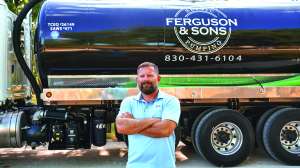
Kevin Johnson, owner of the company, based in Plant City, prefers the units for their simplicity: a single tank separated into three compartments. “There are only a few mechanical parts; just an aeration pump that sits on top and blows into the water,” he says. “And they’re super easy to service and maintain.
“They match our company perfectly because they are supplied by super professional people who are one call away if we have any problems. I can call them and they’ll walk me right through it.”
FujiClean units are compact, one-tank treatment systems engineered to process domestic wastewater to NSF/ANSI 40 standards. No preceding septic tank is required. With a small footprint (7 feet 1 inch by 3 feet 8 inches) and weighing just under 400 pounds, the units are easily maneuverable and can be adapted to the constrained and difficult-to-access sites. They are designed to accommodate variable flows and shock loadings,
With low power draw (1.2 kWh/day) and low maintenance, they are well suited for homes in a variety of sizes. They are available in capacities of 500, 700 and 1,000 gpd, with or without nitrogen capability.
FujiClean systems achieve 95% BOD and as consistently demonstrated in more than 3,500 field samples collected worldwide, as well as in controlled third-party (NSF) testing in the United States from residential models, according to the manufacturer. The design is proven in more than 50 years and some two million residential and 50,000 commercial installations.
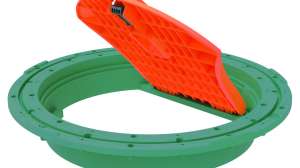
The low-profile systems are aesthetically pleasing; three 20-inch-diameter at-grade covers are the only visible indication that they are present. An unobtrusive football-sized blower and small alarm panel can be located up to 100 feet away and are easily shielded from view.
Units are designed for efficient and effective semi-annual maintenance, mainly accomplished with simple turning of control dials that purges heavy biofilm growth from the treatment media. The process requires no component removal or hose-down. A typical service visit that includes solids backwash cleaning takes 20-30 minutes. Depending on level of usage and influent strength, typical sludge pump out is every two to three years.
The devices’ linear-diaphragm blowers are energy efficient and durable. They have a life expectancy of five years, and low-cost blower rebuild kits are available from the company’s certified distributors and service providers. The blowers operate at what the company calls a “library quiet” 39 decibels.
The plug-and-play units are ready for installation upon delivery. No onsite system assembly required. Systems are compatible with Tuf-Tite and Polylok risers.
The units use a contact filtration treatment process that consists of a controlled, circuitous flow train through anaerobic and aerobic chambers and direct contact with assorted fixed-film media where biological digestion of organic matter occurs. The media are designed and positioned to provide mechanical filtration.
Septic tank effluent first enters a sedimentation chamber where most solids settle out. This is followed by an anaerobic contact filtration chamber, which facilitates decomposition by microorganisms, captures suspended solids, and denitrifies the flow. The aerobic contact filtration chamber then provides an oxygen rich zone for microbial digestion of organic matter, solids filtration and nitrification of ammoniac nitrogens to nitrates.
The system includes two air lift pumps. A recirculating airlift pump returns process water and sludge from the aerobic zone to a sedimentation chamber, recirculating two to four times the inflow per day (four to six times for enhanced denitrification models. The effluent airlift pump helps equalize flow and discharges treated effluent.
Continue reading for free