The Honeywell data loggers set up to monitor and record soil temperatures at multiple depths.

Professor Karen Shakespeare Kokkelink

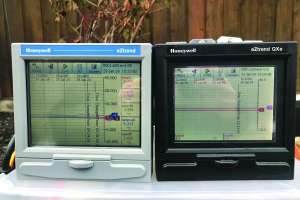

The Honeywell data loggers set up to monitor and record soil temperatures at multiple depths.
Professor Karen Shakespeare Kokkelink
Geothermal heating is rising in popularity as a home heating option. Heat pumps work by extracting heat from the moist soil around them. The warmer the soil, the more heat the unit can extract and use for heating homes.
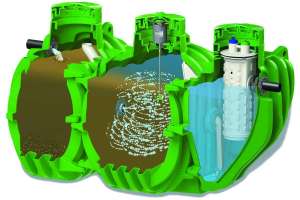
Septic tanks collect wastewater that is sent into them from homes. In the winter months, this water is warmer than the ground the tank sits in, which can sufficiently keep the entire tank warmer than the surrounding soil.
These two realities prompted Karen Shakespeare Kokkelink (M.Eng, P.E.) to wonder, would installing a ground-source heat pump adjacent to a buried septic tank provide it with access to warmer soil? If yes, then this extra warmth would allow the heat pump to work more efficiently and economically.
Kokkelink is a professor of electrical and energy systems engineering technology at Conestoga College School of Engineering and Technology in Kitchener, Ontario. She joined the faculty after a career as a designing engineer at General Motors. Accredited by the Association of Energy Engineers as a Certified Energy Manager, Kokkelink is actively involved in nonprofit organizations that want to make sustainable energy solutions available to the general public.
“As a rural Ontario resident with a septic system, this engineer has observed, winter after winter, the effect of heat over the septic tank as it relates to melting snow,” says Kokkelink. “The snow-covered yard of rural Ontario properties often has a green patch where the septic tank melts the snow. As a developer of Heat Pump course content, including theory about the thermodynamic cycle and how it relates to ground-source heat pumps, it was a simple extension to wonder if this excess heat can be used.”
In response to this question, Kokkelink and her students are conducting a three-year wintertime study to assess the thermodynamic feasibility of installing ground-source heat pumps alongside or even inside septic systems to take advantage of higher soil temperatures during the heating season. The work is being funded by a $10,000 Conestoga New and Emerging Researcher Grant.
Kokkelink was inspired to do this project “because heat pumps are gaining popularity as a viable heating and cooling technology that supports Ontario’s efforts to decarbonize by way of electrification,” she says. “Ground-source heat pumps operate at a higher efficiency than air-source heat pumps, simply because of the enhanced thermal conductivity in moisture-laden soil. However, ground-source heat pumps suffer from high capital costs due to installation of deep vertical boreholes or wide horizontal installations.”
Kokkelink has three research objectives: first, to quantify the amount of heat available to ground-source heat pumps co-located with septic tanks; second, to calculate the performance effect on a heat pump system in such a location; and third, to determine if extracting a septic tank’s ambient
warmth could be detrimental to the tank’s performance. As she explained, “From these three objectives, the thermodynamic feasibility of installing a heat exchanger alongside or inside a septic system can be judged.”
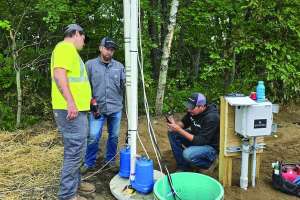
To answer these questions, “two Honeywell DS18B20 data loggers are being used to collect temperature data at multiple depths and distances away from a rural Ontario residential septic tank,” says Kokkelink. “Another thermocouple has been inserted directly into the tank. As well, a control set of thermocouples have been inserted into soil unaffected by the heat gain. An Arduino microprocessor has been programmed in Python to analyze the information from the data loggers. Further Python script is comparing the temperature data to that of ambient air.”
Since the winter of 2023 was too mild to acquire meaningful data — because the sun kept heating up the ground in the test area — the data collection period will run from 2024 to 2026.
“After three winters of data, if the extra heat is found to be significant, the impact will be quantified as a coefficient of performance improvement based on heat pump performance calculations,” Kokkelink says. “The outcome of data collection will be a thermodynamic profile depicting the amount of heat in and around a septic system through Ontario’s seasonal changes. The effect of adding this heat energy to the heat pump and removing it from the septic system will also be calculated. These two calculations will help determine the feasibility of installing heat pumps alongside or inside septic systems in rural Ontario cold-climate conditions.”
If heat pumps can be installed near septic tanks without compromising the latter’s performance, the results could be very positive. “If this proves to be feasible, the cost of installing heat pumps could be lowered,” says Kokkelink. The reason is that when more heat energy is available for a ground-source heat pump, its heat exchanger loop could be made shorter or the compressor could be made smaller, or both.
“An additional economic benefit is that septic tank installation involves similar ground preparation and filling as ground-source heat pump installation, so the two jobs could be combined,” she says. “Deep vertical boreholes and wide horizontal installations could be less necessary and high-efficiency ground-source heat pumps would be viable on smaller properties and more remote, cold northern Ontario applications.”
Time will tell if the warmer ground around septic tanks can be used as a money-saving form of heat generation. If it can, then the colocation of septic tanks and ground-source heat pumps may become a common practice in Ontario and other rural regions with cold winters.
Continue reading for free