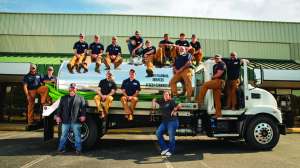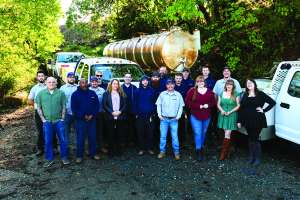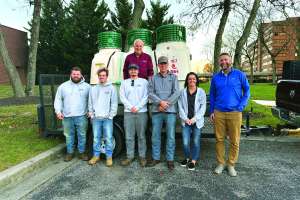

When Chris Navo goes to work, he is surrounded by family members, in-laws and longtime employees who are like family. He is part of the third generation at Navo & Sons, a family-owned and operated full-service septic business that his grandfather started.
Navo manages the company along with his semiretired uncle, Mark Navo. His right-hand managers are sister-in-law Sherri Curtis who oversees administrative operations and 30-year-veteran Wade Avilla who oversees field operations.
The original service line was septic pumping and, although other services have been added over the years — installations, inspections, plumbing, two Roto-Rooter franchises — it is still the main service line.
“Pumping is really what allows all the other things to occur,” Navo says. “It’s an on-ramp into our company. As you’re pumping a tank you get the customer’s trust, so when they have a problem they know they can turn to us.”
The company is located in Grass Valley, California. They employ around 33 people consisting of pumpers (including Navo’s brother Josh), an installation and repair crew (managed by Navo’s cousin Grady), diagnostic technicians, plumbers, an environmental specialist and administrative staff.
GETTING STARTED
The company was always a family affair. When George Navo started it in 1958, his wife and five children worked alongside him. His sons Randy and Mark eventually took over when he retired in 1982, followed by the next generation.
Navo is Randy’s son. He grew up in the business. “In the summers and weekends, we’d help our dad, whether it was just pulling the hose or those sorts of things,” he says. “Later I learned how to do drain cleaning. And then when my mom who was running the office got sick I helped her. I had an affinity for numbers and books and computers, so I brought us into the 21st century.” He also performed every job in the field.
By 1993 Navo was working full time for the company, and in 2012 when his father retired, he started running the business along with Mark. “We were at about 12 employees and we’ve been expanding since then, tripling the size,” he says.
SERVICE LINES
The company’s two main service lines are pumping and installations. On the installation/repair side they do commercial and residential systems, using anything from standard systems up to high-end units. Repairs are part of this division.
Pumping work accounts for about 60% of their sales and is mostly residential accounts. They also do septic design and inspections, leachfield rejuvenation, drain cleaning and other Roto-Rooter services.
The company limits its pumping work to a 50-mile radius because it’s not cost-effective to go further. But it will go up to 100 miles for maintenance, monitoring and design work, recognizing that being in a sparsely populated area, there may not always be another qualified person in the region.
While Grass Valley, located in the Sierra Nevada foothills, doesn’t get much snow in the winter, technicians do encounter snowy conditions as they head into the mountains, which can create some challenging situations. But they charge accordingly, Navo says. “We pumped a tank last winter where we had to use a snowcat to tow in a plastic container so we could pump out the septic tank [using trash can pumps] to fix a float switch. What would have been an $800 or $900 job during the summer was $6,000 during the winter — but it was an $8 million home.”
EQUIPMENT LINEUP
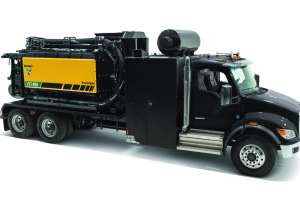
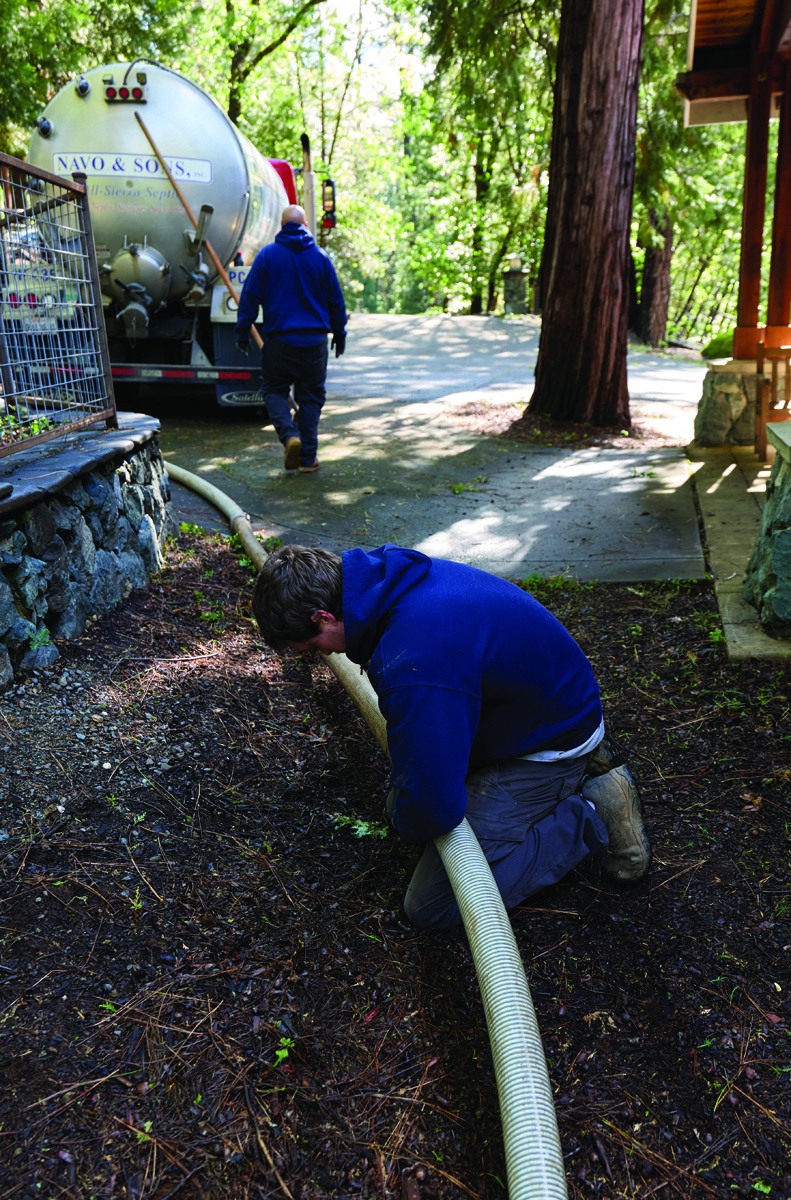
The pumping service fleet includes four vacuum trucks built out by Satellite Industries with Kenworth and International chassis. The 2013, 2014 and 2020 units have 3,400-gallon stainless steel tanks and Masport pumps. The 2018 has an 1,800-gallon stainless steel tank, a hydraulic lift and a National Vacuum Equipment pump. “We use it to pump up dirt, debris and gravel, and filter that out so we don’t have to shut our other trucks down and clean them out as often,” Navo says. The company is also in the process of having a 6,000-gallon vacuum truck built out by KeeVac Industries for larger jobs.
Other equipment on the pumping side includes two jetters (US Jetting), different types of tracing equipment (Goldak and other units), two Crust Busters and a number of locators (RIDGID). They also have a TerraLift (Terralift International Family of Companies) to rejuvenate leachfield soil. Service techs borrow Kubota excavators from the installation side, as needed, to uncover deeply buried tanks.

To keep track of everything, the company uses ServiceTitan software. “We went all digital, so our pumpers can just take pictures at the job site and talk into their phones instead of using pen and paper,” Navo says. “And it keeps track of maintenance and monitoring, when pumpings are due, the chemicals we sell, it gives people reminders and confirmations.”
The company likes to try out new equipment in their quest for efficiency and making things easier for the crew. One recent purchase was a GRABO Pro. “It’s a vacuum grip handle which we think may help remove lids that don’t have handles,” Navo says. Another is Moasure. “It’s an app so you can use your phone to do measurements. That might be helpful to map out where a tank is. Any time we’ve pumped a tank we’ve drawn a map of where it is. We have about 100,000 maps which go back to the early 1980s.”
DISPOSAL SOLUTION
The Grass Valley treatment plant only allows a company to dump 4,000 gpd — and that was an upgrade from the 2,000 gpd it used to be until March 2026 when the facility was upgraded. But Navo says the company pumps up to 18,000 gpd — 9,000 in the slow season. The nearest dumpsite that will take everything is 100 miles away.
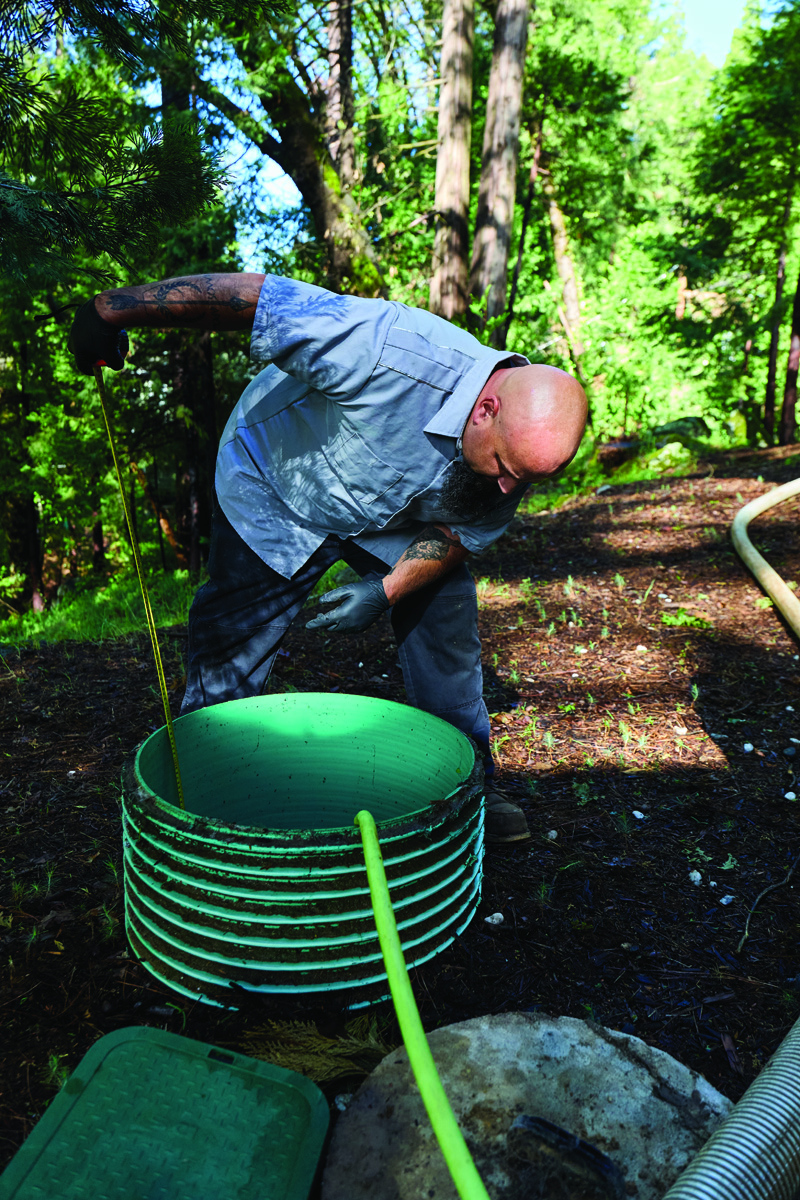
Their solution was to build a 40,000-gallon storage facility on their property through a network of underground tanks, which they did many decades ago. “It’s 5,000-gallon watertight tanks that are put in series with risers up to the surface,” Navo says. “Then we made a custom dumping place with a grate to catch rags and stuff. At the bottom is a catch basin for rocks and debris which can be shoveled out with a tractor, dried out and disposed of. That way we’re only taking to the dumpsites the cleanest material that won’t clog up the dumpsites or our trucks.”
When their storage facility needs a pumpout, the company will either do it themselves if they have the time, or have APS Environmental out of Sacramento come in with a tanker and do it.
CARE AND FEEDING OF THE STAFF
Navo says they really try hard to make the company a good place to work. “The work is tough; the job shouldn’t have to be,” he says.
Besides good pay and benefits, and providing the staff with digital and mechanical tools to make their jobs easier, the company tries to show appreciation, promote camaraderie and make people feel valued.
One example is their monthly family lunch. “This is one of the things Sherry does,” Navo says. “She is an amazing cook. She heads that up with Wade. We shut down the office for an hour and serve lunch to everyone that can come back to the office, or we bag it in the refrigerator for them later. We’ve been doing that for at least 10 years.” Lunch might include steak, chicken, hoagies, tacos, soup, chili.
Office staff and about half the field workers often have lunch at the office. Facilities include a small kitchen, grill, slow cookers, air fryers, ice machine, popcorn maker, refrigerator/freezer, fully stocked kitchenware, a lunch room and outdoor picnic tables. A big-screen TV is hooked up to the internet so people can watch videos on their lunch breaks.
The company also does fun things like camping trips for employees and their families. “The last one was at a lake,” Navo says. “We used Lucille’s Smokehouse which caters to remote locations. They brought their chafing dishes and we had a whole barbecue.” The group also enjoyed boating and fishing.
CONTINUOUS TRAINING
The company has an extensive onsite training program. “Decades ago we realized the world was different and you’re never going to get that person that comes in with a Class A license and knows everything and is a perfect backhoe operator or master plumber,” Navo says. “So we started building our own program.” He worked with Sherry and Wade to build a procedures manual and training classes.
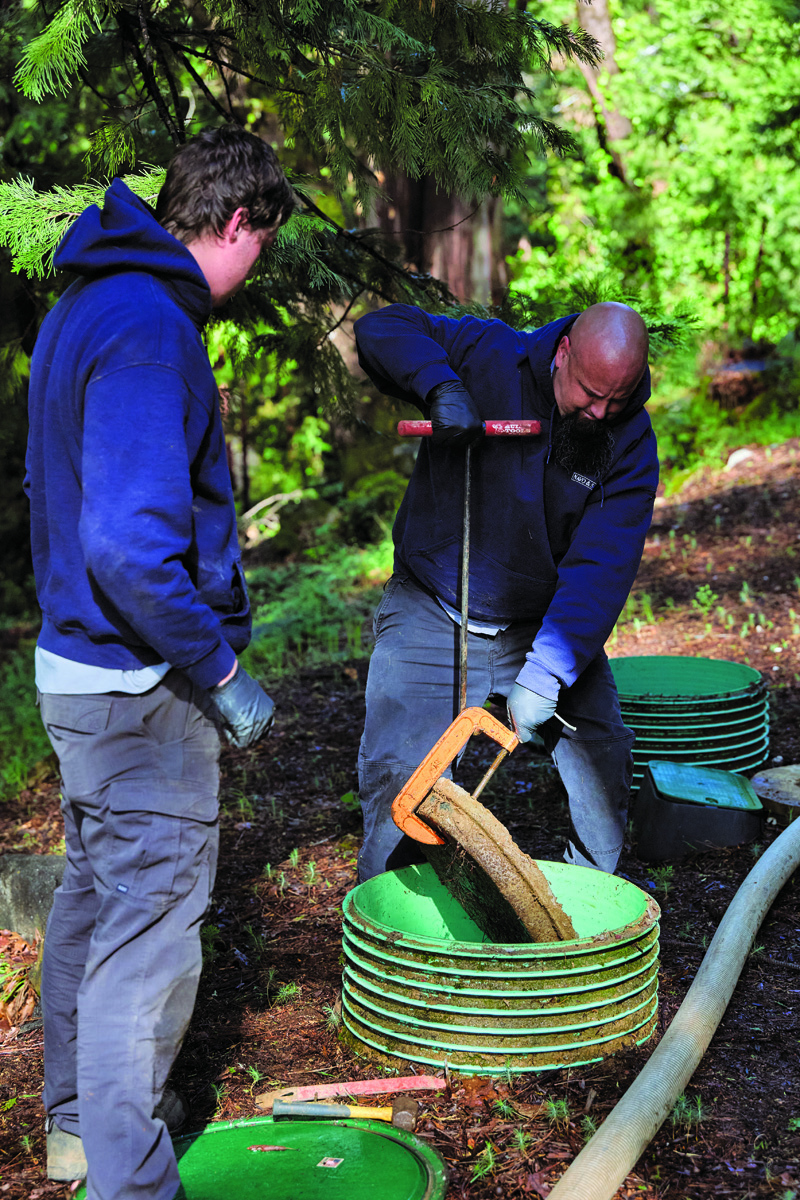
“It’s like McDonald’s that brings in anybody off the street and makes them into a productive worker,” he says. “We focus a lot on hiring the younger generation, or anyone that has a good clean background. We’ll train them all the way to getting commercial licenses, or learning how to do the different services.”
Over 100 different classes are offered on every imaginable topic from how to handle customers to how to handle a backhoe. Sherry decides which classes will be taught each month based on what would be most helpful at the time.
Classes are at 7 a.m. and last 45 minutes. They typically include classroom work as well as time at a job site, the warehouse, or even Navo’s home which has a high-end septic system. Employees are paid overtime to attend. Everyone is required (and paid) to teach a class after they’ve been there a year. Attendance is optional other than for new hires who must take certain classes.
DIFFICULTIES AND REWARDS
Typical challenges for the company include California’s strict rules and regulations regarding employee management and vehicle standards, and the costs resulting from those regulations. For example, California’s overtime rules dictate that everything over eight hours is overtime, whereas in other states it might be anything over 40 hours.
Another challenge is treating everyone fairly. “It’s a balance between keeping the customer happy, the employees happy and still making money,” Navo says. “If you’re not making money, you can’t pay your employees. If you’re taking it all for yourself, your employees will leave. If you’re giving it all to them you can’t pay the bills. But the other side is, you can’t think that the customer is just a blind ATM that will always hand you money.”
When Navo talks about what he loves most about the company, it all gets back to family. It really is a family affair, he says. “The biggest joy I get is to be around friends and family and see them grow, and to be able to give them opportunities to earn a living and live a life in a small community.”
Continue reading for free