
He took the long way around, but eventually Keith Jordan found the septic industry.
The U.S. Army veteran and owner of Dirty Deeds Septic in Oak Harbor, Washington, came to own a septic business after quite the journey. A few months out of high school, he enlisted in the U.S. Army for nine years until 2000, and followed that with three years as a trooper with the Washington State Patrol.
Switching gears in 2003, he started a construction company that faltered during the financial crisis of 2008. But a simultaneous run-in with a drug-resistant staph infection threatened his life. “I didn’t feel well during a snowstorm, and I somehow got into my truck and drove to my parents’ house,” he recalls. “I collapsed in the driveway and woke up in the hospital. The doctors packed me in ice to bring down my temperature, which was a couple of degrees from critical.”
Jordan recalls a parade of hazmat suits, being placed in a hyperbaric chamber to slow the rate of infection and a steady stream of antibiotics that failed to control the infection. Near death, an investigational drug administered in Seattle saved his life.
However, faced with insurmountable medical bills, he was forced to declare bankruptcy and close the construction business. “It was humbling,” he says. “I lost pretty much everything.”
He rebuilt his life following a friend’s suggestion that he train at Texas A&M University to become an unexploded ordnance technician, deactivating military ammunition that has failed to detonate. From there, he took a position as caretaker of Washington’s private Blakely Island. Visiting his parents during the COVID pandemic, he noticed that only emergency vehicles and pump trucks remained active.
“That’s all I needed to see,” Jordan says. “I had completed many installs, repairs and pumping on Blakely over the years while I worked there. I also worked on the mainland with my best friend, doing installs, repairs, inspections and pumping. This gave me the experience I needed to obtain my licenses, starting with my pumper license. In 2020, I bought a pump truck from Imperial and parked it on the mainland while I studied for a commercial driver’s license.”
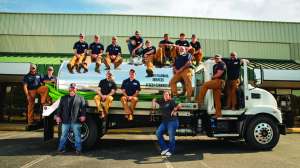
He launched Dirty Deeds Septic in 2021. In just four years of explosive growth, he now owns three pump trucks and employs eight people, including two office staff members. The company offers septic and commercial lift station pumping, and system installation, repairs and inspections in the Island, Skagit and San Juan counties of western Washington. Jordan also hopes to expand to a second location.
“The growth has been amazing,” he says. “It’s like riding a rocket. You just try to hold on as it goes faster and faster.”

1. HIS PRINCIPLES FOR OPERATING A BUSINESS
Jordan stresses communication, offering quality customer service and educating the customer as his top priorities in running a successful business.
“Many customers call us in a stressful situation,” he says. “We need to demonstrate compassion and care in what we do. Have pride in your work and know you are providing a service that people need, not just collecting a paycheck.”
Dirty Deeds employs full-time office staff to answer phones and return calls promptly. Customers can pay their invoices using any method, from checks to online electronic payment.
“People can interact personally with staff or use our website to schedule work,” Jordan says. “Having a wide range of options and evolving with new technology ensures we stay on top of market preferences.”
Dirty Deeds wants customers to understand their systems so they can take better care of them, ensuring they receive consistent care, not just emergency responses to catastrophes.
“I rigorously train my employees and stress the importance of educating the customer,” he says. “This is something we receive a lot of praise for, and it’s reflected in many of our customer reviews.”

2. TAKING A HUMOROUS APPROACH TO MARKETING
“Any marketing I do has a joke somewhere in it,” Jordan says.
The name “Dirty Deeds” came to him in a dream.
“I wanted something that conveyed the way people think of the septic business as sort of a dirty job,” he says. “I also needed a poop emoji logo that would be funny and edgy — a recognizable brand that people would remember, not only for the name and logo but for the people who work here.”
Jordan encouraged a graphic artist to create something that would convey a sense of fun.
“The one I picked has an eyebrow raised like Mr. Spock, and it’s become well recognized and extremely popular,” he says.
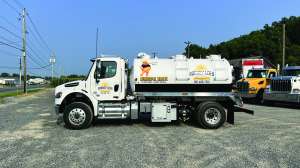
Jordan recalls an older gentleman, hands on hips, staring at a Dirty Deeds pump truck, looking him in the eye and saying, “Son, that looks like a milk truck!”
“I laughed and it gave me an idea,” he says. “The slogan ‘We haul milk on weekends’ was born. It’s on the back of all our pumper trucks and many of our company shirts.”
People have followed the pumpers on the road and, when the driver stops, asked to take pictures with the truck.
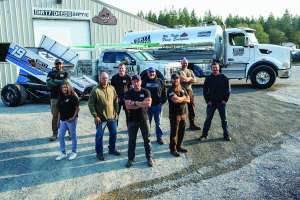
“Slogans and tags play into the whole image,” Jordan says. “I’m often working on new swag and graphics, and we have several different shirt designs. They’re incredibly popular with customers and great marketing for us. We also sponsor a sprint car wrapped in Dirty Deeds Septic logos.”

3. THE VETERANS ADVANTAGE
Jordan credits much of his success to the skills he acquired during his military and law enforcement experience.
“The leadership and communication skills, and self-discipline I gained in those fields prepared me to run this business,” he says. “I take from both trades and blend them into my business model.”
Dirty Deeds also makes it a priority to seek employees who have a military background — five of the eight company employees are veterans.
“Hiring military veterans is very important to me,” Jordan says. “Personally, it’s about helping my fellow veterans to find a stable and secure job and to provide purpose and direction after military life. Many of us struggle to find our way after the service, and finding a place to work that understands us and where we fit can be very difficult.”
He says that military veterans most often come to the workplace with a strong work ethic, integrity, honesty, accountability and responsibility. Veterans also possess a mindset that makes them open to training, so that they quickly attain the skills required.
“They’re some of the most reliable and trustworthy employees you can find,” Jordan says. “Finding more hardworking people with similar drive and skills is the only thing that’s holding the company back.”

4. PRIORITIZING PERSONAL HEALTH
Having survived his previous health crisis, Jordan remains focused on preserving his health.
“It was ironic,” he says. “I was stressed out trying to keep the guys in my construction company busy as people stopped paying me, but everyone kept telling me ‘you still have your health.’”
Jordan likens his life to a candle burning at both ends. On one side are factors you can’t control. Things you can control are on the other.
“How quickly those flames meet is largely up to you,” he says. “As an entrepreneur, you are the business. If you can’t take care of yourself, you can’t take care of the business and you will pay the price.”
Jordan says he watches colleagues who aren’t as careful with their health, who are frequently under the weather and lack the energy they need to devote to their businesses.
“I get up every morning at 4:30 to start work,” he says. “The only way you can do that is to get enough sleep, eat healthy and take care of yourself.”

5. DEVELOPING AN EXIT STRATEGY
From the moment he launched the business, Jordan says that an exit strategy — selling the business one day — was always on his mind.
Jordan began by protecting the company’s intellectual property, which is part of its assets. He hired a law firm specializing in trademarks and copyrights to secure both the name Dirty Deeds and the emoji.
“It was a long and expensive process, but worth it,” he says. “If you don’t protect your image, you build a business until someone else takes it. Then you lose everything you’ve built.”
Jordan also believes in maintaining and renewing his equipment inventory to increase the value of the company when he decides to sell.
He currently owns three newer pump trucks, all Peterbilts supplied by Imperial Industries with aluminum tanks and blowers by National Vacuum Equipment. “Dirty 1” and “Dirty 2” are 2021 and 2022 issues, respectively, both with 2,500-gallon tanks. “The Beast” is a 2024 model with a 5,000-gallon tank. He’s also getting quotes for another Peterbilt with a 4,000-gallon capacity.
“I’ve already had people offer to buy the company or to buy a franchise,” he says. “But I’m not ready to sell yet. I want to keep riding this train for a while to see where it’s going before I walk away.”
Continue reading for free