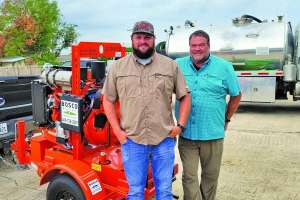

Name and title or job description: Carl Dauterive, president and co-owner and John Dauterive, vice president and co-owner.
Business name and location: Bosco Industries; Bridge City, Texas
Services we offer: Spray and drip irrigation systems, aerobic system maintenance, real estate inspections, vacuum truck services, sewer line jetting, specialty designed holding tanks and prepacked lift stations, tank installation for industrial needs, lift station rehab, lift station pumps sales and diesel pump rental.
Years in the industry: 18 years as a father-and-son-owned business.
Association involvement: We participate in Texas On-Site Wastewater Association events each year.
Benefits of belonging to the association: TOWA Director Randy Chelette is a resource of knowledge and industry experience.
Biggest issue facing your association right now: One of the problems we face is homebuyers who are not being represented when purchasing a new lot for construction or an existing home with an aerobic system. Real estate inspectors are not licensed or trained to inspect a septic or aerobic system, and new homeowners don’t understand On-Site Sewage Facility rules and regulations. So, they might purchase an outdated or dysfunctional unit or land that is too small for a new home that requires an aerobic system and disposal field. These issues lead to costly upgrades after changing ownership.
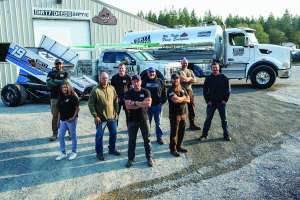
Our crew includes: Office staff - Bree Dauterive, Brittany Carter, Michelle Glove. Install crew — Daniel Pitts, Antonio Saldago, Eddie Avila, Jose Barron. Service technicians — Jayson Arceneaux, Jonathan Herring, Lawrence Fontenot.
Typical day on the job: The construction crew’s day begins at 6 a.m. We meet at our office to begin hooking up all equipment and vehicles for the job. During a typical week, we install three to five units, either upgrades or new construction. Our equipment for each job includes a John Deere 75G excavator, a Ditch Witch 410SX trencher/vibratory plow and a 24-foot enclosed job trailer which houses parts, fittings and job tools.
One homeowner described the construction crew as a bunch of worker ants. Everyone arrives at the install site together, piles out of the vehicles, gets busy on their tasks and, before you know it, the day’s work at the site is complete.
We take pride in being able to complete a new construction installation in four hours. This is extremely beneficial given the speed in which weather conditions can change in Southeast Texas.
Prior to the day’s installation, our supervisor schedules a visit by the local regulatory agency, so each job is ready for use, same day.
The job I’ll never forget: About eight years ago, we installed a commercial unit for a client located less than a mile inland from the Texas coast. During the excavation, we struggled with the hole caving in due to a high water table and sandy soil. We worked with laser-like focus, and we celebrated once the tank was set. We were thankful that our aerobic units are singular concrete tanks with three separate chambers. In order to access the tank to complete assembly, we did something unusual. We built a 20-foot boardwalk of 2-foot-by-6-foot boards.
When faced with this challenging job, everyone worked together to successfully complete the project.
My favorite piece of equipment: We expanded our services by starting a pump rental division, so our favorite pieces of equipment are our new 4-inch and 6-inch trailer-mounted diesel bypass pumps (Godwin). Pump rental contributes to our cash flow during the winter season when construction is limited by site accessibility. The average annual rainfall in our county is over 50 inches per year. When tropical storms are predicted to make landfall in our area, we are there with an emergency response crew to prepare the cities for the increase in inflow and infiltration.
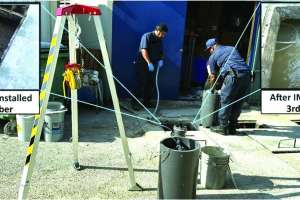
Most challenging site I’ve worked on: We are located near several industrial facilities, so we have worked on a variety of unique projects. One conversion job stands out. The client had six holding tanks 20-foot deep, and we were contracted to convert the holding tanks into lift stations pumping to six aerobic systems we installed. Our crew prefabbed pump shoe plates and built prefabricated pipe into sections and lowered these sections into the holes. This unique technique allowed us to avoid vessel entry and maintain safety while keeping our crew above ground.
Oops, this didn’t work out as planned: One customer owned property across the street from their home. On the land where their home sat, they didn’t have enough usable real estate for the disposal field. We needed to bore under the road. Our bore started at two feet deep and came out the other side at five feet deep.
The craziest question or most insightful comment from a customer: On at least a weekly basis, customers call our office to report an odor. Typically, they ask about the chlorine contents of their unit and mistakenly believe that adding septic chlorine to the tank will eliminate the smell.
Brittany Carter, our lead person in the office, does a great job guiding and educating customers. She asks them questions to determine if a service technician or vacuum truck operator is needed on site to begin diagnosis.
We receive letters and emails from customers thanking us for her guidance and knowledge regarding their inspections, pumpouts and preventative maintenance. Brittany has been with Bosco Industries for 15 years, and as we expanded our services, she increased her knowledge of the industry.
If I could change one industry regulation, it would be: A licensed On-Site Sewage Facilities Installer II should be qualified to complete their own install designs. In this state, Texas Commission on Environmental Quality requires all OSSF designs to be stamped by either a professional engineer or registered sanitarian. It is our opinion that an Installer II is versed in the field and able to complete the designs according to county and state code and regulations.
Best piece of small business advice I’ve heard or came up with: A business client/friend once told us, “Business is a wave. You’ve got to learn to ride it. There are going to be ups and downs.”
If I wasn’t working in the wastewater industry, I would like to:
Carl: I would enroll at Texas A&M University to earn a mechanical engineering degree.
John: I enjoy orchestrating a team. I would like to run an outside sales department and network with people to create business relationships. I have an ability to see someone’s problem and work out a solution.
Crystal ball time – This is my outlook for the wastewater industry: Texas water supply is scarce. As our civil municipal infrastructure decays and Texas water is at an all-time critical level, we’d like to be able to offer an alternative solution. We’d like to have an OSSF system available within a municipality’s jurisdiction. Onsite sewer systems could work alongside an overwhelmed municipal wastewater treatment plant. For example, our beaches and rivers are often red-flagged during droughts due to the fecal content levels coming from wastewater treatment plants. Offering an affordable graywater reclaim solution to all residents could reduce the demand placed on the city’s treatment facilities, level out the increased fecal contents and offer a choice for homeowners.
Continue reading for free