Starting a business pumping waste tanks on pleasure boats seems simple enough. Buy an old pontoon or fishing boat. Install a pump and tank. Pick a harbor. Go to work.
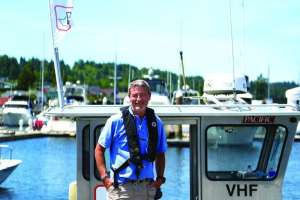
It turns out things are a good deal more complicated. And Paul Weyn, owner of NW Mobile Pump Out based in Gig Harbor on Washington’s Puget Sound, has found a winning formula.
He operates a year-round private business with three pumping boats and runs a federally funded service, also with three boats, that provides no-charge pumpouts to boaters on weekends and holidays from May through October.
The keys to keeping the business profitable include boats that travel at relatively high speed; flexible, reliable and convenient service; efficient routing and scheduling; and willingness to cover a large territory, including more remote harbors and marinas.
A more sedate life
Weyn, a native of the United Kingdom, has lived in Washington since age 18. After a long career as a corporate executive in the electronics business, he looked for a lower-stress occupation. “I was a recreational boater at one time, and I recognized a gap that needed to be filled,” he recalls. “There were very few places on the Puget Sound where you could go and pump out. It was a big hole in the Pacific Northwest boating picture.”
He launched the business in 2020. A year later signed on with the South Sound Mobile Pumpout Program, a collaborative effort of Pierce County, Washington State Parks, the city of Gig Harbor, the Alliance for a Healthy South Sound, the Recreational Boating Association of Washington, and Minterbrook Oyster Farm. He later took on a similar free pumpout program on the West Sound.
Jeff Barney, who manages both free programs as a Pierce County watershed planner and an RBAW board member, says there’s more to the service than boater convenience: It’s about sustaining water quality and protecting a thriving shellfish industry. “The Sound is the world’s largest Manila clam and oyster producer,” Barney says.
“In 2018, the Sound was designated by the U.S. EPA as a no-discharge zone for boating waste. It was mandated, but there was no education or enforcement. When Paul acquired his business, the county approached him with the idea of offering a pumping service to boaters where they recreate. Being boaters ourselves, we saw an opportunity for his business and for our county and adjacent counties with the South Sound Mobile Pumpout Program.”
Funding comes under the EPA Clean Vessel Act as U.S. Fish and Wildlife Service grant that covers 75% of operation and maintenance costs. The balance comes from the other program collaborators.
Getting busy
To start his business, Weyn bought two boats from the owner of a pumping business that had folded; he later bought a third boat. “I just bought the boats, came up with a business plan and started right away,” he says. “It caught on quickly. People were very receptive.
I don’t have any competition. Others on the Sound have been unable to do it successfully. My prices are very reasonable. I run a very lean operation. It has just taken off.”
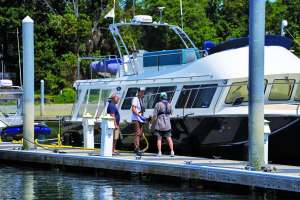
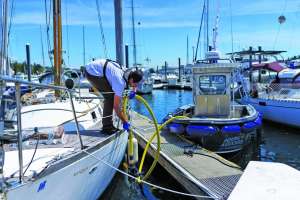
On the private side of the business, Weyn charges per pumpout. On the public side, he is paid an hourly rate. Some recreational boats carry waste tanks of 100 gallons or larger, but most are under 40 gallons. “The average size is 24 gallons, so I can generally do 10 to 12 pumpouts before I have to offload,” Weyn says. The waste tanks on the pumpout boats range from 200 to 400 gallons.
Weyn is strategic about when and where to offload, striving to minimize travel time. He concentrates on locations in Olympia, Gig Harbor and Tacoma where the waste discharges to a municipal sewer system. Docking space at the offload points is easily accessible, and the cities do not charge for accepting the waste.
Weyn generally works eight hours a day, although 10- to 12-hour days are not unusual in the peak summer boating season. On a given day he may have one to three part-time helpers operating boats.
“The most boats I’ve ever pumped in a day is 55, while traveling 140 miles,” he says. “That is a staggering number of pumpouts. I was exhausted. That was with my son and me in two boats. I would offload everything into his boat, and then he would travel 20 miles to offload while I kept pumping.” To maximize pumping revenue, speed between stops is essential. The boats can cruise at 30-50 mph.
Making it work
The financial side of the business is challenging, Weyn observes. His wife Danette has a finance background and keeps the books while also serving as dispatcher when more than one operator is on the water.
“It’s an expensive enterprise,” says Weyn. “There’s the cost of the boats. The insurance cost is phenomenal. I carry $2 million in liability and $1 million for pollution, plus insurance on the boats themselves. And then there are fuel costs.
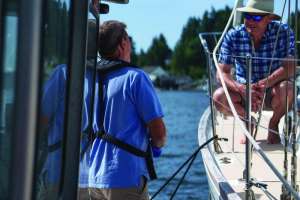
“Making that all work and making it profitable was a concern, but we overcame those problems. Having been a pleasure boater, I had a good sense of what people would pay for the service. I wanted to make it cheap enough so that people would use it.”
Barney cites reasons Weyn is succeeding where others have failed: “Paul was willing to go to places others were not willing to go. He offers service in a wider area, and that really helps him grow. I have watched people convert old tugs that travel at 5.5 knots. I’ve seen people use old Bayliners and old pontoon boats — basically unreliable equipment.
“Paul maintains his equipment. He is always operational. He doesn’t miss days on the water. Equipment that can travel far at rapid speed means more gallons pumped and more hours of coverage on the water. On the public side, we needed coverage for the areas where boaters go, including pretty bays or islands in the deep South Sound. Paul is willing to do that.
“That also creates a network of boaters who get to know him, on the private side and for the weekend free pumpouts. He has built a strong reputation. Where others were inconsistent Paul has remained efficient and punctual. People appreciate that.”
Filling the schedule
Routing and scheduling are keys to profitability. “I keep certain boats in certain locations,” Weyn says. “I have arrangements with yacht clubs and ports to keep boats there. I try to make the service as easy as possible for customers.”
Boaters can visit his website (nwmobilepumpout.com) and book a pumpout. “On certain days I’m available in certain locations,” Weyn says. “They know which day to book on. I have a big banner on the backs of my boats. They can call me, wave me over or hail me on the radio.” The state vessels have “Free Pumpout” banners on their sides.
“I’m out there so frequently, at specific times and specific locations, that people know to expect me,” Weyn says. “The more you do it, the longer you do it, the more successful it becomes.”
To make service still easier, Weyn’s business is part of the Pumpout Nav app, a free nationwide iOS and Android app from the California State Parks Boating and Waterways Division that shows the locations of pumpout stations. “In season, our boats have trackers on them, and people who use the app know in real time where the boats are,” says Barney.
Private pumping customers who book service for the first time prepay using credit cards. “If I have them on a recurring service weekly or every other week, I run their credit card every time I do the pumpout,” says Weyn. “Most of the people I service, especially year-round, are on a weekly or every other week basis.”
A valuable enterprise
Barney praises Weyn for providing a widely beneficial service: “It’s not a case of ‘Gee, I think I’ll just do this harbor.’ Someone who did that would probably cover the fuel, insurance and mortgage and pay themselves $15 an hour. Paul is willing to operate year-round, in freezing weather, navigating rough seas.
“There is no program like it on the West Coast of the United States in marine water. We cover the most geography and service the most boaters. We’re very proud of that. We educate people that they can’t dump their poop in the Sound. That’s illegal.
“If you like to eat salmon, and you like to eat oysters, then we’re providing a continuing message that we’re not just offering a valuable service. We’re helping to keep the Puget Sound clean.”