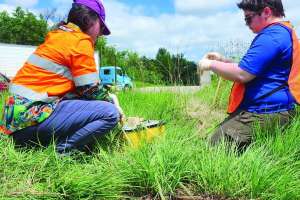

Name and title or job description: Carol Ohm, vice president
Business name and location: Apex Engineering Inc., Newport, Delaware
Services we offer: Surveying, civil site design, construction layout, design of gravity, pressurized septic systems, alternative systems, septic inspections
Age: 60
Years in the industry: 30-plus
Association involvement: Delaware On-Site Wastewater Recycling Association board of directors for multiple years; currently holding the position of Class B Designer
Benefits of belonging to the association: To keep updated on the latest technologies, hear and learn of others’ experiences and issues they have encountered, to have a voice regarding new rules of compliance/requirements and regulations.
Biggest issue facing your association right now: There are few young people going into the field of performing site evaluations to determine the soil capabilities for the location of septic fields and percolation rates.
Our crew includes: Currently, I am the only one in our firm with designer licenses (B & C) and an inspection license (I).
Typical day on the job: Septic designs are a small, but important part of the services offered by Apex. However, we currently are working on a 153-lot subdivision in Middletown, Delaware, where we are designing the septic systems, laying out fields for installers, performing the inspections and preparing as-built plans.
The job I’ll never forget: We designed a drip-irrigation system for a private club in Centerville, Delaware, that needed to be able to handle the day-to-day activities of the club and also large wedding events. The septic system was installed in a horse pasture that was then discontinued from horse use. We still do work at the club, and the system continues to operate in an acceptable manner.
Oops, this didn’t work out as planned: I designed a septic field per the approved site evaluation only to find out soon after it was installed that there was a well on the property across the street that was hidden by a huge shrub. When the shrub was pruned or removed, the well was identified and the septic installer had to install additional trenches on the other end of the field. The Delaware Department of Natural Resources and Environment Control, the site evaluator, Apex, and the installer all had to split the cost of the additional work.
The craziest question or most insightful comment from a customer: “I have lived here for 30 years and have no idea where my septic tank is.”
If I could change one industry regulation, it would be: Using shredded tire chips as a filtering mechanism in a septic field always seemed strange to me for the simple reason that if you discard a tire on the side of the road, it’s considered illegal dumping and carries a minimum fine of $500, but it’s OK to shred it up and fill a trench with it.
Best piece of small business advice I’ve heard or came up with: The three musts of running a small business are getting the work, doing the work and getting paid for the work. They all are equally important. Without one, the others don’t matter. The other part of that equation is this: Running a business is as much managing personalities as it is getting the work done.
If I wasn’t working in the wastewater industry, I would like to: When I am done working in the wastewater industry, I plan to take more walks with my dog and volunteer to walk rescue dogs still looking for their forever families at our local animal rescue shelter.
Crystal ball time – This is my outlook for the wastewater industry: I hope we get back to a point of designers/installers and regulators working together as a team to improve the wastewater industry as a whole. We can accomplish so much more together than we can separately.
Continue reading for free