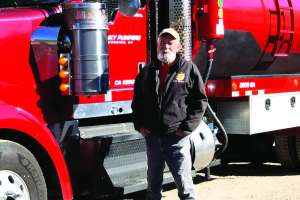
When Pumper first visited Cary Zeschke in 2010, he had been in business for eight years servicing septic tanks and grease traps. His wife, Terri, worked part time in the office, and his teenage children, Cody and Chelsea, helped out.
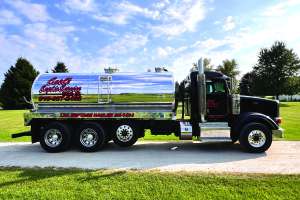
Some things haven’t changed since then. Zeschke is still fanatical about keeping his trucks looking like showpieces. He enjoys it and it’s good for the image of both the company and the industry.
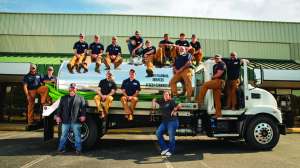
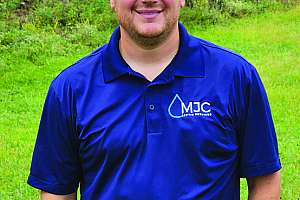
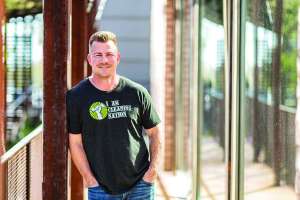
The big change is that Zeschke, 61, is preparing for retirement and will be passing the torch to Cody, 34, and Cody’s friend Ryan Lanham, 33, who has been with the company for 10 years. There’s no set date and they’re going slowly, but Zeschke is getting everything ready.
His company, Zeschke Septic Cleaning, is located in Bloomington, Illinois. They operate out of a 75-by-65-foot building that has three truck bays, a wash bay and two offices. They work in a 70-mile radius.
OPPORTUNITY KNOCKS
Before getting into septic work, Zeschke spent 20 years driving a semi truck on a local route. But he always wanted to be self-employed and so he tried a couple things on the side — landscaping, handiwork — but they didn’t end up being good prospects for full-time work.
Then an unexpected opportunity came along. “My brother-in-law knew a gentleman who was selling an old septic truck, a 1976 Ford F-750 with a 1,000-gallon tank,” Zeschke says. “I approached him and asked what was involved. I knew how to run a vacuum truck because I had worked on a hog and chicken farm running a pumper. He explained everything to me and I bought my first truck for $7,000.”
The seller did not provide a customer list, but Zeschke managed to get an ad in the phone book just before the deadline. That led to him getting a call from a retiring contractor who asked if he wanted to buy his truck, a 1995 GMC TopKick with a 1,500-gallon steel tank, and take over his customer list.
Zeschke took him up on the deal. That’s also how he got into grease trap work. “I also got a grease trap list with it,” he says. “We started out with 45 restaurants so that got me to where at least I had some scheduled stuff.”
It took Zeschke a year and a half working 2 a.m. to 2 p.m. at his job, then going out and pumping septic tanks before it was clear he didn’t have time to do both jobs. “I came to the conclusion that I’d always wanted my own business and this was put there for a reason. So I quit my full-time job and haven’t looked back.”
OFFICE OPERATIONS
Today, Cody and Ryan do all the pumping, allowing Zeschke to work in the office overseeing everything. He is also focusing on training the guys on aspects of the business they have less familiarity with — managerial, financial and office functions. And every now and then he takes time off to play golf or do some traveling.
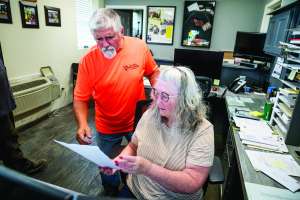
Zeschke’s sister Robbin Veitengruber works part time handling invoicing and bank deposits. And Robin Talsma took over office duties from Terri in 2020.
“She pretty much runs the place,” Zeschke says. “When I hired her I told her to just answer the phone, take down the information and watch TV. But she would listen to us talk and saw things she could do. Now when she gets a call, she goes through a whole checklist — How many people live in the house? So you know where the tank is? Do we have to dig it up? When was the last time it was cleaned? She took on a lot of things out of boredom. So we just let her do her own thing.”
Talsma uses Google Maps, Google Calendar and clipboards to schedule customers based on geographic location. “We try not to let customers dictate when we’re going to be there because when you’re routing stuff you want to do it efficiently,” Zeschke says. “I’d say 99% of our customers don’t care when we come, and we don’t require them to be home.”
SERVICE OPERATIONS
Septic work accounts for about half of the company’s revenue. Equipment includes a Crust Busters tank agitator and Sludge Judge core sampler (Nasco Whirl-Pak). Tanks are usually easy to find, but if not, the technician obtains a copy of the septic permit from the local health department, which usually has the information.
Zeschke had once contemplated installing systems, but at the time there were 25 installers in the county, so it didn’t make sense. But he does work closely with trustworthy installers and plumbers.
The other half of the company’s revenue comes from pumping grease traps. They do this two weeks out of the month from 7 a.m. until late morning before the restaurants open. Zeschke says the company’s location has been one of the keys to success for the grease business.
“We’ve got five major cities within a 60-mile radius,” he says. “When you get a job in one, typically they have a restaurant in those other cities, too. So, we might pick up four or five jobs when we pick up one.”
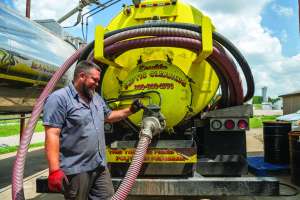
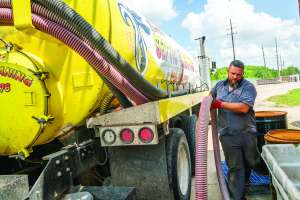
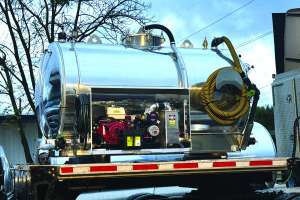
The service fleet now includes three vacuum trucks — a 1995 Peterbilt 379 with a 3,600-gallon steel tank, a 2005 Kenworth W900 with a 4,500-gallon steel tank, and a 2003 Kenworth T800 with a 4,000-gallon steel tank. Pumps are Jurop and Masport.
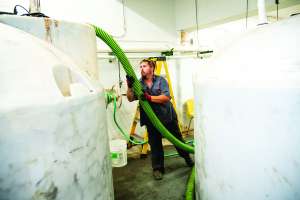
The company no longer land-applies septage. There are a number of treatment plants in the area, the cost is reasonable and they all accept septage and grease. The biggest change recently is the plants are now required to do lab analysis on everything they receive, so pH testing is done on every load the company brings in.
UNUSUAL JOBS
Although the majority of the company’s work is routine septic and grease trap pumping, they have had a few unique jobs over the years.
“A little town north of here was putting in city sewer and we were contracted to pump out all 850 septic tanks in the town,” Zeschke says. “It took us a year. We’d take two trucks and do 20 of them a week.”
Another job was pumping out a septic lagoon at a rest stop. It was 400,000 gallons and took a year. “At first they wanted us to just pump until we got it done,” Zeschke says. “But there was no way we could do nothing but that because we had our regular customers as well. So we did half-days and some weekends.”
When a sewer plant in town had problems processing sludge at one of their facilities, the company was contracted to haul the sludge to one of the plant’s other facilities. They did that for two years, about 20,000 gallons a day.
Large jobs can play havoc when planning for workload, Zeschke notes. But after they got through the first one they became more confident in their ability to handle large projects and work out a reasonable schedule.
CUSTOMER CARE
Talsma sends out reminder notices to customers, usually waiting until March when the ground is no longer frozen and weight restrictions on the roads are lifted.
“At the beginning of the year, we pull up a report for all septics due that year,” Zeschke says. “Then she starts sending out about 30 notices every week or two. Last year we sent out 900.”
What worked even better is when Talsma started calling everyone first and telling them they were going to get a reminder card. “That really increased our business a lot,” Zeschke says. “A lot of people said don’t bother sending it, just put me on the list. It also cut back on the number of cards that came back saying the people didn’t live there any longer. Or if people said they had moved we could go on a county website and look up the new homeowner’s name and send it to them.”
Every homeowner gets a pamphlet on basic septic care and a refrigerator magnet showing the size of their tank, when it was last pumped and the next recommended servicing date.
TRANSITION PLANS
Zeschke has started to put a few things in motion for transferring the business to Cody and Lanham.
They have decided that the company will be divided into two separate businesses with Cody taking on the septic work and Lanham grease. They will share the building and split the cost of office personnel. Zeschke’s daughter, Chelsea, is now a business consultant and will work with them on financial and accounting issues.
Zeschke had the business appraised a few years ago and met with a lawyer.
“I’m going to sell it to them on contract over a number of years,” he says. “That way, they don’t have to have a down payment.”
He was surprised to learn that a seller has to charge at least what the government considers a fair market interest rate (which is about half the going interest rate) when they sell a business, even to family, or it’s considered a gift which would be taxed accordingly.
Zeschke isn’t sure about the timeline. “It entails me feeling comfortable enough that they’re getting to know the internal workings of everything,” he says. “But I think both the boys will do fine. They both know their jobs very well. I get a lot of compliments on them.”
A GOOD INDUSTRY TO BE IN
Zeschke’s wife will work a few more years at Caterpillar until they’re both eligible for Medicare. But she mainly works remotely so they may get an early start on their plans to travel and go camping.
Zeschke says the industry has been good to him. “It’s an industry that will be around forever,” he says. “I don’t think robotics or AI is going to take it over. We’re all in a good industry and there are a lot of good people out there doing it.”