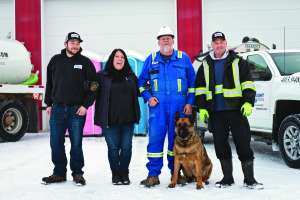


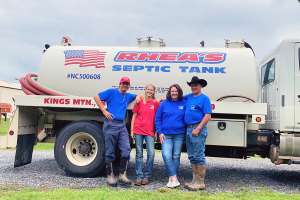
Name and title: Trent and Monica Rhea, owners
Business name and location: Rhea’s Backhoe & Septic Tank Service Inc., King’s Mountain, North Carolina
Services we offer: Septic installations, repairs, pumping and inspections
Age: Trent 56, Monica 53
Years in the industry: Trent: We’ve had our business for 30 years. My dad owned an appliance servicing business and was doing a job for a lady whose husband owned a septic company. They got to chatting and next thing you know dad bought the company. Monica and I were in our early 20s and he wanted us to help run it, and now here we are.
Association involvement: Monica: We’ve been members of the North Carolina Septic Tank Association for 30 years. I have been the secretary for the association for at least the last 16 years.
Benefits of belonging to the association: Monica: Our lobbyists are active in all related laws, regulations and rule changes. They bring everything to the members, get feedback and then lobby hard for what they want. We’ve seen so much change the last 10 years and NCSTA has been right on top of it. We’ve gotten such a good reputation that members of the legislature now ask us our opinion on things and we are an integral part of any rule change that affects our industry statewide.
The association also provides continuing education. We do regional classes all over the state at a very reasonable price. For the last three years, we have also been certified for the new 18-hour installer course. We do four to six a year and help prepare people for the tests afterward to become certified installers. We get a lot of young people for these courses but only about 50% of them actually go into business. The others either don’t realize how expensive it is to get started or how hard the work is. The association has an annual conference lasting two days, one of the largest in the country. This past year we had over 1,100 attendees and numerous vendors. Our association is going strong, we worked hard at it, and I’m very proud of it.
Biggest issue facing your association right now: Monica: One issue facing contractors in our state is a shortage of precasters. Three main ones have gone out of business in the last five years and there’s nobody coming in.
Our crew includes: Monica: Trent is the main backhoe operator, Casey Biddix is a team leader and operator, Kennedy Deaton is an installer/pumper, and I’m the office manager.
Typical day on the job: Trent: We start about 6:30 a.m., then leave the yard by 7:00 a.m. We usually load up everything the day before. We do installations for six or seven hours, then run pump trucks or do service work or inspections until 4:00 or 5:00 p.m.
Monica: My day is filled with answering phones. The phone starts ringing at 7:45 in the morning or earlier and doesn’t stop — but I stop answering at 5:00 and return calls the next day. I also bid jobs, handle estimates, pick up materials, do the accounts payable and receivable, and all the reports and other paperwork.
The job I’ll never forget: Trent: About 25 years ago, we had a job in the woods where it was open and clear and I thought no problem. But when we got the tank set and started digging out our first lateral, we hit what appeared to be a burial site. We stopped and I contacted the county authorities. We put everything back the way we found it and rerouted the system. But disturbing a grave like that — it was nerve-wracking.
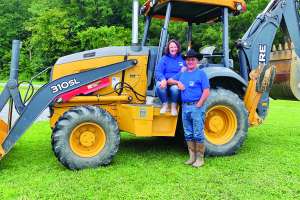
My favorite piece of equipment: Trent: We’re one of the few companies that still does everything with a backhoe. They’re more economical. We started out with a four-lever New Holland 555A and worked up from there. We’ve run John Deere for the last three or four years and now have two. I’m using the 310SL.
Most challenging site I’ve worked on: Trent: An engineer built a fancy house made of steel in the side of a bank. It was probably a 100-foot drop to a lake. We had a pump system to pump it up in front to the drainfield. It took a lot of chains and trucks and backhoes to get the tank down, but I got in there and dug it. Everybody was closing their eyes, scared I’d end up in the lake. I didn’t.
Monica: We were pumping 997 linear feet with 95-feet of elevation to a pressure manifold, so it was not easy.
Oops, this didn’t work out as planned: Trent: I took on a job for a homebuilder I had worked with for over 20 years. I didn’t really go look at it because he kept us so busy. When I got there, it was off the side of a mountain. It was one of those days I thought I wasn’t going to live because of the steepness of the mountain. With a rubber-tired machine, you really don’t want to get more than 2 to 3% grade. But we got it in and covered up. It was one of the toughest jobs we ever did.
The craziest question or comment from a customer: Trent: A gentleman called and said, “Do septic tanks have gas in them?” I said, “Yes, why?” He had a yellowjacket nest beside his tank so he decided he would pour gas in it and set them on fire. The methane ignited and blew his toilet out of the floor.
Monica: On the pumping side, a comment we get almost daily is people thinking we can pump their tank from the plumbing clean-out cap.
If I could change one industry regulation, it would be: Monica: For a long time I’ve been advocating that a certificate of occupancy should not be issued until all subcontractors sign off that they’ve been paid. The only protection we have is that you can file a contractor’s lien on a home — which might affect someone’s ability to sell their home but it could be 30 years from now. It’s not just our time in it, it’s the thousands of dollars of materials we put in the ground. So, I’m not going to quit talking about it.
Best piece of small business advice I’ve heard or came up with: Monica: This comes from our 30 years experience — don’t undervalue the worth of your time. So many young people getting started underbid and cut it to the bone. They look at the price of materials and add a little but they’re not thinking about insurance, worker’s comp, the time spent looking at it, laying it out, bidding it. Another piece of advice is take pride in every job you do. I know young people are learning and getting started, but they’re not always doing a quality job. The reason we’ve been around 30 years and have five-star ratings is because we take pride in every job and stand behind our work.
If I wasn’t working in the wastewater industry, I would like to: Trent: I’d be training horses, which I’m doing now. We do a lot of ranch riding and ranch showing. We do about 11 different events. I’ve got some really cool clients and we’ve been pretty successful. We train them to compete.
Monica: They compete in roping, ranch riding, ranch reining, ranch cutting. Trent has several world titles and reserve world titles. He’s been doing it most of his life.
Crystal ball time – This is my outlook for the wastewater industry: Monica: A lot of farmland around here is being sold off for subdivisions, but it’s very rural and the local municipalities don’t have the resources to expand sewer so the subdivisions have to have onsite systems. So our local industry will remain good. As far as the aging of the industry, at our annual convention we always ask how many people are over the age of 50 and it used to be 80% or more. Now it’s more like 50% so we are seeing some younger blood coming in. I think we need to push more for the trades. There’s a whole population that would be better off doing that instead of going to a four-year university.
Continue reading for free