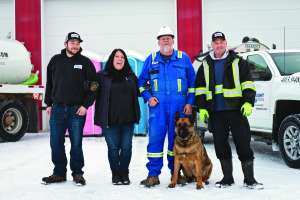
Drake and Cindy Whitney own Cowboy Septic, a single-truck septic pumping business in Airdrie, Alberta, a 30-minute drive north of Calgary. The company has received numerous requests to expand the size and scope of the business. While acting on growth opportunities would certainly expand revenue, the couple applies another lens to any such decisions — would that growth make them happier, keep staff motivated and increase customer satisfaction?
Growing up in the small town of Hanna, Alberta, Drake Whitney developed an interest in rodeo and progressed to becoming a professional bareback rider, competing in rodeos across Canada and the U.S. At 18, he began to supplement his rodeo income working in the oil and gas industry and operating a successful trophy and engraving business.
While many pumpers add portable restrooms to their offerings as a natural extension of their business, Whitney did the opposite, starting out in portable restrooms.
GETTING A START
“As a local business owner, I sat on the board of the Western Heritage Centre Society, a farm and ranch historical organization,” he recalls. “They offered trail rides and other events, and I noticed that one of the biggest expenses in our budgets was for portable toilets and septic service. That really piqued my interest.”
When a business associate mentioned that he had a handsome budget to provide portable restroom service to a wilderness event in neighboring British Columbia, Whitney quickly bought 10 portable restrooms and a slide-in tank for his pickup truck and won the contract.
“The job paid for all my equipment and a decent profit on top of that,” he recalls. “That was the basis for launching Straight Flush Rentals in 2005. I sold the trophy business and went full out into portable restrooms.”
Whitney worked to promote event rentals and service, which were the most lucrative, but realized that construction market rentals were a big part of the business that would hold him through the fall, winter and early spring.
During the first four years, the company continued to grow, with increasing requests to provide septic service to the area around Calgary.
SEPTIC BECKONS
“We live out in the country and a lot of people living on farms and ranches were asking us for pumping service,” he says. “In 2009, we started Cowboy Septic because of my rodeo background and because we felt it was a name that people in the area could relate to — we weren’t just a city company prospecting for business out in the country.”
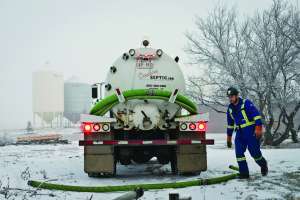
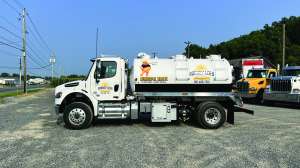
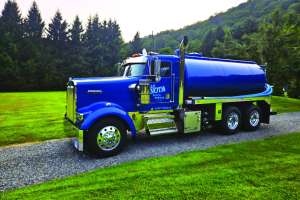
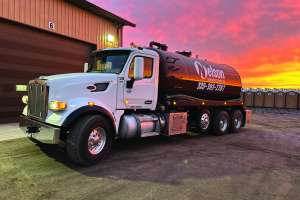
Cowboy Septic launched with a 2008 Peterbilt 300 Series truck with 1,900-gallon steel tank and Jurop pump built out by LMT Industrial Vacuum Equipment (Iron-Vac). Well-maintained, it’s still the company’s solo septic truck.
Both companies operate out of the Whitney family 6-acre farm homestead property, surrounded by ranchers and wheat and canola farmers. It features a 4,400-square-foot shop with five large bays. Business has been good, with organic growth of about 30% for both companies since 2020, primarily in core offerings.
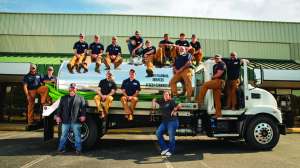
The company employs five people in addition to the co-owners. Whitney has pulled back from daily driving and his wife, Cindy, provides backup to an office manager who handles most of the calls, quotes and dispatch. Although Cowboy Septic and Straight Flush were once operated as separate businesses, they’re now run as a single company, differentiated by two phone numbers. Both businesses provide service within an hour’s drive from Airdrie, including the city of Calgary.
MACHINES MAKE MONEY
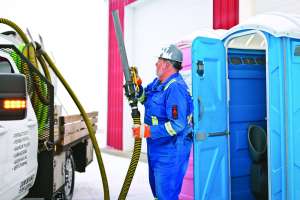
The combined equipment fleet includes the original 2008 Peterbilt on the septic side and three rigs with slide-in vacuum units: a pair of GMCs, a 2016 and 2017, with 400-gallon waste/200-gallon freshwater aluminum tanks and Masport pumps from Brenner Tank Services; and a 2014 GMC with an unbranded fiberglass 300-gallon waste/150-gallon freshwater tank and a Wallenstein pump.
A 2004 Duramax diesel rig carries a 400-gallon waste/200-gallon freshwater steel tank and Masport pump from Crescent Tank Mfg.
“The Duramax always stays in the yard,” Whitney says. “We use it to pump out any portable restroom that needs service when it lands.”
The portable restroom side of the business offers 500 units, all from PolyJohn Canada, including 10 ADA units. For cold-weather service, the
company offers 10 heated restrooms with sinks, lights and hot water from Rockbox Structures.
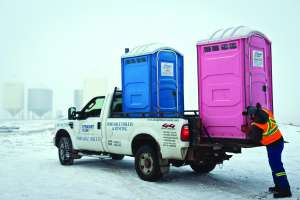
Restrooms are transported on three delivery trailers from McKee Technologies offering eight-, 12- and 14-unit capacity.
Four restroom delivery trucks feature hydraulic Tommy Gates and include a 2008 Ford with six-unit capacity; a 2009 GMC with three-unit capacity; a 2011 GMC with three-unit capacity; and a 2011 Ford with three-unit capacity.
Washroom trailers by McKee Technologies include a two-unit Explorer trailer used for construction sites, and a three-unit Explorer washroom trailer used for special events.
The business offers 75 hand-wash stations from PolyJohn and an eight-sink hand-wash station featuring hot water from McKee Technologies.
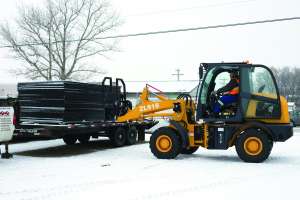
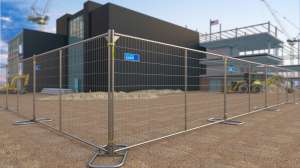
A 2012 Bobcat skid-steer is used for loading portable restrooms and fences, supplied by Olivec Canada. A 2022 ZL918 wheel loader is dedicated to loading fence, which is delivered using a 2023 Southland twin-axle trailer.
VARIED SERVICES
Together, business activity shakes out at about one-quarter septic service and three-quarters portable restroom rental and service. Two of the four drivers concentrate on restroom deliveries, pickup and septic service. The other two service construction restrooms for four days, rotating their service area to different quadrants of Calgary and helping out the other team on the fifth. Three of the four drivers are licensed to operate the septic truck, and all drivers are ready to share duties for special events and fence delivery.
Portable restroom business runs about 70% construction and 30% events. Events are biggest from June to September and include rodeos, fairs, weddings and the many corporate events staged during the annual Calgary Stampede. The company has serviced the Betty’s Run for ALS event in Calgary 18 years running.
“Our septic service operates on a different rhythm than restrooms,” Whitney says. “Most of the time the customer isn’t in a big rush, so we’re able to make the best use of our schedule to provide them with service.”
The septic work is primarily rural/residential with about 15% devoted to commercial work, largely for businesses not served by municipal sewer systems.
“Many of the farm properties have two houses on them, each with their own septic tank,” Whitney says. “Our business customers include rodeos, breweries, grain elevators, campgrounds, sports facilities, public works locations, public washrooms, recreational vehicle parks and various offices located out in the country.”
Customers have asked Cowboy Septic to install or repair their systems, but Whitney doesn’t believe it would make the company stronger.
DON’T TAKE ON TOO MUCH
“It’s a real achievement to have our business in balance,” he says. “We’d be looking at adding an excavator or backhoe, and hiring a new employee and I’d have to wrap my brain around a whole new type of education and getting permits for the business. We recommend that type of work to someone we trust, and I assume we’re getting the same kind of recommendation for septic service.”
Offers to pump restaurant grease traps would also involve new hires and new equipment.
“I have a lot of respect for my staff and I want to keep them,” he says. “They know summer is going to be predictably busy and there’s a lot of opportunity for them to earn overtime. But come the fall, I don’t want to tell them that I’ve added an extra septic truck to extend our service offerings and have them stressed out, working until 7 p.m. each night, just so they can come back again at 7 a.m. and run themselves into the ground.”
Over the years, services such as water delivery, fence rental and waste hauling seemed like a good idea, but only fence rental proved right for the business. “Sometimes an additional service seems like a natural fit,” Whitney says. “But when you crunch the numbers, they aren’t always profitable, so it’s better to get out quickly.”
ALWAYS IMPROVE
However, he remains open to new business opportunities and continued organic growth. He and his wife attended the 2024 WWETT Show to explore new ideas and equipment that will make the company more efficient.
“We love innovations that allow us to do a better job on our core services,” he says. “If your customers tell you that you’re good at something, stick to it.”