An onsite wastewater treatment system operation and maintenance service provider is a professional trained in the O&M of onsite wastewater treatment systems. It may involve cleaning of septic tanks, but goes much further into evaluation of both conventional and advanced systems.
More and more regulations are distinguishing this profession as it requires advanced knowledge of the operation, required evaluation and troubleshooting of the wide range of technologies. In addition to regulatory requirements, some funding institutions are requiring a Responsible Management Entity be in place to ensure systems supported by local or federal funds are being properly managed after installation.
O&M is essential to the long-term performance of onsite wastewater treatment technologies. All system components require maintenance. O&M service visits can provide early detection of problems that could result in malfunction of onsite wastewater treatment systems if left uncorrected. Early detection makes it possible to take remedial action before a system becomes a public health hazard, a detriment to the environment or a liability for the homeowner.
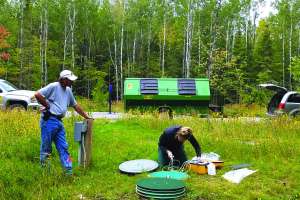
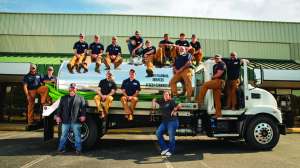
The O&M professional may be self-employed or employed by an O&M service company or RME. The O&M professional performs a variety of services for the end user (system owner) that include:
- Assessing the onsite wastewater treatment system to determine operational status.
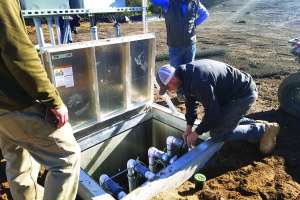
- Performing routine activities required to keep the system operational.
- Responding to emergencies in a timely manner.
- Collecting and recording information regarding operational status of treatment components and recommending timely maintenance, replacement or pumping of various components as required.
- Monitoring system performance through collection and analysis of effluent samples when appropriate.
- Reporting system operational status and/or system performance to homeowner, regulatory community and others.
- Serving as an informational resource for the homeowner.
- Troubleshooting components not performing as design/prescribed.
One question that arises is how often O&M is needed. The frequency required is related to the complexity of the treatment process, system reliability and the quality and quantity of wastewater loading. However, monitoring frequency is also determined based on public and environmental risk. Maintenance frequency is determined by the risk of failure due to site- and watershed-scale factors as well as by performance requirements.
Monitoring frequency is typically mandated by code or regulation. A system constructed on a site with a higher risk rating would not be expected to have the same monitoring frequency as a system on a site with a lower risk rating. The system operating permit sometimes requires the homeowner to maintain a current service agreement with a local O&M service provider.
System complexity and the risk to public health and environment are directly related. As system complexity increases, environmental consequences of improper wastewater treatment increase. Generally, the site is assessed for its ability to provide effective wastewater treatment in the soil. Sites with deep, well-drained soils can use a septic tank for pretreatment and a trench distribution system for final treatment and dispersal.
The soil provides most of the treatment, and the system operation is relatively simple. As the depth of available treatment soil on the site decreases, the system requires either additional pretreatment components to reduce the contaminants in the effluent prior to dispersal or a different type of distribution technology. As the depth of well-drained soil decreases even further, the complexity of required pretreatment and distribution technologies increases.
A system directly discharging wastewater to a water body poses the greatest risk. Even though disinfection is generally required, most of the treatment occurs in the pretreatment components. The effluent then leaves the system via saturated flow directly to the surface, without the added treatment from the soil treatment system.
The second highest level of risk is associated with surface distribution. The potential for human contact with effluent increases because effluent is applied on the ground surface. Dispersal of wastewater and nutrient uptake still occurs in the soil; this therefore provides some treatment. Soil-based systems have the lowest risk since the effluent is designed to prevent human contact with the effluent.
Development density is another parameter used to establish the relative risk for a site. A site of one acre or less in a subdivision, where all facilities are served by onsite wastewater treatment systems, has a greater risk than one facility on several hundred acres of land. The potential for contaminant loading is greater for the subdivision of small lots compared to single facilities on large tracts of land. The increase in risk of human exposure to wastewater and environmental risks caused by developmental density should lead to an increase in O&M frequency.
System performance is directly affected by the quantity of wastewater being treated relative to the design capacity of the system. Systems perform best if the actual average daily flow is less than 70% of the design capacity. If the actual average daily flow is greater than 70% of design capacity, peak flows likely exceed design capacity. Therefore, the system is operating in a mode where greater attention will be needed, and the number of O&M service visits should be increased. If the load averages more than 70%, the treatment system can be augmented with additional components, such as a flow equalization tank and a timer. This flow equalization tank and timer will assist in limiting the risk of hydraulically overloading the following treatment components. Treatment components used prior to a flow equalization tank must be adequately sized to accept and treat peak flows.
The expansion of the onsite wastewater treatment industry combined with the integration of management has created an opportunity for professionals entering the market. Expanded services are needed due to the increasing use of systems that require routine O&M service visits, the increasing number of systems being placed near one another, and more stringent performance requirements set by regulatory authorities. The demand for services has resulted in a greater number of people entering the profession and a need to standardize the services offered.
In 2005, the Consortium of Institutes for Decentralized Wastewater Treatment developed a manual and training resources for training service providers. The National Onsite Wastewater Recycling Association, in partnership with the Rural Community Assistance Partnership, is currently updating these materials. The end products will be available to anyone interested in providing education regarding and will be available via online training. See nowra.org/education/ for more information.