
Brian Haboush bought Krueger’s Septic Services after a 25-year career in data center network and cloud security solutions serving major corporations.
So it stands to reason he would bring a dose of business savvy and technology — maybe one day even artificial intelligence — to what is largely an old-school profession.
“At the end of the day, we’re not solving time travel,” says Haboush, who retired from his technology career at age 52. “But if you run the business correctly and have some automated systems and processes, route optimization and other things, the numbers make sense.”
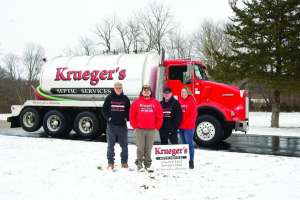
Haboush and his four-member team operate from Niles in the southwest corner of Michigan. The business specializes in pumping; services like installation, time-of-sale inspection and major repairs are referred to other contractors.
He acquired the company in August 2023. Within a year, he reported revenue was up 350%: “That has continued to the current day, and it’s even getting better as we tweak and fine-tune. It’s a compliment to the team we’ve put together — hardworking, dedicated, intelligent.”
That team includes Holly Thompson, office manager and marketing coordinator; Zack Brawley, head of operations, truck driver and septic technician; and Scott Krassow, septic technician.

TIRED OF TRAVEL
Haboush jokes that he chose septic pumping as a post retirement venture because, “I wanted to make my parents proud and work with poop.” In reality, he got tired of traveling every week for more than two decades and wanted a less hectic lifestyle.
He had known the owners of the pumping business, Fred and Sharon Krueger, for several years. “They were getting up in age, and Fred had talked about wanting to sell the business,” Haboush recalls. “One day while running errands, I swung by his house and asked if he was still looking to sell.
“He said yes. I asked when. He said, ‘Yesterday, or six months ago, or a year ago.’” Relying on his business background and a degree in accounting and finance from the University of Michigan, Haboush did his due diligence. After just two months, they had a deal.
On one level, Haboush kept things simple. He retained the company name and phone numbers, the truck and the logo: “The prior owners [Fred and Sharon] did a great job of building a strong business and reputation. All we did was turn the volume up.” That started with creating a database of the customers served in the past five years and sending them a rate card, a refrigerator magnet and the date of their last service.
Business quickly increased from three to four pumpouts per day to eight to 12. “The phones just exploded,” Haboush says. “People were happy to be reminded. We’ve integrated that as part of the system. Now we can go back and reference repeat customers and any notes: ‘where the tank is located,’ ‘where to park,’ ‘call ahead because of dogs.’”

STEPPING IT UP
But Haboush wasn’t content to just to function in the old-school way: “We’re bringing a 30-year-old business into the present and into the future.” Discussing the competitive landscape, the previous owner said it consisted mainly of husband-wife teams. He drove the truck while she ran the office.
“Nothing was computerized,” Haboush says. “People would call in. Notes would be written on napkins or whatever paper was handy. The driver would write out the invoices.” Eventually the couples aged out of the business, sold the truck and closed up shop.
Haboush saw the necessity to modernize, and that started by getting customer information into electronic form, first in Excel spreadsheets. In the near term, he plans to implement a customer relations management package with integrated accounting, calendars and route optimization.
“I’ve also got future ideas to integrate AI because of my technology background,” says Haboush. “I’m not willing to divulge how, but it will be in the areas of route optimization, predictive truck maintenance, cost modeling and marketing aspect. There is a lot of power in AI. I understand it extremely well, and I think we can bring that to this industry.”
At present, route optimization is a manual process. Services are scheduled a week or two in advance, so it’s not difficult to cluster them for efficiency. Of course, system backups and other emergencies happen; for those the company imposes a same-day scheduling fee, to which customers have not objected.
Krueger’s also adds distance charges for customers beyond the company’s standard 30-mile operating radius. “We don’t call it a fuel surcharge because it doesn’t equate to what our additional diesel costs would be. It’s more a question of compensation for our time.”

DIVERSE OUTREACH
Marketing blends the new with the basics. The company is active on social media and has a website that integrates search engine optimization. “We have an FAQ section,” Haboush says. “People who hit the website can get educated about the do’s and don’ts of septic system maintenance. We update the website constantly with good content. The search engines of the world see that, and it makes us more relevant.”
On the traditional level, the company supports a variety of community groups and events.
“We bought equipment and new uniforms for the high school baseball team,” says Haboush. “Last year when the Niles football team went far into the playoffs, we funded fireworks for every time they scored a touchdown. People went bananas. And the phone rang.
“We don’t do these things to beat our own chest. We want to give back to our community. We sponsor a lot of charity golf outings. I have a huge passion for veterans. My brother served, and so did my dad and a lot of my friends, and so we have veteran discounts.”
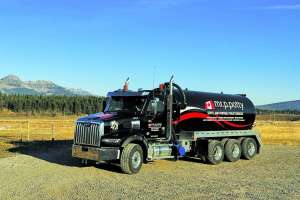
Then there’s the truck, a 2004 Kenworth known as “Big Red” with a 3,200-gallon aluminum tank and Masport H400 Series pump. “We take pride in keeping it clean and polished. It’s such a good-looking truck that it’s a rolling billboard. It’s one ingredient in our secret sauce — keep the truck nice and clean and bright. Be professional. People like that.”

A TIGHT FOCUS
“We stick with our core competency,” says Haboush. “We’ve created strategic partnerships with people who strictly do inspections, who install tanks and field systems, do line clearing and distribution box repairs. It has been great because they pass business our way, and we pass business their way. There is no conflict.
With specialization comes attentiveness to customers: “I go back to Warren Buffett, who is one of my business heroes. The types of businesses that he invests in are companies that have a great product or service and passion, an infatuation, with customer service.”
For him, that means answering the phone no matter if calls come in after hours, on weekends or at 4 a.m. “If you don’t answer the phone, people are going to call the next company,” Haboush says. “When Mrs. Jones is having a backup in her toilet and you do some backflips to service her, that word spreads. You can see that on your Google reviews.
“It’s nothing more than caring. When we get a call, the team and I put ourselves in the shoes of the customer. What if we were the ones having a problem? What if it was our grandmother? People want to be taken care of, and that’s what we do.”

DISPENSING KNOWLEDGE
Education is a key component of service: “A lot of people like to come out and talk. We go out of our way to explain everything. On our invoices we list the free six-point inspection checkboxes. Our drivers walk the clients through that.
“If there’s an issue with the field, when we get the tickets back at the office and see that noted, we make a courtesy call to the client, walk them through what that means and recommend who they can call to have that addressed.
“It’s just trying to add value wherever we can. If they have got a filter, we show them how to pull it out and clean it. If they’d like Krueger’s Septic to do it, we’ll get them on a schedule. If we see baby wipes in the tank or other things that aren’t biodegradable, we’ll explain how that may be what caused their filter to clog.”
EXPANSION PLANS
Business has been good enough that Haboush is considering a second truck and a driver/helper. The idea is to buy a smaller truck, perhaps 2,000-gallon capacity, to use for routes within a tight radius from the Niles Wastewater Treatment plant, the primary dumpsite.
That truck could then repeatedly do two pumpouts, then empty the tank. “If you have the density of business, you get great fixed-cost leverage,” Haboush says. “Maintenance is down; fuel costs are down.”
Another possible longer-term strategy is to buy out pumpers beyond the basic 30-mile radius who are looking to retire: “My concept would be roll-up acquisitions where we would buy the customer base and the truck, keep the current employees and keep the company name and phone number because that has the local feel. Then we would integrate the business on the back end into our system for routing, centralized accounting and marketing.”
Haboush sees changes like those he has made or is planning coming into the business as younger operators take over long-established business: “I think that is a huge shift that’s happening. We have tons of these ideas. It’s just a matter of the number of hours in the day.
“To the pumper brothers and sisters out there, I say keep revolutionizing or evolving the business. It’s never going away. It’s recessionproof. If you acquire a business, have good mentors and don’t try to do too much.
“Make sure you have all your DOT permits, licensing and registration. Keep all those things real tight because that’s the heart of the business. Otherwise, just work your butt off and have fun doing it.”
Continue reading for free