
Maggie Morehouse is an environmental health specialist II with the Environmental Health Division of Thurston County, Washington, and is the division’s dye test lead and trainer. She has 15 years of experience in dye-testing, including public health roles in Kitsap and Pierce counties. She was recently elected to the Washington On-Site Sewage Association Board Regulatory Authority.
Pumper: What is dye-testing designed to accomplish?
Morehouse: A dye test in Thurston County is designed to find and identify onsite septic systems whose sewage is reaching a body of water before being fully treated. We’re specifically concerned about two Marine Recovery Areas — areas where untreated wastewater will run off and reach Puget Sound.
Pumper: Thurston County stresses that the dye tests are legally defensible. What does that mean?
Morehouse: The county started dye-testing in the 1990s, but our policies were not highly legally defensible. Somebody hired an attorney who pushed back on our processes. In response, we hired attorneys and researched dye-testing on test properties for two years along with engineers and the lab that manufactures and tests our dye. We took that research back to the Thurston County Board of Health and rewrote our policies. Since that rewrite, we have been successful in legally enforcing our policies.
Pumper: How is a dye test administered?
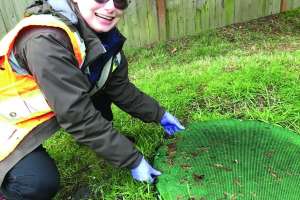
Morehouse: We begin by placing charcoal packets contained inside a little net around the environment in any place that the dye might come up downstream of the septic system. You need that slope and somewhere “liquidy” to place the packets. You’re going to be looking in divots, ditches, storm drains and outlet pipes — any place downstream where water’s coming out. We walk all around the property, often working with the homeowner, asking them if they have water diversion drains or other water infrastructure we don’t know about.
Once we place the charcoal packets, they absorb any dye and the only way to get it out is by chemical elution using a solvent.
These “background” or “control” packets are first placed a week before the dye test to test the possibility that we’re inadvertently catching dye that’s in the environment before we put the dye down the drain. After starting the dye test, we set down fresh charcoal packets just after the dye is introduced to the septic system.
Pumper: How do you get the packets to stay in place for dye-testing?
Morehouse: It’s not easy to fix them in turbulence and you’d be surprised how hard it is to tie a packet to a round rock. There are objects on the beach that you would think aren’t going to move — logs and giant rocks — that are gone on the next visit. One of the toughest applications is beach outlet pipes that are flush with the bulkhead. A great technique here is to take a metal coat hanger, push that into the hole and then attach the packet to the coat hanger with a binder clip.
Pumper: What types of dye are used?
Morehouse: Fluorescein, rhodamine or eosin are used because septic systems are not designed to remove dye. Fluorescein can be cheaper if you have a lab to perform initial analysis. It’s green and generally easier to see by eye. Rhodamine and eosin are more resilient in the environment but harder to see without full analysis. We use exactly 6 ounces of dye per household to ensure we don’t inadvertently skew results between households.
Pumper: Where is the dye introduced into the septic system?
Morehouse: We typically pour the dye down a graywater and blackwater source. We pour dye down the toilet and additionally down a sink such as bathroom sink, kitchen sink or the drain by a washing machine.
Pumper: How long does the dye take to go through the septic system?
Morehouse: Our test allows a two-week period after we add dye. If something’s going to come out, we believe we’ll see it in that timeframe. If it’s a failure in a direct connection or broken pipe, it may come out very quickly. If you have a seeping failure, it might take a few days.
Pumper: How are the samples analyzed?
Morehouse: I run our lab and I mix up KOH solution, a mixture of potassium hydroxide and alcohol. We mix the KOH solution with the charcoal, and if we think we see dye in the KOH liquid, we send it off to the lab at Ozark Underground Laboratory. Ozark manufactures the dye and does the analysis to confirm that it’s their dye and the concentration. Once we confirm dye presence, we go back to the location where the dye was found, take a water sample and check for fecal bacteria. More than 200 colonies per 100 mL of fecal bacteria and dye positive is when we consider the septic system has failed.
Pumper: How many home systems do you test?
Morehouse: We have 660 properties designated as being close to a body of water or a creek that outflows to our marine recovery areas. Each year approximately 80 properties are scheduled for a dye test. I put them on a map and I look at where they’re located so that individual dye tests won’t interact with each other. You can separate tests in the same area by five weeks or you could also use two different types of dye if the houses are close to each other.
Pumper: How many dye tests have you conducted, and how many houses have failed the test?
Morehouse: We’ve conducted approximately 1,200 tests since 2006, with 48 failures. When we identify a failure, we can legally require the homeowner to repair the system.
Pumper: Does the homeowner have to agree to a dye test?
Morehouse: We have the right to test, but we’ve had a high success rate on voluntary collaboration with homeowners — only four have declined to date. Instead, we worked with the properties around them and we haven’t found any indications of failures in the nearby waterways.
Pumper: What are the challenges of convincing homeowners to let you dye test their systems?
Morehouse: It’s easier to test if you already know that you have a septic problem and just determine whose surfacing sewage it is. But when you are coming from a position of asking to test a system that the homeowner believes is working perfectly, that’s a little bit higher of a reach.
We overcome those challenges by providing information, handouts and letters to owners, explaining the process. We also stress that their neighbors are also getting this test done — everybody is being treated the same. Of course, it can be a bit concerning to have your septic system dye-tested, but getting a negative result brings a lot of relief and satisfaction.
Pumper: How are repairs overseen?
Morehouse: Our results identify that there is a problem, but may not identify which part of the system is the problem or the cause. However, we will work with the homeowner and local certified septic professionals to guide them to a solution if we can help. Once a repair has been undertaken, we’ll dye-test again to confirm the repair has fixed the sewage in surface water. One homeowner who was trying to repair his system had three dye tests before a camera revealed that a PVC pipe junction had become dislodged.
Pumper: Are people ever alarmed by the bright colors of a dye test?
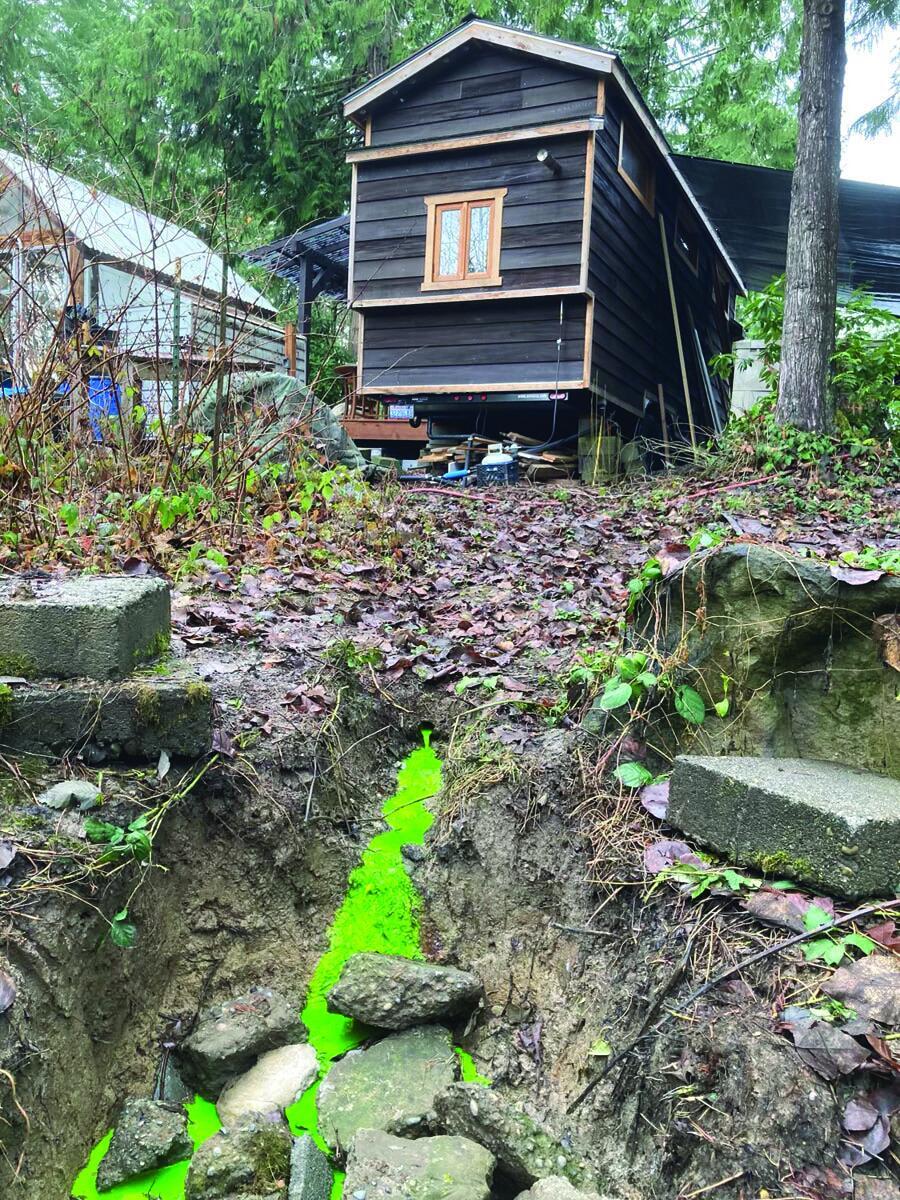
Morehouse: I had an incident back at Pierce County when we tested a house and it turned the ditch bright lime green. Somebody thought it was an antifreeze spill. They called a road crew who was out there with hazmat pads sopping up what they thought was antifreeze.
Pumper: How has the program evolved?
Morehouse: We used to test each of the 660 homes every six years. However, some of these properties are now going on their third round of dye-testing and we are finding fewer failures each year. Based on data we have collected over the years on dye tests in our MRAs beginning in 2017, we increased the time between dye tests to every nine years.
We’re also hoping to improve accuracy by switching from measuring fecal coliform bacteria, which can include decomposing plant matter. In our next policy update, we’ll move to sampling for E. coli. Another option our Pollution Identification and Correction team has used is testing genetically to make sure it’s human contamination we’re tracing.
Pumper: What effect has the dye-testing had on sensitive marine areas?
Morehouse: Pollution from septic systems has decreased and water quality has been improving despite an increase in development, population and number of septic systems within the watershed protection areas. Because of water quality improvements, shellfish harvest areas have been reopened.
Pumper: How can professionals learn more about Thurston County’s dye-testing program?
Morehouse: Anyone interested in the dye-testing program at Thurston County can contact me at maggie.morehouse@co.thurston.wa.us. We’ll be happy to share copies of our training material for dye-testing, dye test policies, procedures and tasks, forms used by staff and handouts and letters for homeowners.
Continue reading for free