It’s not uncommon to see sites with soil or size limitations housing systems utilizing pressure distribution.
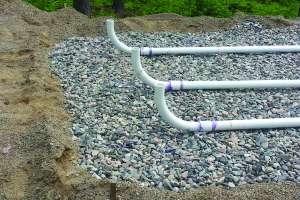
Low-pressure pipe distribution involves the use of a pump and small-diameter pipe (1-2 inches) with small, drilled orifices/perforations (1/8- 1/4 inch) to distribute wastewater over media or soil under pressure. A pump typically controls the application, which proceeds at a rate determined by the long-term acceptance rate of the soil or media.
Pressure distribution at the proper rate maintains an aerobic environment for effective treatment. Media filters and many other advanced treatment units rely on pressure distribution. Many soil treatment systems also utilize pressure distribution to ensure event distribution over the soil treatment area.
Design characteristics
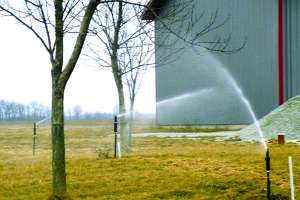
When an LPP system is designed, it commonly has a required distal head or squirt height. This means at the time of installation if you measure the head or squirt height at the end of the lateral, it would go up several feet (typically 1-7 feet). This height is ideally confirmed at the time of installation and then tracked throughout the life of the system. If the squirt height increases, this indicates some of the orifices are plugged and cleaning is needed. If the squirt height decreases the pump may be wearing out, additional friction has been added in the pipes or there may be a leak in the supply line or a lateral.
For the LPP to perform as designed throughout the life of the system, it must be maintained. A critical issue is that the orifices must be kept clear for the system to work properly. Septic tank effluent inevitably contains some solids, which can plug the system. Also, LPP pipes leave behind small amounts of nutrient-rich wastewater, which can feed microbes living in the pipes. Effluent screens help to protect these systems further by limiting the size of suspended solids leaving the pump tank. Maintaining these aspects of the septic tank and distribution system is critical for long-term performance.
Proper setup
For an LPP system to be properly managed, it must have clean-outs. Many older systems may not and unfortunately are not serviceable without digging up the laterals. This is typically not done unless there is a problem, which often results in uneven distribution over years leading to surfacing of effluent.
Clean-outs are placed at the distal end of pressurized laterals to allow flushing of the system prior to startup, measurement of operating pressure and regular flushing of solids. The pipe configuration of the clean-out varies, but the most basic and convenient clean-out consists of a 90-degree turn up. Two 45-degree elbows or one sweep 90-degree elbow may be used. Using these allows the service provider to use a pressure washer or bottle brush for cleaning purposes because the gentle turn allows easy insertion of the pressure line.
If a cap assembly is used, a female screw cap is easier to remove during O&M activities. Alternatively, ball valves may be installed at the distal end of the lateral in a vertical position. These can be opened to flush laterals using pump pressure. During normal operation, these valves are turned off, but they can be accessed one at a time when flushing the distribution laterals.
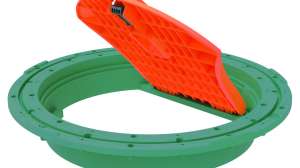
There does need to be a perforation part way up the elbow to make sure that air is able to re-enter the pipe after the pump shuts off. The clean-out is then brought to grade and covered with a landscaping box. It is recommended that rock be placed in the box to cover the perforation, so effluent isn’t spraying freely in the box. Larger-sized boxes are preferred because small ones tend to make getting your hands inside to remove the threaded cap more difficult. In cold climates, insulation is also recommended on the lid of this box. Some installers will also place removable insulation around the clean-out.
Plan for plugging
Experience with pressure distribution has indicated that laterals have the potential for plugging. Even with large perforation and high pressure, it is possible for solids to plug up the perforations. Providing maintenance access is probably the single most important component for long-term operation of a pressure distribution system.
Assessing uniform application of wastewater is usually done by determining distal head on the individual laterals conveying wastewater. Uniform distal head on each lateral means that uniform application of wastewater is occurring. The distal head pressure is typically measured with a clear calibrated PVC pipe that is attached to the end of the lateral and held vertically. When the pump is activated, the effluent rises in the clear pipe and the height is recorded. The distal pressure at the end of each lateral can also be checked by threading in a cap with an orifice pointing upward on each lateral. The height to which the effluent squirts up should be the same in each lateral. If it is higher in one lateral versus another, this indicates that the lateral with a greater squirt height has plugging in some of the orifices and that flushing and cleaning is needed.
Partial plugging of the distribution piping may also be detected by long dosing times, such as 25% extra run time per dose or a decreased drawdown following the dose event (decrease from original settings).
Proactive approach
When running a service visit, you may decide to simply flush and/or snake systems on a regular basis and not measure distal head as this will save time and ensure even distribution.
The ends of the distribution laterals should be exposed and the pump activated to flush out any solid material. If necessary, the pipe can be cleaned. Any visible solids or effluent that discharge from the pipe should be removed from the site and properly disposed of. The process of snaking the laterals involves either a bottlebrush attached to the end of an electrician’s or plumber’s snake, or a small diameter pressure washer nozzle and hose.
Initial flushing of the laterals removes the inevitable collection of solids that collect at the lateral end. Once the laterals are snaked, they should be flushed again to remove any solids that may have been dislodged. Laterals may also be vacuumed out with a pump truck.
Proper maintenance of LPP systems will provide value to any system that utilizes a pressure distribution for the distribution of effluent in a media filter or soil treatment system.