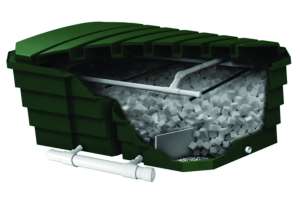

For something relatively simple in concept, there is a lot going on inside a septic tank. First and foremost, they are a settling device, but anyone who works around septic systems also knows that they are digesting waste and creating gases during the process.
It is a two-stage anaerobic process occurring in septic tanks. In the first stage, the acid forming bacteria decompose complex organic molecules to simple soluble compounds. The starches are decomposed to simple sugars and the proteins are broken down into amino acids, while the fats remain essentially intact. Continued metabolism leads to the formation of organic acids, which depress the pH and retard further bacterial decomposition.
Breaking It Down Further
In a continuous process, a second group of organisms known as the methane-forming bacteria utilize the organic acids as food and metabolize the acids to carbon dioxide (CO2) and methane (CH4). The amino acids are now broken down, resulting in the formation of ammonia, which tends to neutralize some of the acids and raises the pH to a more favorable level for methane bacteria, which also attacks the fats. The fatty acids are decomposed into simpler compounds that can then be metabolized to CH4 and CO2.
The sludge and scum layer are also generating gases. Anaerobic decomposition of the organic sludge and scum takes place, first forming volatile acids which are then eventually converted mostly to water, CH4 and CO2.
Many facultative (live in both an aerobic and anaerobic environment) and anaerobic bacteria grow, reproduce and die in the tank. A lot of these organisms are carried up by rising gas bubbles so as to seed the liquid contents and enhance the anaerobic decomposition of the remaining organic material. This gas production can impact the settling properties of the tank.
Exit Route
The reduction of organic matter during anaerobic decomposition is accompanied by the generation of hydrogen sulfide and other foul-smelling gases while CO2 and CH4 are odorless. These gases typically escape the septic tank by flowing back through the household plumbing vent, usually exiting through the residence roof, through the septic tank risers, or out through the soil absorption system.
Gas Risks
The results of studies and testimonies by the Public Health Services, the EPA and other experts that have accumulated to date are convincing and conclusive that generally methane concentrations generated in the septic tank with respect to the available oxygen are also explosive. In 1992, the National Fire Protection Association found the atmosphere to be nonexplosive, the effluent was nonvolatile and the gas vapors did not normally exist in volatile mixtures or quantities. Consequently, the National Electric Code through NFPA 820 recognized that passively vented residential septic tanks are nonexplosive unclassified environments.
However, the septic tank is an extremely hazardous confined space with insufficient oxygen and toxic gases and should never be entered without the appropriate classification, air monitoring and ventilation equipment, training, permits and rescue plans.
Source Studies
CH4 has been identified as a greenhouse gas that is over 20 times more effective at trapping heat in the atmosphere than CO2.
The U.S. Environmental Protection Agency’s GHG inventory in 2009 estimated that 76% of wastewater sector methane emissions in the United States are from septic systems. This is due to the large number of individual septic systems in use and the anaerobic conditions present in septic tanks. It is important to note that wastewater is a small contributor for methane emission behind natural emissions from wetlands and human-derived emissions from agriculture, energy and landfills.
A 2011 field study of eight septic systems in California found a majority of the CH4 was from the septic tank and not the soil treatment area, although there was no ponding in any of the systems. Their data indicated that past modeling overestimated the emissions by a factor of over two. They also found that the presence or absence of a scum layer did not significantly influence the emission rates of methane and carbon dioxide.
Solutions
Do septic tanks produce the same amount of CH4 and CO2? There are many variables which will impact production of gases. If the BOD loading, pumping interval, temperature and depth of sludge increase, the amount of gas produced also goes up. This means that septic tanks that are pumped regularly produce less GHG.
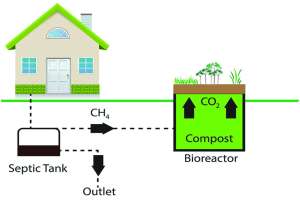
Research in Utah is testing if the methane from septic systems can be treated in a compost biofilter system where the methane can be converted to carbon dioxide, which can then be used by plants growing on the compost. They have found favorable results and are looking to test it at field scale.
Continue reading for free