
Managing solids is fundamental to ensuring septic tank performance.
When the sludge and the scum are greater than 25% of the operating tank depth, the contents of the septic tank should be removed. When servicing a system with a dosing tank, it should also be evaluated for sludge and scum accumulation. The pump should only deliver effluent with sludge and scum to downstream components.
Aboveground Checkpoints
The location of the access is an important aspect of septic tank maintenance. If the tank access is farther than six feet from any tank wall, it makes maintenance in those areas very difficult. Once located, also check the riser seam for root intrusion stains that would indicate infiltration of groundwater or surface water. Ideally, the riser should come to grade so that no digging is required to reach it. The lid on the tank or riser should be securely fastened with safety screws (screws or bolts that require a nonstandard tool) or other means. The lids must be removable by the service provider but childproof. Secondary restraint safety features are a great addition that can be retrofitted into existing tank lids.
Inside Inspection
When the septic tank cleaning access is open, check the condition, length and submergence of the inlet and outlet baffles/screen. In the past, if someone attempted to service a septic tank through the inspection pipes over the inlet and outlet baffles, those baffles may be broken or dislodged. Septic tank service personnel should recommend replacement if they are missing or in poor condition. The pipes and baffles should be evaluated to determine that they have the correct slope and are not collecting solids.
Check the inlet to evaluate flow into the tank. Normally, the flow will start and stop due to use in the home. Continuous flow into the tank, especially without foaming may be associated with a washing machine or dishwasher discharge, which may indicate a plumbing leak. Notify the owner if this is the case and direct them to check for and correct any plumbing leaks.
With the access open there is a good opportunity to evaluate the tank for surges and infiltration. If there signs the effluent was above the outlet pipe you know you have a system with a downstream problem. If there is water directly entering a component via a sump pump, downspout, foundation drain or condensate line or through a leaking pipe, pipe penetration or access riser/ tank seam this will increase flow beyond design capacity and reduce detention time. This results in solids carrying over that can clog the distribution pipes, and excess hydraulic loading that can saturate the soil treatment area and cause the system to malfunction. All tanks must be watertight to prevent water from entering or leaving the system through openings other than designated inlet and outlet piping.
Level Check
Under most conditions, the liquid level in a septic tank should be at the invert of the outlet of the tank. The maximum liquid level for a tank is measured from the bottom of the tank to the invert of the outlet pipe.
Note whether levels have exceeded the maximum or if the level has dropped without the tank being pumped out (an indication of a leak).
Measure the current level in the tank with respect to the outlet. If the level is below the outlet, the tank may not be watertight. If it is higher than the outlet, the effluent screen may need cleaning. If the screen is not the problem, there may be problems in a downstream component that are preventing flow through the system such as pipe blockage or ponding in the soil STA.
The clear zone represents the treatment volume in the tank, which should be about 67% to 75% of the operating tank volume or liquid depth. This means the sludge storage volume is roughly 25% to 33% of the liquid depth. Thus, the combined depth of the scum and sludge should not exceed 25% to 33% of the total liquid depth. The scum layer should be at least three inches above the bottom of the outlet baffle, and the sludge should be at least 12 inches below the bottom of the baffle to help prevent solids from escaping the septic tank.

Proper Pumping
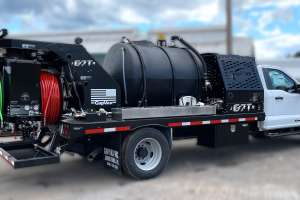
When servicing the tanks, all solids and scum in the tank should be removed to the point of seeing the bottom. Cleaning can be done a few different ways. Mechanical mixing, air mixing or backflushing are all methods to deal with the solids.
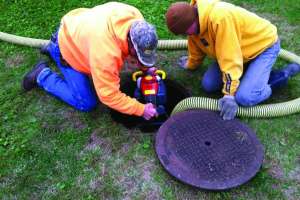
Removing all of the septic tank solids involves more than just pumping the tank. To start, the cleaning access cover or the tank cover must be removed to facilitate cleaning and to ensure that all solids have been pumped out. A septic tank cannot be cleaned adequately by pumping out liquids through a four- or six-inch inspection pipe. This improper practice often results in the scum layer plugging the outlet baffle when liquid again fills the tank. Removal of all sludge, scum and liquid must be done through the maintenance hole. Unless the cleaning access is open, it will be almost impossible to tell if all of the solids have been removed from the tank.
Mixing Makes It Easier
Be sure the effluent level in the tank is below the outlet piping so no solids are pushed out of the tank. Recognize that the vacuum will remove the water first and the important solids second. If the scum layer is hard, it may be necessary to agitate the tank with air, a mixer or a long-handled shovel through the cleaning access in order to break up the scum layer.
Mechanical mixing of the tank contents can make the removal of solids an easier and quicker job, and septic tank agitators are designed to do just that. Mechanical agitators are very helpful when tanks have more than one third full of sludge and scum and the solids are very thick. There are also devices designed to push the sludge off the bottom.
Flush Cleaning
Another method for removing and mixing the solids is back flushing. In this method, the tank is partially emptied and the septage is pushed back into the tank for further mixing and cleaning of the tank. This is a good way to allow for the removal of the solids when the tank is closer to 25% full. Care must be taken that the volume being put back into the tank is not more than the tank capacity as overfilling the tank puts solids in bad locations, like back into the structure or the soil treatment area.
Additional Tips
Note the presence of nonbiodegradable items in the tank like sanitary wipes, cigarette butts, toys, hygiene products or similar items.
It is not necessary to leave solids in the septic tank to “start” it again. Sufficient bacteria remain in the tank on the walls and bottom.
The use of fresh water can help deal with septic tanks that are overly full. This allows for more liquid in the tank. Fresh water can also be used to spray off effluent screens and dislodge other solids that may be attached to components resulting in a cleaner tank when the job is completed.
Beyond the tank
Leaving the property as you found it is a small but important step to minimize problems at the site. Making sure the power is on and the lids are all secure is a must. This is also a great time to check and pick up all the tools used at the job.
All systems need to be managed to operate properly. It is critical that all system owners understand that all properly operating systems will have a management aspect in order to serve as a long-term solution. Your service visit is a great opportunity to discuss the system with the owners or to leave behind educational materials. These activities are straightforward but necessary and time sensitive for systems to operate properly.
Continue reading for free