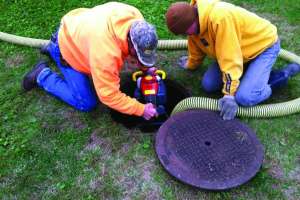
An approved installation crew putting in a SRLP system at a Michigan farmstead.

Anne Mitchell



An approved installation crew putting in a SRLP system at a Michigan farmstead.
Anne Mitchell
For many families, an order to repair or replace a failing septic system can present significant financial hardship. A program launched in Michigan in May 2024 has already helped 183 families in need by offering loans geared to income to help them engage local contractors to remain compliant.
Under the Septic Replacement Loan Program, the Michigan Department of Environment, Great Lakes and Energy has partnered with Michigan Saves, the nation’s first nonprofit green lender, to offer financing for the repair or replacement of documented failing, near-failing, nonexistent or inadequate septic systems. The Michigan legislature awarded $35 million to fund the program, which was inspired by the Washington Regional On-Site Sewage System Loan Program, also known as the Clean Water Loan Program, in the state of Washington.
With a background as a sanitarian at the health department of Michigan’s Ingham County, Anne Mitchell headed up an earlier grant program to fund the replacement of residential septic systems at the local level. She jumped at the chance to expand the concept statewide through EGLE as the septic program loan manager for SRLP.
Pumper: What is the overall state of residential septic systems in Michigan?
Mitchell: We estimate about a 25% failure rate. This number may be on the low end because it’s based on septic system failures currently known to and reported by local county health departments.
Pumper: How does the SP work to help homeowners afford septic system repairs and replacements?
Mitchell: If the system is failing and the homeowner can’t afford the required work, EGLE has contracted with a third-party, nonprofit green bank lender, Michigan Saves, which accepts loan applications. The loans are divided into two categories. Tier 1 loans involve income-based financing, and Tier 2 loans are market-based. The EGLE funding backs those loans and allows for lower interest rates on Tier 1 loans.
Pumper: Why was Michigan Saves selected as the loan provider?
Mitchell: We put out an RFP. Prior to this, they’ve worked primarily in energy efficiency projects such as solar, windows, heating and cooling, but they had not dipped their toe into the septic world. They already had the lending network in place and had already had the software built for the contractors to interface with, which made it an easier transition for all of us.
Pumper: How do you ensure that the system work that SRLP finances meets local standards?
Mitchell: We don’t have a statewide sanitary code. EGLE has developed a set of minimum standards for each installation, but the system must still meet local county codes. Once Michigan Saves approves the loan, I get brought into the project, and I get a copy of the permit, the design, the soil conditions and the site evaluation. If revisions appear to be needed, I work with the contractor or the local health department, and we make any necessary changes. When the permit is approved, we move forward with installation.
Pumper: All of the work must be completed by a Michigan Saves-authorized contractor. How does a contractor become authorized?
Mitchell: They have to attend either in-person or virtual training, which involves watching a program video. A list of requirements includes having liability insurance, having a business license and being in good standing with the state of Michigan’s Corporations Division. If their county certifies installers, that certification needs to be up to date. They also need to refresh their SRLP training once a year, either in person or by watching the video, which I anticipate will have some small changes.
Pumper: How did you engage contractors to join the program?
Mitchell: We really leaned on groups like the Michigan Septic Tank Association and the Michigan Onsite Wastewater Recycling Association. We also went to local health departments and asked them to supply us with a list of their certified installers — contractors that they trust, and they really work well with. In year one, we got a lot of contractors recruited, and as we start installation season two, we’ve seen a big influx of new contractors coming on board. We currently have 216 authorized contractors.
Pumper: Other than completing the work, what are the responsibilities of contractors?
Mitchell: The contractor is responsible for uploading all of the documentation that has to be reviewed and collected — not the homeowner. Initially, it can be a bit challenging. I always tell contractors, “The first two projects, you’re going to feel overwhelmed. But I’m here to support you.” All of them have said that after the second one, it’s easy.
Pumper: What if a homeowner wants to apply to SRLP, but their contractor isn’t already authorized by Michigan Saves?
Mitchell: The contractor can be certified in a couple of days, but if they have all of their paperwork and certificates of insurance ready to upload, they could complete the online training and be certified within a day.
Pumper: How does the program ensure that the contractor is paid for the work when a loan is approved?
Mitchell: The way that the program is structured, the contractor receives the money at the end of the job, not the homeowner. Once the local health department does a final inspection, it gets uploaded and looked at by me. When the contractor and the homeowner sign a certificate of completion, the payment is dispersed to the contractor within 24 to 48 hours.
Pumper: The program guide lists approved design manuals from specific manufacturers, including Eljen and Sludgehammer. How come?
Mitchell: Although it’s not required, we wanted advanced technology like what’s available from those manufacturers to be utilized in this program. We put out an invitation for submission to manufacturers to supply testing data, certification data and their design manuals. Once we approve their submission, they go up on our website as eligible for use within the loan program. For advanced treatment systems, we require that the system be designed by a third party.
Pumper: If the program pays the contractor, how does the homeowner pay the up-front costs of design and permitting?
Mitchell: For advanced systems that need to be designed by a third party, the homeowner needs to pay for that directly. If a homeowner says “I don’t have the money to cover my permit,” the contractor has the homeowner call the lender. On a case-by-case basis, they will do a preapproval for up to a certain dollar amount. The contractor can then lump the permitting costs into the loan, cover it up front and get reimbursed at the end.
Pumper: How would you assess the success of the SRLP?
Mitchell: I think it’s a great start. From just one installation season, we now have more than 21 million gallons of sewage a year that’s being properly treated before re-entering our waters, and I think that’s a win in itself.
For more information on the Septic Replacement Loan Program, visit the Department of Environment, Great Lakes and Energy website.
Continue reading for free