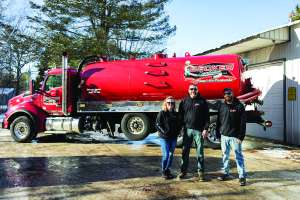

It was time for a change, and the septic business was calling their name. Now, James Bearden and his wife Brittany are co-owners of 24/7 Septic. In 2019, after Bearden left the Florida car sales business, they moved to Austin, Texas. The Beardens founded 24/7 Septic there, spending $10,000 to buy a well-worn pumper truck. The gamble paid off: Today, 24/7 Septic has a second outlet in Central Florida and is planning a third business in Denver, Colorado. The company has 12 employees in all, multiple trucks and is prospering.
Pumper talked to Bearden about those tough early days, how their willingness to work during COVID-19 boosted their business, and what they would have done differently if they knew then what they know now.
Pumper: How did you go from selling cars to working in septic?
Bearden: My wife’s family was in the septic business, and on my days off, I would go help them. I wanted to get out of the car business because we had a newborn daughter. After missing her first words and first steps because I was always away from home, I spoke to my wife about possibly starting our own septic business. So I worked with her family part time until we were able to start 24/7 Septic Solutions.
Pumper: So you moved to Texas and started the company in 2019. Is it accurate to say that you used every cent you had to start the company?
Bearden: Yes, we did. We used our whole savings to buy a 1998 Chevy 7500 with a 3,000-gallon tank on it. It wasn’t the prettiest thing, but it got us started. Still, the driver’s door didn’t open and the driver window didn’t roll down. So when I would pull up to customer’s houses, I had to get out the passenger side to greet them.
Pumper: Did you just pretend you had an invisible chauffeur?
Bearden (laughing): Yeah! Times were tough. We couldn’t afford to get the driver’s side door fixed.
Pumper: I understand that the COVID-19 pandemic was surprisingly good for your business. Why so?
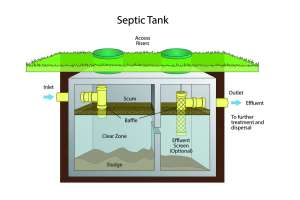
Bearden: When COVID was on, everybody was stuck at home. There were more people at home than usual using the toilet, so their septic tanks filled up sooner. And there was a shortage of toilet paper, so everybody was flushing wipes. This led to clogs in the inlet pipes and their filters, causing their septic tanks to start backing up into their houses.
Pumper: So COVID resulted in more business?
Bearden: Yes. We went from two or three pumpouts to seven to eight pumpouts a day, seven days a week. I ended up having to hire a driver. I had a friend that was looking for a job so he came to work for us. Then we bought our second truck in 2021 and started building the business from there.
Pumper: Did you get one with a working driver’s side door?
Bearden: Yes! It was actually a 1995 Mack that I paid $16,000 for, but it had a 4,000-gallon tank on it. The miles were unknown because the odometer had already rolled 1 million miles. Still, both trucks were some of the only pump trucks with heated valves on them during the 2021 freeze in Central Texas that year. This meant we were the only trucks capable of pumping at that time, which brought us more work.
Pumper: Obviously you were in the right place at the right time and you were able to provide service when others couldn’t. So how has 24/7 Septic grown since then?
Bearden: We do installs and pumpouts in Florida and Texas, with multiple trucks in each location. We are going to buy another truck for the new location.
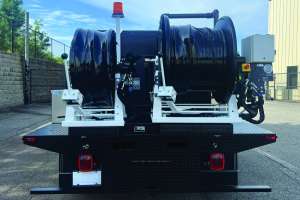
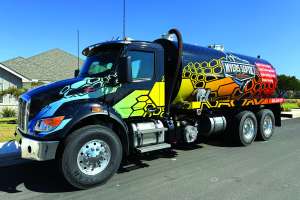
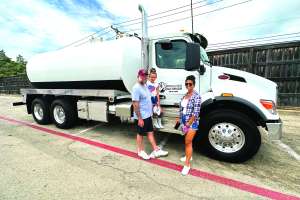
We have three 2025 Peterbilt 567s with 4,000-gallon tanks in Texas, and two 2024 548s with 4,200-gallon tanks and a 2006 Peterbilt 335 with a 4,000-gallon tank in Florida. We have used two different builders for our trucks. Iron-Vac for the Florida trucks and Vacuum Tanks Sales in Oklahoma for the rest.
Pumper: Is it true that, to open up in Florida, your wife went to that state to get certified in septic? And you have plans for another location in the near future?
Bearden: Yes, while I stayed in Texas and worked, she went to Florida, got her license and we opened that second location. We’re up to six employees and two install crews in Central Florida. As for the new location we’re opening, we’ll only be doing grease pumping, not septic.
Pumper: What are the challenges that you face, operating in multiple states?
Bearden: The septic systems are totally different between Texas and Florida. Texas requires digging into rock and installing a lot of aerobic systems here. Meanwhile, Florida has soft soil and uses gravity systems, nitrogen reduction and mound systems, which are much easier to manage.
The real struggle lies in finding good people. I know a lot of people in Florida, but not in Texas. So it’s hard for me to know who I’m hiring in Texas and trusting them with our pump trucks here. Our Florida location is mainly run by friends and family, which helps out a lot.
Pumper: With the septic business experience you’ve got now, is there any advice you’d give to yourself starting out?
Bearden: I would’ve advised myself to buy newer trucks rather than used. The two older trucks that I bought in the beginning have been a headache because when something happens, it’s not just small repairs. I had to put a whole new engine in the first truck that I bought. Other than that, I wish I would’ve known more about locating tanks because there’s a lot of rock to dig through in Texas. I would have jumped on the install side a little faster than I did, because it’s good for the business. But with all that, I wouldn’t change a thing because the struggles have sharpened us into the company we are today.
Continue reading for free