
Fred Luhn moved his family from New York to Alabama with plans to retire. The house he bought had a failing septic system.
He got to talking with the contractor who replaced it and soon had a job offer — driving a truck.
“I said, ‘What kind of truck?’” Luhn recalls. “He said, ‘Well, that one,’ and pointed to the septic truck. I said, ‘Are you crazy? I wore a suit and tie to work. You’ve got the wrong guy.’”
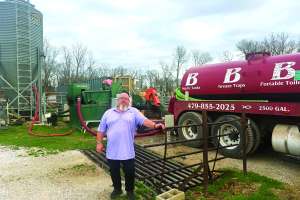
His wife, Jacqueline, had other ideas: “She was probably tired of me being home by then. She said, ‘Maybe you should try it and check it out.’” And today, Luhn owns Fred’s Environmental in Alexandria, Alabama, a rural town about an hour from Birmingham. He pumps tanks, repairs and installs systems, and does time-of-sale inspections.
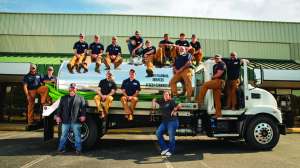
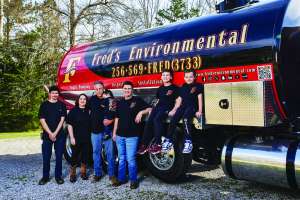
He runs the business with Jacqueline working the office, 16-year-old son Jayden helping on evenings and weekends, and 25-year-old nephew Michael Chaparro pitching in on weekdays.
Long transition

It took about 10 years for Luhn to evolve from team member to owner. In New York, he managed car dealerships, and his experience there prepared him well to run a service company: “If you can be successful in the car business, you can be successful at anything.”
He worked for the first septic pumper with a young helper, Trey Snyder. “I liked it,” Luhn says. “I got to play with an excavator, try this and do that. Within six months I was a driver.” After three years, that company folded. Not long afterward, Snyder started a plumbing business and hired Luhn to pump tanks.
Then in 2025, after Snyder sold his business, Luhn bought a vacuum truck and took off on his own venture. He already had his basic and advanced installer’s licenses and his pumper license. He started promoting through a Google service that charges per customer phone call. “As long as I could talk to somebody, I could close the sale,” he says.
One lesson he learned was to answer every phone call right away: “People have a list of four or five companies they’re going to call. If they call me and I don’t answer, by the time I call them back they’re already calling a competitor.”
Stepping up a notch
His service area includes a number of one-man, one-truck competitors and many customers with limited knowledge of their septic systems. “I can count on one hand in the last year the people who called me out just for pumping because it was due,” he says. “Usually, it’s ‘Oh my gosh, the toilet is overflowing.’ They wait until it’s backing up in the tub to call us.”

Many of those systems have been neglected for years; when pumping, Luhn also does a full system inspection, which often turns up issues that need attention: “I give the customer a copy of the invoice with everything checked off on the bottom, what’s good, what’s bad, what needs service right now and in the future.”
Accessing tanks isn’t easy. “Almost 90% of the tanks here are buried a foot or two deep in hard clay soil,” he says. He digs them up with a 2025 Bobcat E35 excavator with 24- and 36-inch buckets, an extended arm, a hydraulic thumb, an angle blade and an enclosed cab with touchscreen interface: “I bought the best E35 Bobcat makes, since it’s my only machine for now.
“I needed one machine that I could carry behind the pump truck and that was able to do an assortment of tasks: getting into backyards, uncovering tanks, setting concrete lids, performing exploratory digs to expose mainlines and header lines, and doing on-the-spot field line repairs. I can also install new septic systems with this machine.”
He and his helpers take pride in quality work. They pump both sides of two-compartment tanks, clear clogs between the house and tank if needed, install risers (TUF-TITE), and do exploratory digs in the drainfield.

“If we do an exploratory dig because the field is backing up, that’s an upcharge,” Luhn says. “But if the customer hires us to install a new tank or new lines, the cost of the dig is credited to the job. We charge them to diagnose the problem, but then we apply that to the solution.”
On new and replacement drainfields, they use mainly chambers (Infiltrator Water Technologies). For challenging sites they install Eljen geotextile sand filters. Some difficult-to-access sites call for plastic septic tanks (Infiltrator).
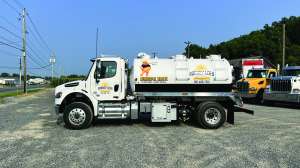
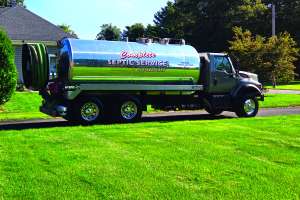
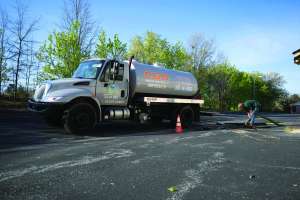
As for pumping, the Western Star truck’s 5,000-gallon waste tank comes in handy. “We get to more jobs without having to go to the dump so often,” Luhn says. “We dump mainly at the Gadsden and Piedmont wastewater treatment plants. They have different hours and are open on different days, so we need them both.”
Teamwork pays
Although he carries a small staff now, Luhn has clear ideas on how to motivate and compensate team members. “You can’t just pump and run all day long,” he says. “You have to sell work sometimes. If you want to make a lot of money, use commission-based pay. If you want people to run out the clock and not finish the job, pay them hourly.”
His helpers receive a set percentage commission based on the job profit. That includes commission for basic pumping as well as upsells: “They’re out there working hard, and they’re trying to upsell all the time.”
Luhn also learned some lessons from the car business, one of them being: The customer is not always right. He’ll back up his people when they have to deal with difficult customers. “Don’t spend your days trying to appease one customer at the expense of discounting your price or annoying your team members,” he advises.
“If you interviewed people properly when you hired them, if you trained them regularly and correctly, you have to trust what they say as if you were there yourself. I don’t second-guess my people. If I send a guy to do a job, it’s the same as me being there. If he tells me a customer is a problem, I believe him. We might agree not to service that customer anymore.”

He also recommends: “Don’t be afraid to work late if the business is late, or early if the business is early. Don’t be afraid to get wet if it’s raining. You work when there is business. We try to work around the customer’s schedule and not make the customer work around ours.”
Clean equipment is also a priority. “In the car business, your cars on the showroom floor represent your sales,” he says. “We keep the truck clean like I always kept the cars clean. It’s part of the drivers’ job to make sure our truck is clean every day. Hit it with the pressure washer. If it’s summertime, soap and water it down.”
Punctuality pays dividends. Drivers contact each customer ahead of scheduled arrival. We always text an hour beforehand with the driver’s picture to say we’re on the way,” Luhn says. “If they don’t reply, we follow up with a phone call. We always see in our online reviews that the communication was very good.”

Ambitious plans
As for the future, Luhn has considered expanding into plumbing, but he sees the septic business as more satisfying and with fewer headaches. “With septic pumping,” he says, “I go to their homes and they can’t use the bathroom, and when I leave, they can. They’re happy, I’m happy.
“I’d like to eventually see two or three trucks rolling all the time. I’d like to be able to focus more on installations and have my team members do the pumping. Then I could focus on pricing engineered systems and bigger jobs.”
Luhn calls the business “a family affair.” Jayden plans to pursue a business degree in college and then return to take over Fred’s Environmental. “I plan on passing it over to him because I’m 59 years old and I can’t keep doing this forever.”
Stepping away will also mean more time with Jacqueline and his other children: Samantha Luhn, age 2, who loves playing on the excavator; Nicholas Luhn, 11, a whiz at math and robotics; Joseph Luhn, 12, a saxophone player and horticulturist; and John Lombardi, 21, an IT specialist in the U.S. Navy.
All things considered, life is good.
Continue reading for free