


Name and title or job description: Wade Loggins, co-owner with brother Brandy Loggins
Business name and location: L&L Enterprises, Milner, Georgia
Services we offer: L&L specializes in concrete precasting, producing a range of products including concrete septic tanks (from 1,000 to 3,500 gallons) and grease traps. Additionally, we manufacture various related items such as distribution boxes in multiple sizes, manhole ring extensions, cattle troughs, water meter vaults and storm shelters. We proudly serve as the largest residential precaster in Georgia.
Age: 47
Years in the industry: We’ve been in business 26 years, but our experience in the industry goes back further. L&L was founded by my father Frank Loggins and myself in June 1998. Leveraging my father’s previous industry experience with various other companies, we established the business with a focus on pumping and installation before we transitioned to full-time concrete precasting around 2005. In 2011, Brandy and I acquired Bertram Septic Tank Service, which handles septic maintenance, pumping, installation and repairs. He manages Bertram’s while I oversee L&L. Both operations are based out of the same facility.
Association involvement: I’ve been a member of the Georgia Onsite Wastewater Association since its formation 22 years ago. Although I missed a year or two, I have been actively involved over the past year. I have served on the board of directors and currently hold the position of vice president.
Benefits of belonging to the association: Being part of the association provides me with a platform to voice my opinions and represent the concerns of my customers. I interact daily with installers who share their issues and feedback, which I can relay through the association. Additionally, it keeps me at the forefront of industry developments and regulatory changes, which is a significant advantage.
Biggest issue facing your association right now: One of our main challenges is strengthening membership.
Our crew includes: I currently have a team of five and am looking to expand further. Roy Swails, who has been with me for nine years, plays a crucial role in managing all scheduling, day-to-day operations and daily tank deliveries. Margaret Partain, our secretary, is also an integral part of our operations. She manages all administrative tasks, billing and bookkeeping for both companies.
Typical day on the job: I coordinate between different responsibilities throughout the day. I handle office work and administrative duties, manage regular tank deliveries and address maintenance issues that arise.
The job I’ll never forget: One memorable job involved a situation with concrete tanks at a customer’s property. After the customer pumped out both a tank and a pump tank, the high water table caused the tanks to float. To address this, we constructed two tanks with additional concrete extensions around them. We poured slabs and positioned the tanks within these slabs, ensuring the concrete extended two feet beyond the tanks. This design effectively secured the tanks and prevented them from floating.
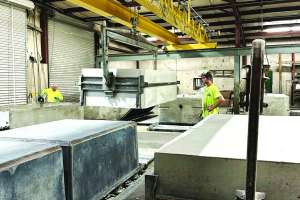
My favorite piece of equipment: We installed an overhead Shaw-Box crane in our shop in 2020. This 5-ton unit has significantly enhanced our operations. Previously, we relied on a boom truck, but the crane offers greater speed and smoother performance. It has revolutionized our tank production process, allowing us to work indoors regardless of weather conditions, which is crucial for maintaining our production schedules.
Most challenging site I’ve worked on: We were setting a 2,500-gallon tank at a dairy in Montezuma, Georgia, for Marler’s Plumbing and Septic. The excavation was particularly difficult due to the deep, sandy soil which caused the holes to collapse into large caverns. Because our trucks couldn’t access the site, Marler had to use an excavator for the tank installation. We frequently encounter difficulties with site access, including steep inclines, limited space and muddy conditions. On several occasions, we’ve needed assistance to get in and out of locations. And there have been instances where a crane was required to maneuver tanks over the top of a high-end residence to place the tank into position. We deliver tanks using tandem axle boom trucks with 20-foot beds from Del Zotto Products, Bethlehem Mfg. and Taylorsville Mfg.
The craziest question or comment from a customer: The most surprising comment we often hear from customers is, “Can’t you just drive over that?” This typically occurs on sites cluttered with building materials, piles of dirt, trees and rocks. It’s clear that driving over such obstacles is not feasible.
If I could change one industry regulation, it would be: I would advocate for a regulation requiring that all tanks in Georgia be equipped with access risers that extend to ground level.
Best piece of small business advice I’ve heard or came up with: Do what you say you’re going to do and follow through on your commitments.
If I wasn’t working in the wastewater industry, I would like to: I would pursue my interest in grading and landscaping. I have substantial experience in this area from previous years, although I haven’t been active in it over the past decade.
Crystal ball time – This is my outlook for the wastewater industry: I am optimistic about the future of the wastewater industry. We are witnessing significant advances and changes driven by a shift from traditional practices to innovative approaches. As many experienced professionals retire, newer generations with fresh perspectives are emerging. Over the past five years, the industry has evolved considerably and I am particularly excited about the potential growth in the pumping and repair sectors, especially given the increased demand since COVID. Historically, the wastewater industry was often undervalued compared to the HVAC and plumbing industries. However, there has been a notable shift in perception, with many professionals in the field becoming highly educated and skilled. I anticipate that over the next two decades, we will see continued advancements in technology, improved products and a growing recognition of our critical role in the trades.
Continue reading for free