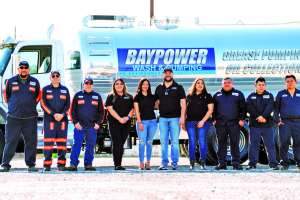
It turned out to be a good move. What started out as a commercial kitchen hood-cleaning business has diversified into also pumping out grease traps and collecting used cooking oil for recycling. The company employs 10 people, runs eight service trucks and generated about $2 million in revenue in 2023, he says.
“Losing that job actually ended up being a good thing,” says the 42-year-old entrepreneur. “It pushed me out of my comfort zone — forced me to move forward.
“It was a little daunting at first,” notes Marquez. “But I had a 1-year-old at home and bills to pay, so I had to make it work.
“There was no turning back.”
Shoe-leather marketing
Marquez first heard about power-washing through a co-worker at his old job who always raved about her husband’s successful power-washing business. After doing a little research, he decided he wanted to do something similar but different, and set his sights on cleaning commercial range hoods.
The business offered inherent advantages. The startup costs aren’t prohibitive. The industry is largely recessionproof. And many municipalities, as well as business-insurance companies, require regular hood cleanings to help prevent fires, which creates built-in demand for business, he says.
The bad news: A majority of commercial hood-cleaning companies fail within a year, he says.
“It’s a very volatile business,” Marquez says. “And it’s hard to retain staff because it requires working at night [when restaurants are closed] and working with grease, which smells really bad.”
Forging ahead, Marquez attended a Mobile Powerwash Boot Camp in Texas, hosted by Powerwash.com, which provides equipment and training for the industry. Then he hit the pavement and started making cold calls at restaurants, handing out business cards and developing quotes for service agreements for hood cleaning.
The initial response from cold calls was better than he expected.
“Turns out a lot of places needed the service,” he says.
Building a business
Nonetheless, it still took about two years to build a solid customer base.
“I did jobs myself with help from a laborer,” Marquez says. “I worked nights and made calls and developed quotes during the day.
“I didn’t get much sleep for about two years,” he adds. “It was hard. But I’m not a quitter and I saw that the business was growing.”
For equipment, Marquez started out with a Nissan NV 1500 service van and a skid-mounted DELUX RK40 hot-water pressure washer, featuring a General pump (4,000 psi at 2 gpm). Since then, the company also bought a DELUX CK40-C pressure washer and a DEWALT pressure washer.
Cleaning commercial hoods is a fairly straightforward process. After covering cooking equipment with plastic tarps to protect it, technicians apply a degreasing chemical. After waiting a few minutes for it to take effect, they use pressure washers to remove the built-up grease. Wastewater drains into a grease trap, he says.
“The grease buildup can be very slight or it might be up to a quarter of an inch thick,” Marquez explains. “We use different kinds of degreasers, depending on how thick the grease is.”
Technicians also must clean ductwork that connects a hood to a roof-mounted fan, which exhausts cooking fumes. The fan also must be cleaned, Marquez says.
“A typical job might take anywhere from two to four hours,” he says. “It’s just a few basic steps, but it’s a lot of hard work.”
Grease is the word
Marquez began to diversify the business in 2019 when he decided to start cleaning hood filters, which must be cleaned regularly, then decided to also pump out grease traps. Both services were logical bolt-on extensions of the company’s core offerings, he says.
Ironically enough, the move to pumping out grease traps was spurred by Marquez’s inability to find a contractor that could clean a grease trap in his own shop.
“I kept calling around and everyone was booked,” he recalls. “I had to wait two weeks – I just couldn’t believe it was that hard to find someone. Plus other customers kept asking us if we did grease traps.”
Today, grease traps account for about 25% of the company’s revenue and hood cleaning generates another 50%, he says.
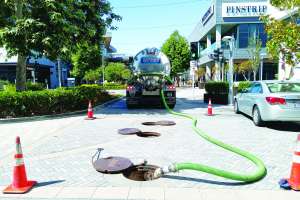
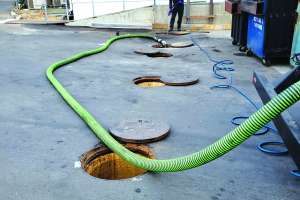
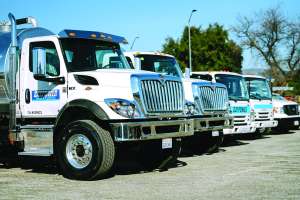
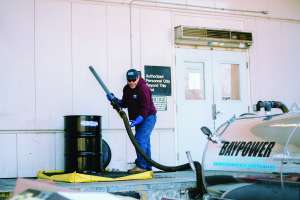
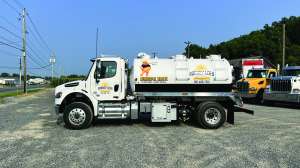
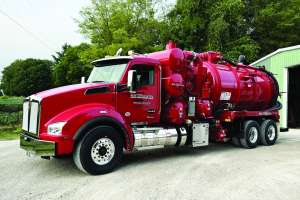
To clean large grease-interceptor traps, the business relies on two International trucks that feature 3,800-gallon aluminum debris tanks from Imperial Industries; and pumps from National Vacuum Equipment.
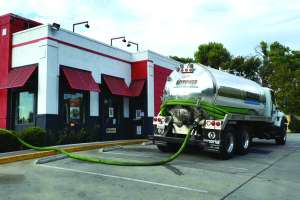
The business also dedicates an Isuzu NRR truck to cleaning smaller grease traps (40 to 100 gallons). It’s equipped with an 800-gallon aluminum waste tank from Imperial and a Masport pump.
The company also has invested in two-wheeled portable vacuum units that feature 55-gallon debris tanks.
An emerging market
Toward the end of 2021, the company entered yet another market, this time collecting used cooking oil for recycling. This service now generates about 25% of company revenue, Marquez says.
“Customers kept asking us to do it because they couldn’t get ahold of their contractor, plus I figured it was a good industry to get into,” he explains. “And all we had to do was pivot a little to pumping oil instead of grease, which actually is easier.
“It’s also easier to find workers,” Marquez adds.
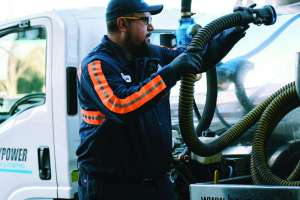
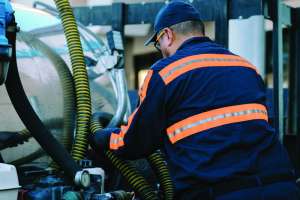
To collect used cooking oil, the company relies on two trucks: an Isuzu NRR truck equipped with a 950-gallon aluminum tank made by Imperial with a Masport pump; and a Ford F-550 featuring a 995-gallon aluminum tank from Davidson Tank and a Masport pump.
Offering all three services helps Marquez land more business, he says. His customers, primarily restaurants, like the one-stop-shopping aspect, he says. “I have some competitors that clean grease traps and collect used cooking oil, but no one else does all three,” he says.
More growth ahead
Looking back, Marquez says he’s proud of what he has accomplished, despite never earning a college degree (he took business classes for two years at a local community college) and starting a business from scratch in a new industry.
“It’s been a great business,” he says. “It keeps growing and it actually helps people by providing them with an essential service.
“When restaurant owners have an overflowing grease trap and we show up and fix the problem, we’re their heroes for the day,” Marquez says. “It’s a really great feeling.”
The business is somewhat a family affair, too, with Marquez’s father, Rogelio, helping out in the shop and his wife, Veronica, managing the office.
Looking ahead, Marquez expects geographic expansion and adding additional services on the pumping side of the business. But he wants controlled, manageable growth to ensure that customer service and work quality doesn’t suffer, he says.
“We want to keep growing,” he notes. “But I don’t want to grow so big that it takes us three or four days to get back to our customers.
“You see it all the time, where companies grow quickly and customer service suffers,” he continues. “I don’t ever want to get to that point. I want to be able to maintain our original vision and ethics.”