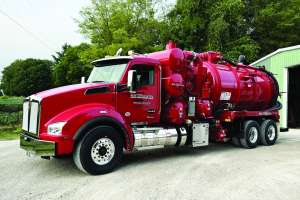

Chris Musack went to culinary school and became a chef, working in the restaurant industry before realizing that he wanted to work in a less chaotic environment. He is now president of American Grease and Septic of Evansville, Indiana, a company offering pumping and collection of grease and cooking oil, nonhazardous industrial pumping and portable restroom rentals and service in southern Indiana and western Kentucky.
The company employs 10 people and operates seven pump trucks. Musack believes that being able to speak the languages of both the restaurant and pumping industries has helped him to tailor services to meet the needs of food-service clients.
Pumper: What attracted you to the hospitality industry?
Musack: Ever since I was a kid, I really loved cooking. I had seen a lot of the Food Network shows growing up and aspired to be a chef. Sullivan University in Louisville, Kentucky was renowned for its culinary program and that was the start of my culinary path.
Pumper: Why did you shift careers?
Musack: I worked at smaller kitchens in local bistros in Louisville, but I always held multiple jobs. I worked my way up to an executive chef position at a country club where it was normal to put in 16-hour days. I realized that if I wanted to have a family and pay attention to them, I wouldn’t be able to do that in the restaurant industry.
Pumper: How did you get into the oil and grease collection business?
Musack: A friend from Sullivan University was operating a turnkey fryer filter business in the Louisville area and he began to expand into collection of oil and grease. I joined the company in 2016 to develop a satellite territory around Evansville and Owensboro, Indiana. In 2018, his company sold several of its routes to American Grease and Septic and they made a really good offer for me to join them as well.
Pumper: There’s still some confusion about the grades of grease you collect, can you elaborate?
Musack: There are common misconceptions, even in our industry. There are basically two kinds. Yellow grease is grease that goes directly into a containment bin. It can include up to 40% contaminants and water, typically from boiling out the fryers and throwing that in the bin. We need to process this grease further for buyers to pay top dollar.
Brown grease winds up in the grease trap and it’s heavily tainted by water used in cleaning. It’s typically 3 to 10% grease and it must be heavily filtered before it can be sold.
Pumper: How much control do companies that generate the grease have over the quality of the product?
Musack: Oxygen degrades the oils and can cause it to become rancid over time, especially in deep fat fryers sitting open to the air. It changes the flavor profile and makes the color of the cooked food darker, even when it may be undercooked. We encourage our customers to close the lids on their fryers at the end of each day.
Pumper: Your company offers “ethical and responsible” collection of grease. What does that mean to customers?
Musack: In many cases grease traps are pumped when the owner isn’t present, so there’s no verification of service. Some contractors vacuum from the bottom and discharge grease back into the trap. Although levels are lower, the grease layer thickens. When we encounter this, we call it “flagpoling” — we can stick our stinger into the trap and it’ll stand straight up in the thick layer of fat. Regulations in our county require us to do a full evacuation and we believe that’s the way to go.
Pumper: What do you do with the yellow grease you collect?
Musack: We sell it to buyers who want to use it in other applications. Most of it goes into making renewable fuels like biodiesel, but it’s also used in industrial applications, other food uses and animal feed.
Pumper: How does the price of brown grease compare to yellow grease?
Musack: According to The Jacobsen index, which we use to determine commodity prices, brown grease roughly tracks at about half of the value of yellow grease.
Pumper: How does your grease and oil “bundle and save” program work?
Musack: A lot of the big companies that take yellow grease have since gone out of the grease trap business. We offer both in one package and customers get back a rebate based on the value of the yellow grease at that time.
Pumper: You install oil pumping systems at no cost for some clients?
Musack: For high-volume accounts, the installation and equipment for integrated used cooking oil systems can be financed by the oil rebate they would otherwise receive. Many systems include a fryer filter machine and a pump that conveys oil through black iron plumbing into 200-gallon vertical tanks. We then have our own port to evacuate the tanks.
Pumper: How does your background in the food-service industry help you relate to customers?
Musack: A lot of people sell on the premise that this service is top-of-mind for the customer. I know that’s not true — it’s a necessary evil. We tell them we’ll stay in the background so that they can continue to provide good food service. I sell on the premise that we’re going to keep you compliant. All the communications are going to come through automatically. Here’s the service checklist and before and after photos, if you want to check it at your leisure.
Pumper: What are your near-term plans for the business?
Musack: We’re currently permitting and building our own pretreatment plant to extract the grease from our brown grease stream. That gives us the capability of pretreating our own wastewater and removing the solids which can go to landfill or be land-applied as fertilizer. It also increases the value of the concentrated brown grease. It’s not something we would bank our business on, but we see increasing the value of brown grease as icing on the cake. We also have plans to expand to an additional location in Indiana.
Pumper: What is your message for people who are considering this segment of the pumping industry?
Musack: I started in this field to build a better life for myself. But I’ve found that this business is an important part of the infrastructure of our country in terms of recycling and the supply of renewable sources of energy. By pumping grease the best way I know how in our corner of the Midwest, we’re helping the nation to better utilize its resources and lower our carbon footprint.
Continue reading for free