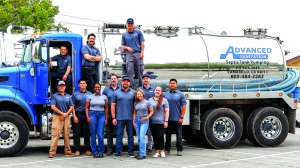
Technicians collect septic samples for analysis.


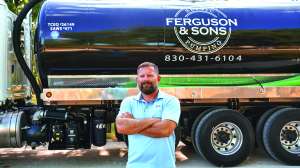
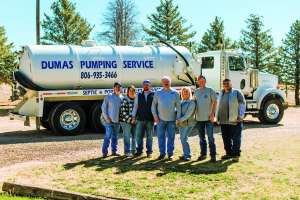
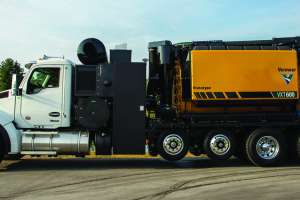
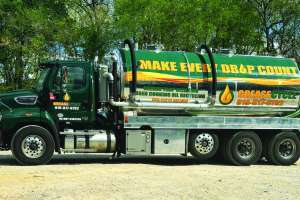
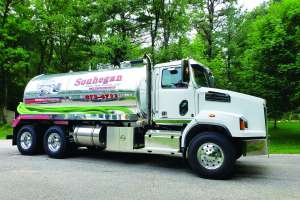
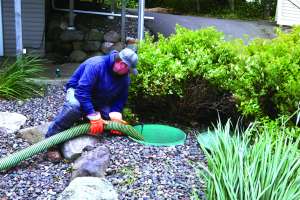
A technician pumps a septic tank.


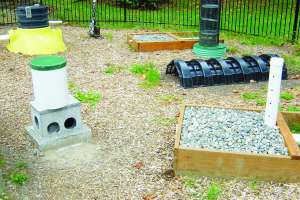
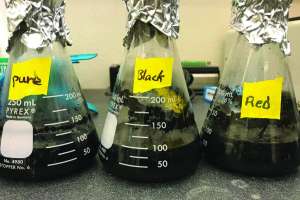
Biochar research evaluates treatment of various samples.

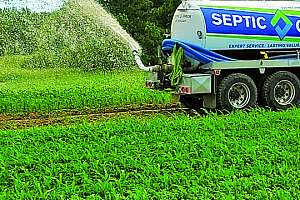
Typical land application of septage where the practice is still allowed.


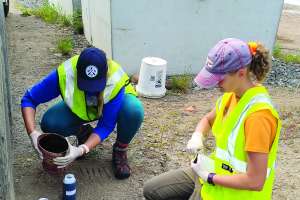
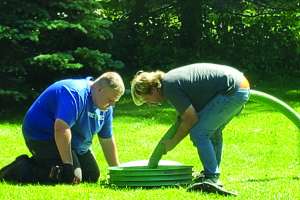
Technicians collect septic samples for analysis.
A technician pumps a septic tank.
Biochar research evaluates treatment of various samples.
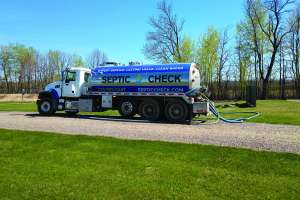
Typical land application of septage where the practice is still allowed.
Globally, 2.7 billion people rely upon septic systems to treat their wastewater, and septage handling and treatment is an important growing issue. Improperly treated septage can contaminate ground or surface water, and therefore the septage has historically been taken to a wastewater treatment plant or land-applied to fields to provide nutrients for crop production.
Some WWTPs do not accept septage due to a lack of capacity, unknown characteristics and load variability. The typical data referenced in the Domestic Septage Regulatory Guidance regarding septage characteristics is from the 1980s and 1990s. Since this time, septage characteristics have changed due to increased maintenance frequencies, increased tank capacity and household practices. More current data is needed about levels of varying contaminants and nutrients.
In a 2022 study from North Carolina, heavy metal concentrations were substantially lower than the concentrations referenced by the U.S. Environmental Protection Agency. The North Carolina study also found that the layers in a septic tank can contain varying amounts of contaminants and should be mixed prior to determining appropriate application rates, which is not commonly discussed in current guidance documents.
In some parts of the U.S., governments and private businesses are considering building septage treatment facilities. For instance, in the Flathead Valley of Montana, a facility is being constructed to serve the 40,000 and growing number of septic systems needing routine cleaning.
Nationally, land application of septage faces increasing scrutiny due to many factors including public perception. The amount of septage produced each year is increasing, and the number of options for proper treatment is decreasing. As an industry, we need to be aware of new methods to treat septage in a safe and effective manner to limit environmental impact and recover nutrients and even energy.
Biochar is a carbon-rich solid made from organic waste material or available biomass that is combusted in the presence of limited oxygen. The thermal process is called pyrolysis, which creates effective treatment media that is highly porous and has a high surface area. Biochar has been identified as a media amendment to improve nutrient removal from wastewater.
Constructed wetlands can be an effective wastewater treatment system with the advantages of low cost, simple operation and maintenance, although long-term nutrient removal can be challenging. A recent research project evaluated treatment of septage in a CW with pure sand media and sand amended with biochar focusing on nutrient removal and plant growth.
The nitrogen removal efficiencies ranged from 63% to 87%. The sand amended with biochar had significantly lower concentration as the physical chemical properties of the biochar facilitated microbial processes and adsorption. Strong positive correlations were observed between biochar content in the media and nitrogen removal rates. The phosphorus removal was not found to be enhanced by the addition of biochar.
In typical treatment of septage with anaerobic digestion, it is retained for 15 to 30 days in an enclosed vessel to achieve biological reduction of organic solids. Historically, AD has not been used except for co-treatment with sewage sludge. However, one advantage is that anaerobic digestion generates methane gas, which can be used for digester heating or other purposes. AD is widely recognized as an environmentally friendly option to treat highly organic and biodegradable industrial wastes like dairy effluents.
One recent study evaluated the treatment of mixed cheese whey and septage. The mixing of these two sources has the benefits of buffering capacity, balanced carbon to nitrogen ratio and supplying other essential nutrients. The application of anaerobic methods for treating wastewater effluents is not only energy conserving, but also helps in the generation of energy in the form of biogas. The research found that keeping the whey fraction less than half of the total substrate mixture optimal for improving methane yield and biodegradability.
Composting is a biological process which converts organic wastes into stable end products like humus (can be used as soil conditioner or fertilizer) and carbon dioxide. Since septage has a low carbon to nitrogen ratio, it needs to be co-composted with complementary wastes. Liquid septage or septage solids are mixed with a bulking agent (e.g., wood chips, sawdust) and aerated mechanically or by turning.
Biological activity generates temperatures that are sufficiently high to destroy pathogens. The composting process converts septage into a stable, humus material that can be used as a soil amendment. This process tends to create odors that can be a problem if not handled properly and active aeration has been found to be helpful.
Septage, unless land-applied, has typically been treated through traditional WWTP. Other options can be used to close the loop on decentralized wastewater treatment. Biochar can potentially be used to reduce the load into the WWTP, anaerobic digestion — when mixed with other sources — can produce energy, and composting of septage can produce a valuable soil amendment. Work needs to be done to further develop these and other options to treat septage.
Continue reading for free