While they face business hurdles on a daily basis, the couple is rewarded beyond measure by the customer relationships built during the 25 years they’ve owned the company. They and their business have become indelibly woven into the fabric of the community they call home.
“This is much more than just a business for us — it’s very personal,” says Stephanie Purcell, 56. “It’s all about building relationships and taking care of our people, who are much more than just our customers. We find it very gratifying to provide essential services. We take a lot of pride in that.”
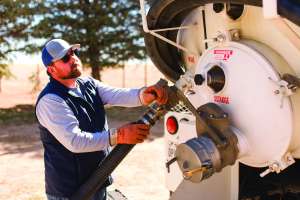
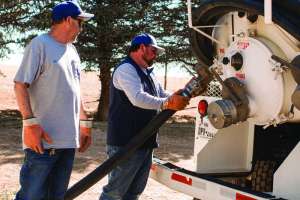
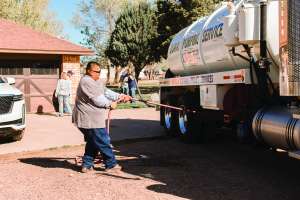
Stephanie also is an outlier in the industry, a woman who loves to ride along on septic pumping routes with Ray — and pull hoses and get her boots dirty.
“Ray and I love to work,” she says. “I love working outside.”
CAREER CHANGES
The Purcells never planned on running a septic and portable sanitation business. But in 1998, they heard that the company — established in 1979 — was for sale. Stephanie says Ray, who was working at a refinery at the time, convinced her that buying it would be a good move.
“Ray didn’t want to work at the refinery for the rest of his life,” says Stephanie, who was an elementary school teacher when they purchased the company. “And his grandfather installed septic systems, so Ray knew a little bit about the business.
“When he said we should buy this company, I said, ‘You’ve got to be kidding!’ We’ve done a lot of different jobs, but I never in a million years we’d be dealing with peoples’ waste. But here we are.”
About five years later, Ray quit his job at the refinery and started running Dumas Pumping full-time. A year or so later, they bought a portable restroom business, a perfect “bolt-on” complementary service.
A couple of years later, Stephanie quit her job to handle phones and office duties and run a pump truck route. At about the same time, their son, Jason, who was taking some college classes while working at a refinery, quit to work with his father. And the business became a complete family affair when Jason’s wife, Natalie, came on board.
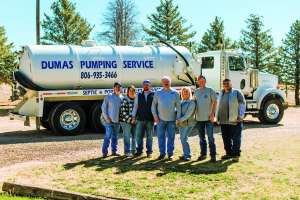
Today, Jason is a shop foreman and also runs a vacuum truck and jetter truck, Ray runs a septic truck and Stephanie rides along as his helper, and Natalie manages the office.
“She’s the best office manager in the world and also my best friend,” Stephanie says.
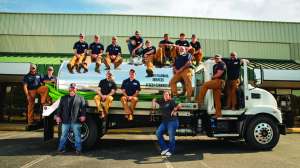
The company also relies heavily on Jeff Gadbois, lead portable restroom technician; Cody Watson, a portable restroom technician; and Ralph Gutierrez, who handles truck maintenance and also assists wherever he’s needed, she says.
“Everybody works really well together and does whatever is required to help each other out,” Stephanie says. “We’re like family — they’re more than just employees to us. We wouldn’t be able to do all this without them.”
DIVERSIFY AND GROW
Business started out slow. There were times when the Purcells wondered if they’d make enough money to make the monthly payment on the bank loan they took out to buy the business.
Adding the restroom business made a difference.
“Diversification was always in the back of my mind when we first started out,” says Ray, 58. “To make something really work, you have to diversify. The portable restroom business brought in more income, and then when we saw needs in different areas, we decided to go for them — get into as many things as a small company could handle.”
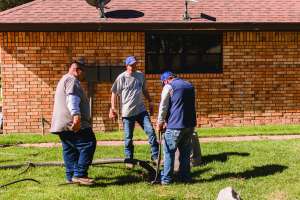
One of those services was mainline municipal sewer cleaning, which eventually turned into a service for a wide range of customers including dairy production facilities, refineries, hospitals, hotels, prisons and truck stops, Ray says.
Septic pumping currently generates about 60% of the company’s gross revenue, followed by portable restrooms and waterjetting services at 20% each. Within the restroom business, monthly rentals contribute about 70% of the revenue while special events chip in the balance, he says.
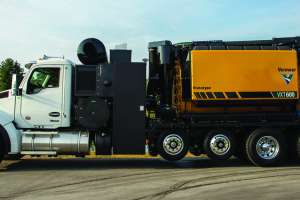
The company also uses septic vacuum trucks to provide municipal wastewater services, such as pumping out sludge from digesters, lift stations, separators and so forth.
A GROWING FLEET
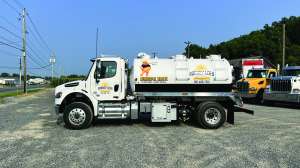
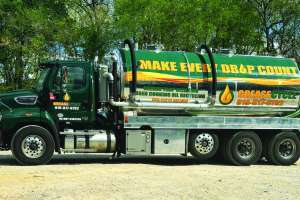
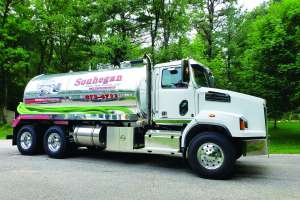
As the company grew, so did its fleet of equipment. To pump septic tanks, the company owns two trucks: a 2006 Mack Granite and a 2008 Western Star 4900. Each one is equipped with a 4,200-gallon steel tank (4,000-gallons waste/200-gallons freshwater for washdown use) built by Lely Tank & Waste Solutions (now owned by American Tank) and a Fruitland pump.
The big tanks are a necessity for route drivers who might drive 1 1/2 hours, for example, to clean three septic tanks at three different homes located on a large ranch, Stephanie explains. “We want to be as efficient and cost-effective as possible,” she says.
In addition, the company owns about 600 restrooms and 60 hand-wash stations, mostly from Satellite Industries. To service restrooms, Dumas relies on a 2019 Ford F-550 with an 800-gallon waste/400-gallon freshwater steel tank from Lely and a 2022 Ford F-600 with an 800-gallon waste/400-gallon freshwater aluminum tank from Keevac Industries. Both trucks feature Masport pumps.
Most of the company’s trucks are equipped with a washdown system powered by Burks DC10 pumps (Armstrong Equipment, Inc.), and hose reels from Reelcraft Industries.
The company also owns five aluminum trailers from Satellite that hold two restrooms and one hand-wash unit each; they’re used mostly by road crews to efficiently move restrooms to where they’re needed. Dumas also owns two delivery trailers from Liquid Waste Industries that hold 10 restrooms each.
To clean sewer lines, the company relies on a custom-made water jetter, fabricated in-house and mounted on a 2008 Sterling chassis. It features a water pump from NLB Corp. (up to 4,000 psi at 95 gpm); 700 feet of 1/2-inch-diameter jetter hose and 1,000 feet of 1-inch hose; and a 3,300-gallon water tank from Norwesco.
To examine drainlines, the company invested in a pipeline-inspection camera from RST (now Subsite Electronics). The business also owns roughly 40 210-gallon holding tanks from Kentucky Tank used for temporary trailer offices at construction sites.
KEYS TO SUCCESS
Stephanie cites honesty and compassion for customers as keys to the company’s growth and longevity.
“It all goes back to taking care of our people and solving their problems,” she says. “Sometimes we help people even if we’re not going to work for them.”
As an example, she mentions a widow who called because she thought her septic tank needed pumping. But instead, the problem turned out to be a clogged line, which a technician cleared for free.
Stephanie concedes that it’s not a good business model to provide services for free.
“But it all goes back to having integrity and just being good human beings,” she says.
The company also strives to be as efficient and proactive about challenges as possible. For example, due to supply-chain disruptions, the company stocks more spare parts and other items.
“When you have a breakdown in rural communities, chances are you won’t find parts where you’re at,” Stephanie says. “Now there are things we have to keep more of on hand than ever before to stay on top of things — items like tires, parts, motor oil and portable restroom supplies.”
SLOW, STEADY
Looking ahead, Ray expects limited growth. It’s not that the business environment is bad, it’s just that good workers are hard to find, which hampers expansion. “We could seriously grow more if we could find diligent people,” he notes.
While reflecting on the company’s success, Ray says he’s a little bit surprised at how much the company has grown during the last 25 years.
“But it just goes to show if you put forth a lot of effort and buy good, productive equipment that will help you expand, you’ll actually grow,” he says. “More equipment helps you do more and eventually the word gets out.”
When the Purcells retire, they expect Jason and Natalie to take the reins.
“They’re both great,” he says. “They’ve been with us since the get-go, so they know the business inside and out. The company will be in very good hands.”