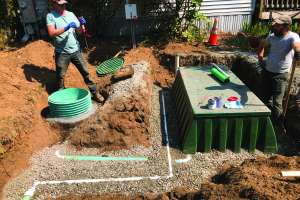
The Goose Creek Rest Area in Harris, Minnesota, was one of the locations where septage was tested.

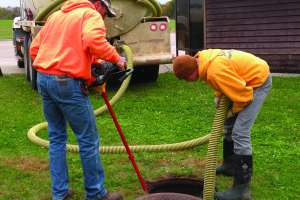
Unidentified septic service workers use a Crust Buster tank agitator during a pumpout at a Minnesota rest stop.



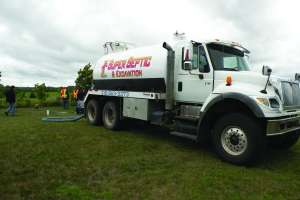
The Goose Creek Rest Area in Harris, Minnesota, was one of the locations where septage was tested.
Unidentified septic service workers use a Crust Buster tank agitator during a pumpout at a Minnesota rest stop.
A new study from the University of Minnesota evaluated 25 highway rest areas as their septic tanks were being maintained during a normal maintenance visit. The water use at rest areas and travel information centers is known to vary from typical residential usage, since it is produced almost entirely by toilet-flushing and hand-washing.
Flow estimates for most of these systems was based on a study conducted by the Minnesota Department of Transportation, which collected data at rest areas for design of water supply and sewage treatment. They found on average that with water-conserving devices people used 2.8 gallons, while devices that do not conserve water used 4.5 gallons. Since that study was done, all the rest areas plumbing fixtures have been upgraded to utilize low- or ultra-low-flow toilets.
Little research exists regarding the characteristics of the septage removed from septic tanks that are predominant source is toilet flushing. This septage would be like other facilities that commonly lack graywater, including businesses, churches, office buildings, convenience stores, etc. The goal was to determine if or how this septage is different from domestic septage.
The usage in gallons per day varied dramatically across the sites with daily flows ranging from 400 to over 8,000 gallons. The septic tank capacity also varied from site to site with the minimum capacity of 3,800 and the maximum at 18,000 gallons. Most of the systems are below-grade trench or bed systems although a few sites have mound systems. A few of the newer systems included pretreatment with an aerobic treatment unit or textile filter for reduction in organics and nitrogen.
Biochemical oxygen demand, chemical oxygen demand, phosphorus, total Kjeldahl nitrogen, ammonia, and total suspended solids concentrations and pH values were measured from septage samples taken from the septic tanks at 25 sites. Arsenic, cadmium, chromium, copper, lead, molybdenum, nickel, oil and grease, selenium, mercury and zinc concentrations were measured at half of these sites and mercury concentrations at 13. Furthermore, samples from five sites were tested for a selection of per- and polyuoroalkyl substances.
When available, measurements of scum and sludge depth, total septage volume in the tank at the time of sampling, and qualitative observations are also provided. Our report details the methods used to collect and analyze septage samples and provides a summary of the data.
The results in this study were compared to the range of septage characteristics from the U.S. Environmental Protection Agency reference document: EPA Guide to Septage Treatment and Disposal from 1994. The mean value was the center value of all the data and the max value was the maximum at all sites.
Information collected about solids accumulation and tank conditions suggests that, in systems with multiple septic tanks in series, the first tank needed pumping every six months to one year. But if the system was regularly maintained, the second tank did not always need pumping. When the system had gone more than one year, it was common that all the septic tanks needed maintenance.
In general, there were no concerning or unexpected differences between the septage from these service visits. This useful information should assure those land-applying septage or taking it to a wastewater treatment plant that septage from facilities where the primary use is toilet-flushing are not significantly different in terms of waste strength.
For a full copy of the report see septic.umn.edu/research
Continue reading for free