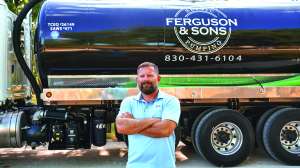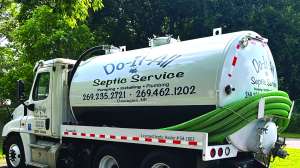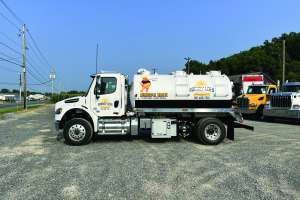

When a business is hampered by scarce labor, efficiency takes on an even greater importance. That’s why Ray Purcell — co-owner of Dumas Pumping Service in Dumas, Texas — customizes his septic service trucks with features both big and small to maximize productivity.
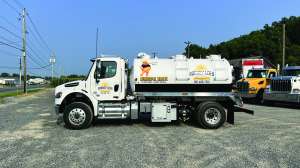
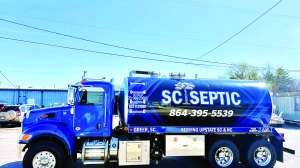
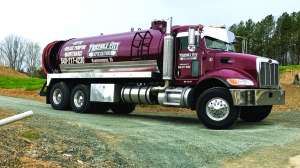
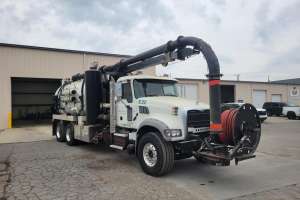
For starters, each of his two trucks — a 2006 Mack Granite and a 2008 Western Star 4900 — carry a 4,200-gallon steel tank (4,000-gallons waste, 200-gallons freshwater for washdown use) built by Lely Tank & Waste Solutions (now owned by American Tank).
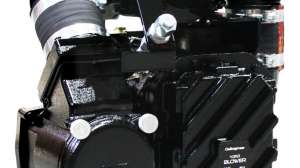
Purcell also had them equipped with twin 500 Series vacuum pumps (500 cfm) from Fruitland Manufacturing. “That helps us load a lot faster,” says Purcell, who owns the business with his wife, Stephanie. “We can pull 23 to 24 inches of vacuum with twin pumps.
“With these pumps, we can use 6-inch diameter suction and discharge lines instead of 3-inch lines. When we’re dealing with wastewater (at a treatment plant), that’s a big help because you have to load and unload as quickly as you can to keep up with the amount of liquid coming at you.”
This also minimizes downtime for the customer. In many cases, for example, a Dumas crew might have to work around the clock to vacuum out a digester or a separator to get wastewater to a manageable level where repairs can be made, he says.
To illustrate the productivity advantage, Purcell says that with the twin pumps and a 6-inch hose, he can load one of his septic trucks in three to four minutes and unload in under two minutes when working at a 10- to 12-foot depth. With a single pump and a 3-inch hose, the same job might take about 20 minutes to load and 15 minutes to unload.
“It saves us a lot of time and that lets us get to other jobs faster,” he says.
The trucks also are equipped with tinted windows to help keep the interior cooler during blazing-hot Texas summers and air-ride seats for both the driver and the passenger, which boosts comfort and reduces fatigue.
“Minimizing fatigue is important because on some ranches, and farms, we have to drag hoses 300 to 400 feet,” he says.
Purcell also specced a rear-mounted control box.
“For safety reasons, I wanted it where an operator can stand at the back of the trucks on the driver’s side and operate all the systems,” he says. “Plus the operator doesn’t have to run back and forth to the cab for this and that, which reduces fatigue.”
Continue reading for free