Any owner of a septic business, especially a full-service one, knows there is a lot on their plate. There are countless projects and administrative tasks keeping any leader in the industry up at night.
Like many business owners, they may be looking to expand, which could mean taking on new territory, more equipment, more employees and more clients. But what most fail to realize is that they are taking on too much at a time. No one has infinite capacity to do everything. Not even entire organizations. The key is figuring out which things are truly the most important to work on.
The idea of growing may seem like an easy path to more profit. Think of a pumping business owner who wants to take on more advanced septic system installations along with pumping services. They can charge more and obtain new clients, and everything is looking good. Now they have the money to buy that new excavator, a new pumping truck, redesign the website, hire a salesperson, hire an admin and send employees to training courses. The list goes on and on, and they all seem like good ideas.
Busy work
The problem is that by taking on too much, you actually impede your own progress. Our brains become inundated with everything that has to get done. Then inertia settles in, and the thing you wanted to accomplish doesn’t happen at all.
When everything feels overwhelming, it is clear that something needs to give and your work needs to be prioritized, which is easier said than done. Many business leaders feel everything is a priority. However, if everything is a priority, nothing is. It becomes difficult, if not impossible, to gain momentum on any project or initiative because it is constantly slowed down by everything else competing for your attention.
In fact, most people can only focus on a few items at a time. In my own experience people who say they are great multitaskers are almost always mistaken. I find there is often a psychological reason why people like to be inundated with work. Doing many things at once makes you feel busy, and it can make the business appear to be making progress. Unfortunately, being busy is not the same as progress. The key is to focus on the critical few things that truly need to get done.
A simple way to prioritize
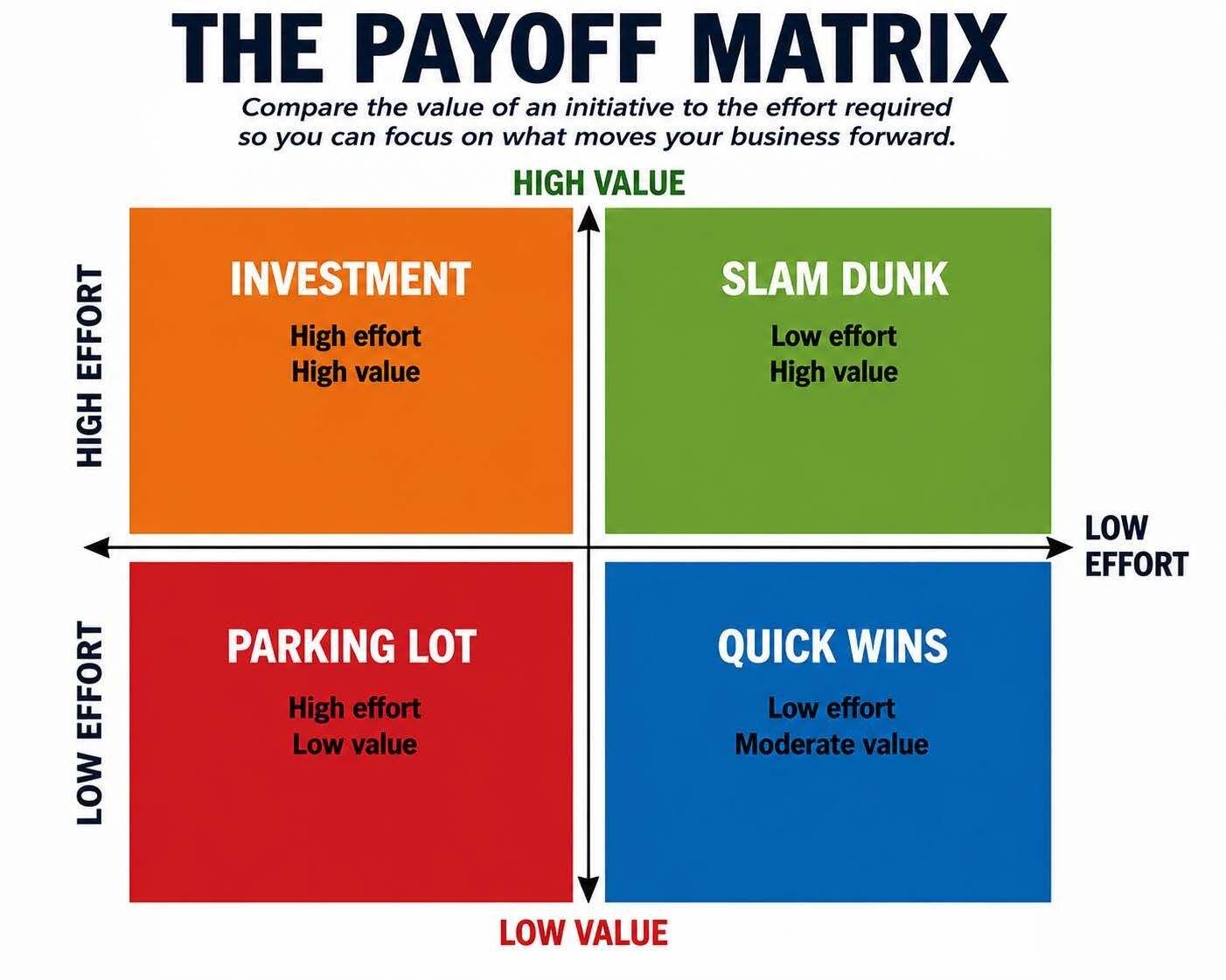
One tool I have used within various businesses is the payoff matrix. It is a four-square grid where you can place the various activities, projects or initiatives that you are either planning or are currently working on. Each quadrant is broken down into the definitions below:
Parking Lot: High effort with little benefit
Investment: High effort with high long-term benefit
Quick Wins: Low effort with moderate benefit
Slam Dunk: Low effort with high benefit. These are the projects you should prioritize.
These quadrants help provide a visual representation of how each project/initiative should be prioritized relative to each other. First you’ll want to list all of the projects and activities that you or your business are currently working on. Then place each in its respective quadrant.
Take note if one quadrant has significantly more projects than the others and determine whether they should be rebalanced. Most of the time, you should have quite a few items in the Parking Lot and Investment quadrants, while only a handful should be in the Quick Wins and Slam Dunk quadrants.
When people see things laid out like this, they gain a much better understanding of how everything relates to one another. More importantly, they see how many activities they are trying to take on. It is one thing to think about a single project, but when it is placed alongside every other initiative, it quickly becomes obvious how overwhelming the workload really is.
The idea is not to overwhelm you, but rather the opposite. By forcing yourself to evaluate each project based on its value relative to its effort, you naturally begin justifying why that project should or should not move forward. Once you see all of the projects laid out, you realize that neither you nor your team has the capacity to do everything.
Consider how much effort each project will require. As you do, you will find more activities that belong in the parking lot. In fact, I would suggest that quite a few projects should end up there once you honestly consider your team’s capacity.
Ask for help
You do not even need to have a specific number of projects in mind. Ask your team how much availability they realistically have and make an honest estimate of what they can accomplish. Stretch them, but do not overwhelm them.
It is also important to get your team’s input so it does not appear that you are making all of the decisions for them. Otherwise, resentment can build and projects may be delayed or never completed. Not only will you gain different perspectives, but everyone will understand why certain projects move forward while others do not.
Remember, this is not a scientific exercise. It is simply a tool to help evaluate all tasks and projects in your business based on benefit versus effort. It helps justify why a project should or should not move forward. Once people see everything laid out, it becomes much easier to decide what not to do.
By using a simple approach like this, you will reduce the number of initiatives competing for your attention and focus your time on the projects that will move your business forward the most.
About the author: Kevin is the founder of Optima Workflow Consulting LLC and has over 10 years of professional experience helping businesses improve their operations. He brings his knowledge from the military, construction, manufacturing, logistics, project management, business advising and consulting to help clients solve their greatest operational challenges. If you have questions or want to connect, he can be reached at ksaboori@optimaworkflow.com.
Continue reading for free