
During regular service of the septic tanks in our onsite wastewater treatment systems, the soil treatment area is often ignored. There is a great opportunity to evaluate and service this component and this type of service work will extend the life of the system.
The first operational and management step in the STA is to determine the type of distribution. Once you have this information, you can evaluate, service and recommend further actions to the property owners.
With all treatment areas, it is best to check each lateral or section of the system. Inspection ports within the STA provide a location to measure the amount of effluent ponding in a system. These ports should be installed into the distribution media/soil interface.
An evaluation of the extent and depth of ponding can provide some indication about how much of the system is being utilized at the time and may also be a function of seasonal ground wetness. To determine the percentage of system in use, the number of lines and the amount of available storage in the distribution media is needed.
Be sure to check if the inspection ports or clean-outs have been damaged and note any evidence of vehicular traffic or other heavy loads over the STA. If ports or clean-outs for evaluation and service are not available, recommend that they be located or installed to facilitate better management of the system.
Gravity systems
If the effluent flows by gravity to the STA location, a distribution box or dropbox and inspection ports are needed to properly assess the system. Unfortunately, many gravity systems are lacking these devices or lacking access to the devices. If not accessible from grade, the recommended further action is locating and providing the ability to maintain these components. Often these components are not identified until a problem exists, which has resulted in uneven distribution for an extended period of time.
Parallel distribution
This design commonly employs a distribution box with the assumption that effluent is split uniformly and concurrently among all lines. A parallel trench configuration is designed to load multiple trenches at the same rate provided the outlet pipes are at the same elevation and the distribution box itself is level. Flow control devices, which are adjustable weirs, are placed in discharge pipes to control flow to individual trenches or improve uniform distribution among individual trenches.
Over time, distribution can settle and shift resulting in uneven distribution. Additionally, solids and other debris can accumulate in the box, which can impede even flow to each lateral. Surface access is needed to relevel and clean distribution boxes to ensure even distribution. Without service, most distribution boxes will not be uniformly loaded, and this overloading can cause premature failure. With parallel systems the amount of ponding in the inspection ports should be similar across all lines.
Sequential distribution
This is accomplished on sloping sites typically with a dropbox approach. Effluent enters the first dropbox and the first trench, filling it before flowing over to the second dropbox to the next trench.
The first trench continues to accept effluent at its long-term acceptance rate and excess effluent enters the second trench. After the second trench reaches its LTAR, effluent will flow down to the third trench. A dropbox can load trenches placed on both sides of the dropbox. Therefore, lines could extend both directions from the dropbox along the contour of the site. These boxes should be assessed to determine if they are functioning as designed, and if multiple lines are in use, the upper line can be rested to increase system longevity. The inspection ports at the high end of the system should have more ponding than the lower lines.
Pressure distribution
The style of distribution to the STA should provide an additional component for maintenance — clean-outs.
These clean-outs are located at the distal end of the pipes to facilitate flushing of solids. If lines are not flushed over time, the holes in the low-pressure pipe system will plug with solids. Clean-outs should be installed with two 45-degree elbows or one sweep 90-degree elbow as these facilitate cleaning of the lines because they make it easier to insert a pressure-washer hose or plumber’s snake.
The clean-out also serves as a means of checking the operating pressure/squirt height and the evenness of distribution. It is best to measure system operating pressure before and after cleaning. The operating pressure in the lateral line determines the flow rate of liquid leaving the orifices. A rigid standpipe or a length of clear flexible tubing should be used for checking the operating pressure to avoid squirting sewage onto the surface. During service, the operating pressure can be measured and compared to the amount required in the design and at the time of installation. If the squirt height goes up, it is an indication of plugged holes and the need for flushing and cleaning of the lines.
To flush laterals, open the cap on the distal end of the lateral and run the pump manually until the effluent is free of accumulated organic matter or debris. Initial flushing of the laterals moves biosolids out of the end of the lateral. Once the accumulated solids are removed, snaking can occur.
The process of snaking the laterals involves pushing a cleaning device, either a bottlebrush attached to the end of an electrician’s or plumber’s snake or a small diameter pressure washer nozzle and hose through each lateral from the distal end. Initial flushing of the laterals moves biosolids to the end of the lateral. Once the laterals are snaked, they should be flushed again to remove any solids that may have been dislodged. Laterals may also be vacuumed out with a pump truck if the orifices are well protected.
The operating pressure should be checked after snaking and flushing the laterals. After cleaning the lateral, the operating pressure should be roughly equivalent to the initial baseline value recorded during system startup. A decrease in the operating pressure noted over time might be an indication of pump fatigue, clogging or malfunction, or a leak in the distribution system.
Captions: Photos submitted by Sara Heger
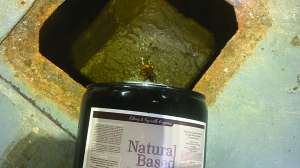
Distribution box - When ports inside a distribution box look like this, there is a good chance flow going to the soil treatment area is not happening equally or efficiently, and a good cleaning is in order.
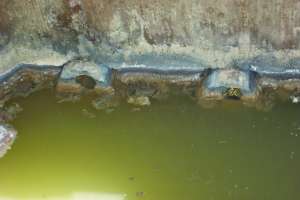
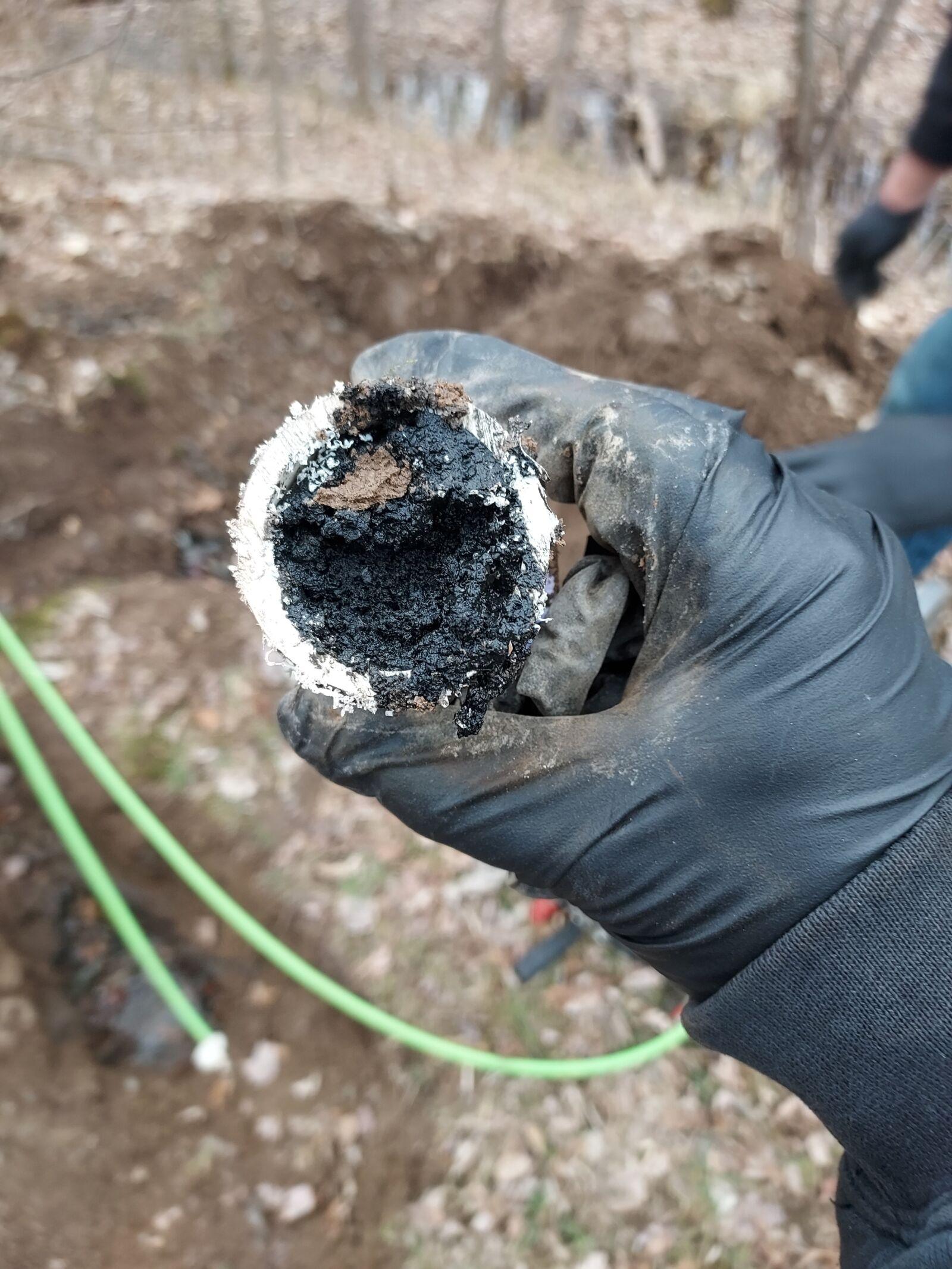
Plugged line - A distribution line that has not been maintained can easily become clogged to the point where a routine flushing isn’t enough to remedy it and larger infiltration is required.
Continue reading for free