
Sara Palmer was skeptical when her husband, Todd, quit his job in construction to launch T. Palmer Septic Service in Danbury, Connecticut, in August 1995.
“I quit my job as a hairdresser when our first son Garrett was born in June,” she says. “Todd was the only one working, and he came home and asked: ‘Guess what I did today?’”
But Todd had already laid the foundations for a business that’s sustained the family for 30 years.
“We were working on new developments, and I was one of the only guys that ended up getting a licence to do septic installations,” he says.
Septic installation work was already winding down for the season through late summer, but by the following spring, things were looking up with a slate of installation contracts, line changes and D-box installations.
In 1999, the company moved to New Fairfield, Connecticut, to take advantage of the community’s school system.
“I also really liked the local health department,” Todd says. “They were very easy to work with to find solutions for challenging installs.”

Expanding into pumping
By 2003, the company was installing as many as 35 septic systems per year with the assistance of a part-time employee. But slow response from area pumpers was holding back the growing amount of work.
“At the end of tax season, my accountant told me I would either have to pay a bunch of money in taxes or buy something,” Todd recalls. “So we ended up buying a used pump truck from a contractor in 2003.”
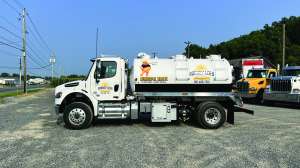
The truck was a 1989 International S1900 with a 2,900-gallon carbon steel tank and Wallenstein pump built by Vacutrux Limited. It also happened to come complete with a logo featuring a skunk.
“The contractor who sold us the truck was known in his service area as the ‘Skunk Man,’” Sara says. “He told us to keep the logo because it had been good luck for him. We thought it was cute and it’s now on all of our trucks, hoodies and T-shirts.”
While Todd pumped his own construction contracts, neighbors began asking him to pump their tanks.
“We never really advertised pumping,” Todd says. “But more and more people started to call about pumping. We would take a day or two each week to pump and then go back to our installations.”

Taking on tough installs
In the early days of the company, Todd preferred to do tough installation jobs, taking on contracts that competitors wouldn’t.
“You can earn more money for those installs, and Todd just happened to like the challenge,” Sara says.
Oldest son Garrett, now 30, worked with the company during its early days but now works as a property manager. His brother Grant surprised the family by joining the Marines after graduating from high school in 2017. Halfway through boot camp, he suffered stress fractures in both tibias and was hospitalized.
“He didn’t heal properly, so they sent him home in February 2018,” Sara says. “He decided he was not going back to the Marines and joined the company instead.”
Grant soon earned his commercial driver’s license and septic pumping license and took charge of the company’s pumping arm.
Overwhelmed by inspections
Although they’re not required by law for real estate transactions, the company became heavily involved in septic system inspections during the COVID pandemic when real estate activity accelerated. At the same time, the pumping business tripled.
“We were probably doing four inspections a day,” Todd says. “At peak, my son and I performed 130 inspections in one month. But we were losing pumping customers, so we cut back on inspection work to concentrate on pumping.”
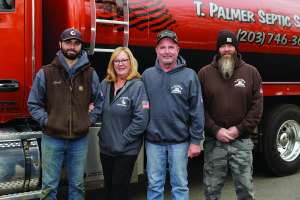
Fast-forward to 2025, and the company is still largely run by Sara, now 61, Todd, 57, and Grant, 26, with the assistance of Dean Prosser, who spots them as needed, and a short list of electricians, plumbers and landscapers.
About 75% of the company’s work is pumping — primarily residential with some commercial and grease trap work. Septic system installations and repairs, and inspections make up the remainder.
Sara handles day-to-day operations, answering phones, scheduling work, permitting, invoicing and banking.
“She’s the heart and soul of the business for sure,” Todd says. “My son and I just work here.”
Todd still likes to handle the installations and repairs. Grant concentrates on pumping full time.
While pipe-and-stone systems were once the mainstay of the company, Todd notes the cost of removing and replacing sand and aggregate has made it cheaper to install proprietary systems that require a smaller footprint.
“We’re often installing systems like the Mantis Series by Eljen,” he says. “The fabric filters give you big improvements in effluent numbers.”

Upgrading the pumpers
The company has continued to operate its original 1989 pump truck, used to service lake communities where bigger trucks find the space constraints challenging. However, it’s now up for sale, to be replaced by a similarly sized 2016 Kenworth T370, with a 2,500-gallon carbon steel tank and Masport pump built out by City Body Shop Center of Hialeah, Florida.
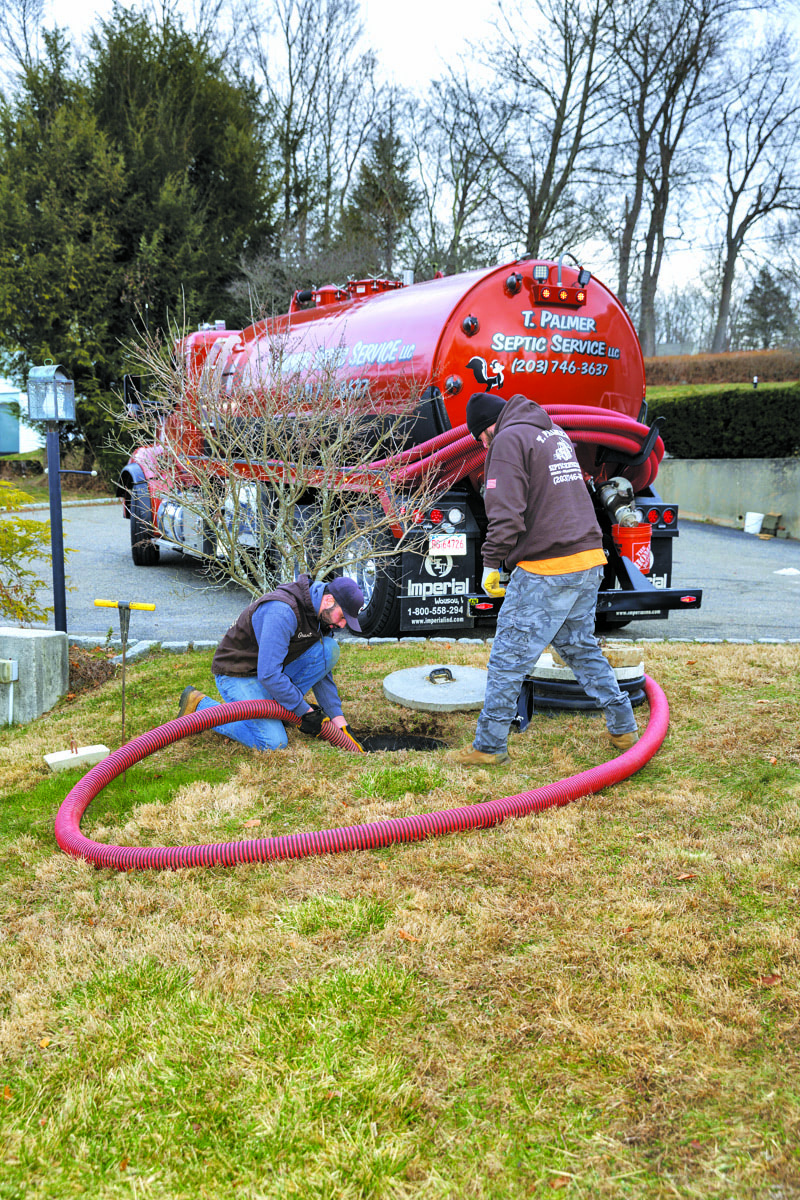
The newest addition to the pumper family is a 2025 Kenworth T880 with a 4,250-gallon aluminum tank and NVE 4310 blower built out by Imperial Industries.
The company’s excavation fleet is anchored by a pair of excavators — a 2000 Samsung SE50-3 and 2021 Kubota KX057-5 — assisted by a 2000 Mustang 2040 skid-steer. Dump trucks include a sturdy 1979 GMC six-wheeler and a 2017 Dodge 5500.
Regular suppliers include septic tank provider M & M Precast Corporation of Danbury, which supplies concrete and plastic septic tanks, as well as concrete risers and lids, and aggregate provider O&G Industries of Torrington. The company owns a Spartan Tool Traveler camera to assist in inspections.

Local septic work is plentiful
Septic system installation, repair and pumping offer plenty of opportunities in the local service area, about a 25-mile radius from home base. Danbury is only about 40% served by sewers, and New Fairfield is entirely served by septic systems.
Many residents are required by law to pump their septic systems on schedule. For each pumping job, towns issue a permit and the company must record the homeowner’s name, address and number of gallons pumped. It’s part of a comprehensive plan to ensure that these municipalities don’t experience a certain threshold of septic system failures, which must be reported to the state. That would require the state to compel the municipality to install sewers, with a resulting increase in local tax burdens.
“If a resident of New Fairfield doesn’t pump their tank every three years, they receive a letter from the health department through the town attorney,” Todd says.
The pumping season lasts from about March or April to the end of November. Pumping, repair, inspections and excavation work continue through winter as weather permits.

Facing local challenges
One of the company’s current challenges is the mass retirement of health department sanitarians with whom the company has worked for decades.
“The training period for the new health department staff has slowed down the issuing of permits and presented different interpretations of county codes,” Todd says. “In some cases, delays in permitting and inspections can lead to weeks of delays on a project.”
But Todd points to greater cooperation between competing companies as a positive development in the local pumping industry.
“When I first started, you couldn’t get two installers in the same room,” he says. “Today we have each other’s backs. I don’t know how many times we’ve helped competitors whose trucks have broken down on the side of the road or loaned them a piece of equipment or a tool. Our shops are open to each other because we realize we all need to work together.”
The company continues to focus on punctuality, cleanliness and solid work.
“I tell people, we’re never the cheap guy, but we’re always professional,” Sara says.
Planning for the future
The Palmers have sponsored a baseball team in the New Fairfield Baseball league for the past 27 years — long after their kids stopped playing. The team won the local division championship in 2025. The Palmers are delighted with the victory, of course, but the sponsorship is also a testament to the company’s long-term commitment to the community.
The family’s business plans include another 10 years of Todd’s active involvement, although he’s becoming more choosy about the installations and repairs he wants to take on. “I’m not going to go do a shopping plaza system, but I still like to work in the smaller lake communities that don’t seem to get a lot of attention from other contractors,” he says.
Grant is likely to take over the business after that.
“Under Grant’s management, it would likely be more of a pumping company than anything else,” Sara says. “We’ve encouraged him to become more involved in inspections because these are future pumping customers.”
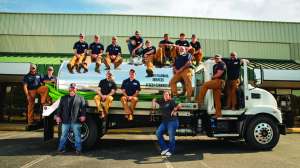
T. Palmer Septic Service recently celebrated its 30th anniversary, inviting family, friends, colleagues and competitors.
“We had 80 people celebrate with us — bigger than our wedding,” says Sara. “It was a great party.”
Todd agrees.
“We’ve come a long way,” he says. “We’re very happy with where we are in our business and in our lives.”
Continue reading for free