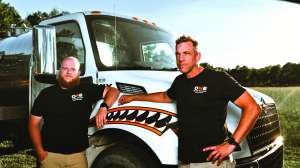

Name and title or job description: Jared Willey, co-owner with David Mead
Business name and location: Advanced Onsite Services, Colchester, Vermont
Services we offer: Our primary business is innovative alternative maintenance and inspections. We are also the Vermont Perc-Rite drip dispersal distributor, the Orenco Systems commercial and municipal representative, and the Vermont Nibbler (Aqua Test) rep. We’re not a dirt contractor, but we often do the technical installations involving the critical plumbing and assembly of innovative components. We also repair and maintain standard systems such as pump stations and mounds, especially in partnership with area septic haulers.
Age: 45
Years in the industry: Fresh out of college with an associate degree in ecology and environmental technology, I quickly found my first wastewater job operating a dairy lagoon, then a Living Machine treatment system for a ski resort. Then I started working for the regional Orenco dealer about the same time as Mead. For almost a decade, we traveled around New England and New York installing and maintaining innovative systems and community liquid-only sewer systems. Then we purchased the service end of that company in 2011.
Association involvement: I had worked with many of the directors of the Yankee Onsite Wastewater Association, so they knew me. In late fall 2024, they asked me to be on the board, which I agreed to, and that’s when I joined the association. YOWA is made up of onsite wastewater professionals from the New England states — Maine, Vermont, New Hampshire, Massachusetts, Connecticut, Rhode Island.
Benefits of belonging to the association: Being able to tap into the collective brain trust of the other members is invaluable. And being able to connect and network and learn about what’s going on in the region for septic innovation and wastewater treatment. For anybody in the trade, it’s worth being part of the regional organizations.
Biggest issue facing your association right now: Outreach and education about who we are and what we do is a big issue. I’ve been tasked with trying to connect folks in Vermont with the organization. We want to increase our membership and make our presence known.
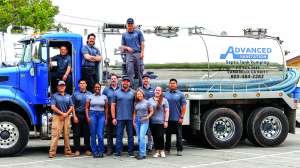
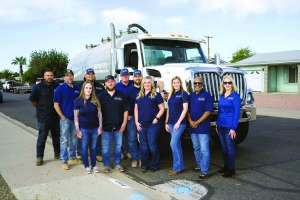
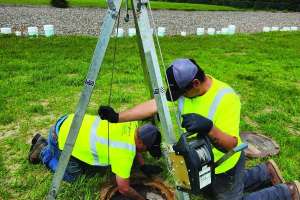
Our crew includes: We have 10 employees that take us from March until the end of the calendar year. In the winter, we go to a skeleton crew because we’re not doing many inspections, just mainly emergency services. So we’ll keep one or two technicians during January and February. Three-quarters of the onsite systems we maintain have permit conditions that require us to be there at least once a year, some are four times. We’re doing both preventive maintenance and state-required inspections and reporting. Our goal is to take systems into the 30-year mark and beyond.
Typical day on the job: I take the calls, do the dispatching using a program called ServiceTitan and get the crews out the door in the morning. In the height of the season we may have three or four crews. Around 10 or 11 a.m., I’ll jump in a truck and be out there in the field for the remainder of the day. I’m very much one of the technicians but also do payroll and help Dave manage the paperwork. I take the Zoom business meeting calls and do project management as well.
The job I’ll never forget: We did some consulting work for a treatment system that’s maintained by the Appalachian Mountain Club. They’re a very capable organization that maintains a lot of their own equipment. They have a system on the top of Mount Washington at the Lakes of the Clouds hut. One of my sons and I went there to do some staff training and tweaking of the system. To get up there, you take the toll road to the top of the mountain. Then we put our gear into our backpacks and carried the Sludge Judge down a 1,200-foot elevation drop from the top of the mountain to the hut. We did our inspection, trained the staff, made some programming changes to the controls, had lunch, and then walked the 1,200-foot elevation back up the stone steps to the truck. It was a memorable day and a cool thing to do with my kid.
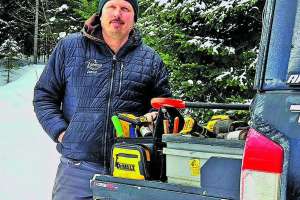
My favorite piece of equipment: I have several Sperry clamp-on multimeters we use on nearly every job. The Sludge Judge allows us to see what’s going on under the surface of the water. And there’s our DeWalt impact drill. If you have those three things and a truck you could work for me. But my most favorite tool is my truck bed slide-out. Kneeling on the ground for 20 years has taken its toll on my knees. Having my entire truck bed accessible on a roller makes me smile.
Most challenging site I’ve worked on: On several occasions we have worked on the edge of a cliff on a lake where equipment had to be winched down over the bank and carefully lowered into place. One challenging job was on Esther’s Island off Nantucket. All the equipment had to be either choppered in or brought in on a work boat. One time I brought my family with me on a work vacation to Cape Cod. We took the ferry to Nantucket, then a taxi to the furthest point. I dropped my family off at the beach, then took my cooler, Sludge Judge and DeWalt drill and walked through a tidal pool to get to Esther’s Island to do a service and take samples.
Oops, this didn’t work out as planned: We had this harebrained idea to do a full lake aeration system for a large lake, something outside our normal scope. The more we got into it, the more we realized we were in a situation where there was no guarantee of success. Thankfully, another supplier won the bid. The lesson is, if you’re really good at one thing, it’s probably best to focus on that.
The craziest question or most insightful comment from a customer: A customer used ChatGPT to research a problem — “What happens when my recirculation pump fails?” It gave him about seven different things that could happen. He texted me its response on a Sunday morning while I was in church, and asked what I was going to do about it.
If I could change one industry regulation, it would be: I’d like to see a requirement that a septic inspection has to be performed when someone sells their house, which is not currently the case in Vermont. And if you have innovative technology, which is common here, that you have to have it inspected by somebody authorized to do so.
Best piece of small business advice I’ve heard or came up with: Find a niche and do really well in it. And do it with partners — you can only go so far alone.
If I wasn’t working in the wastewater industry, I would like to: I would probably be a minister or an electrician.
Crystal ball time – This is my outlook for the wastewater industry: The infrastructure is aging, so if you’re in the business of installing or maintaining infrastructure, there is work to be done. No matter what happens with regulations there will still be a need for maintenance and replacement of infrastructure.
Continue reading for free