
By the time she started her third septic company in 2017, Tanya Wilson had a good idea how she wanted to run it and what kind of people to hire. She is laser-focused on customer service, employee development and industry promotion.
There were some bumps along the way that included getting a divorce and losing a business. But those were all learning experiences and Wilson came back from all of it stronger and more determined than ever.
Wilson originally called her company Priority Pumping Service, but has now rebranded it as HomeField Onsite Environmental. They operate out of an office trailer and construction yard in Gilbert, Arizona, just outside Phoenix, providing septic pumping, installation, repair and inspection services in a 50-mile radius.
Wilson is the owner and chief executive officer and runs the company with her husband Jake, the operations manager, who oversees fieldwork. She manages internal operations, growth into new markets, marketing and community relations. She also says a big part of her job is taking care of the staff — creating a supportive and enjoyable work environment, providing continuous training, and offering advancement opportunities.
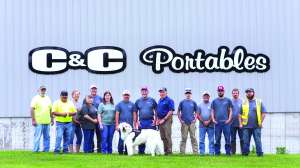
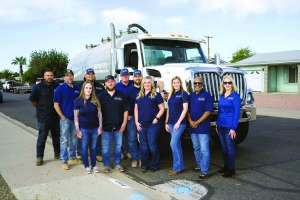
The team includes Lauren Ditusa, office administrator; Heidi Hooker, marketing director; and Twyla Hawkins, customer service representative. On the pumping side are Seth Coburn, lead pumper; Tim Butler, service manager; Issac Bencomo, technician and inspector; and Justin Carr, technician. Installations are done by Dustin Nelson, project manager and Dusty Tuckfield, technician.

HISTORY
When Wilson’s ex-husband suggested in 2009 that they start a septic business, she found the idea a bit distasteful at first, but after a little research enthusiastically embraced it. She was excited to get a chance to use her business administration degree, and it played to her strengths in marketing, customer relations and team building.
The company grew to 12 people and a seven-figure income, but due to unfortunate circumstances the couple split ways and lost the business.
With two young children to support, she worked briefly in the corporate world, and also helped a couple of former employees get a septic business going. But her goal was to start her own company. She finally did that by partnering with two gentlemen, buying them out in 2020 and bringing her new husband onboard. “This time around I have 100% control over what it looks like,” she says.

INSTALLATIONS
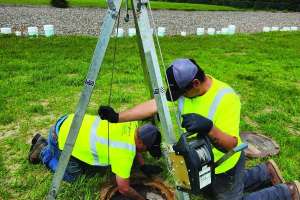
Septic installations account for about half the company’s revenue. Equipment includes a CASE CX30 excavator and a CASE skid loader.
Most of the company’s installs are conventional systems. They are currently putting in units at solar farms in the area. “It’s been interesting,” Wilson says. “The farms are all financed by government grants and it can be intimidating to see contracts come from places like that. And they have extra requirements, such as you can only have so many people on a job site, otherwise you fall into the prevailing wage situation where you have to have an apprenticeship program. I’ve learned a lot and we’ve gotten really good at asking questions.”
They are also installing conventional systems at assisted living homes where they work closely with engineers who must consider the effects of medications that can sometimes be corrosive to systems.
The company also installs Advanced Enviro-Septic (Infiltrator Water Technologies) systems as people are building closer to the mountains where advanced treatment is required. One recent project was for a bus depot near the interstate highway.
PUMPING
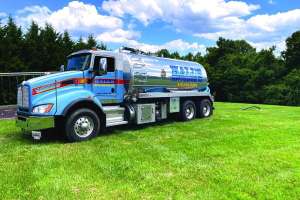
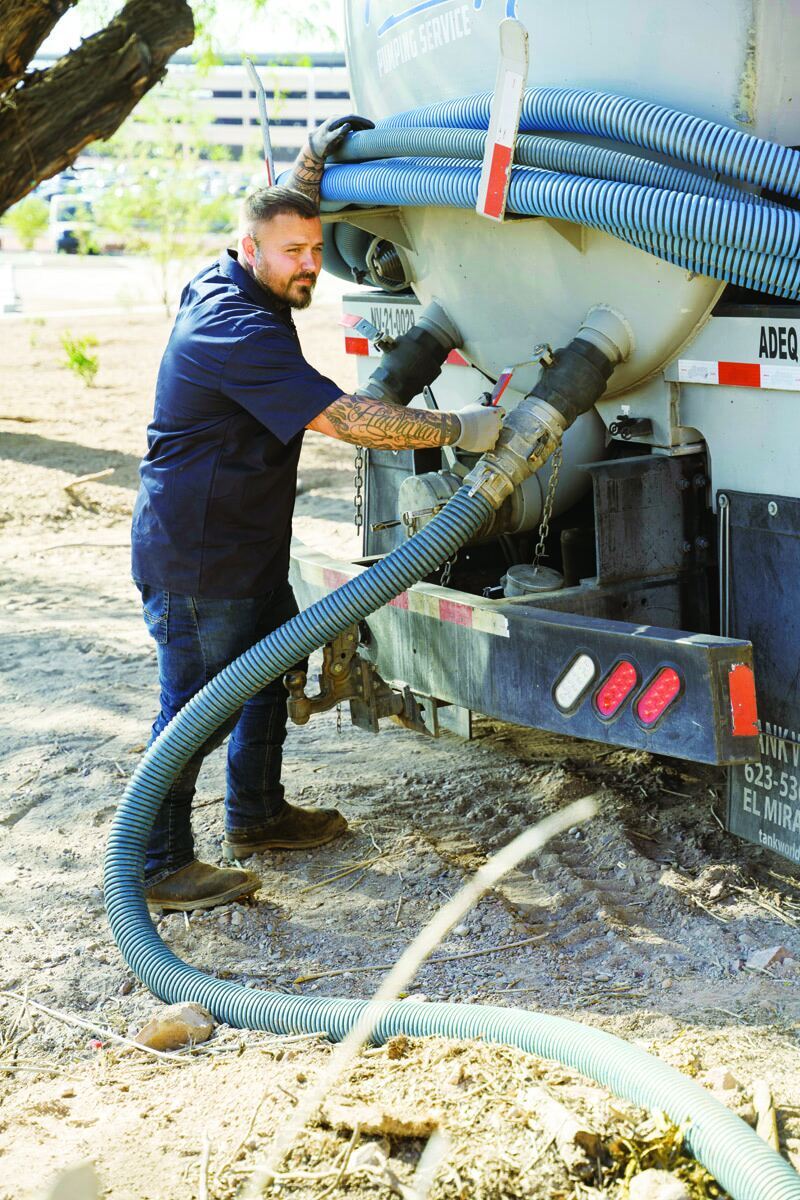
On the pumping side the company has three vacuum trucks from Tank World — a 2021 International and a 2022 Freightliner with 3,500-gallon steel tanks, 500-gallon freshwater tanks, Honda jetters and Masport pumps; and a 2021 Peterbilt with a 4,000-gallon steel tank and Fruitland pump. They also use Spartan cameras.
The company’s three mini-excavators (CASE CX17C, Kubota U17, Takeuchi TB210) see a lot of action. “Many people here still have older systems that could be anywhere from 2 to 7 feet down,” Wilson says. “So we need the excavators to dig them up versus trying to hand-shovel them in this hard Arizona dirt.”
The company is working on educating homeowners on the importance of having risers and ground access. “It’s a slow process, but house by house we’re getting them there,” Wilson says. “It’s especially important on two-compartment tanks with filters in the back where we’re having to dig down to tank openings to pull and clean filters.”
Wilson says they do a lot of discovery work before going to a job site, including looking at county records, to get some idea of what to expect. But, as a precaution, the drivers almost always take an excavator with them, pulling it with the vacuum truck. “We dig up probably 85% of our septic tanks,” Wilson says. “Regulations now make it mandatory that risers be within 6 inches of grade, but they still allow people to bury them.”
The company also services grease traps. Their main customers are assisted living facilities and mom-and-pop restaurants. Industrial clients include manufacturing facilities, car washes and Amazon distribution centers.
On the commercial side, customers are put on a rotating schedule and auto-billing. And recently the company created the HomeField Advantage Plan for their residential customers. “It’s a membership plan,” Wilson explains. “The homeowner gets charged a small fee every month which goes towards their next pumping service. It makes it more affordable for them and it’s great security for us that they’ll use us.”

SUPPORTING HER PEOPLE
Creating a great culture is very important to Wilson. “I truly care about the people who work here,” she says. “We’re a family by choice. They come to our house, we have barbecues, we know their families, we know what sports they’re involved in. It really is a great atmosphere.”
The interview process is quite thorough and includes discussing an applicant’s goals and thoughts on what they want from the job and from an employer. “We want to get to know what makes them tick and how we can best support them so they can achieve those things,” Wilson says. “Those people will help you build an amazing company.”
The selection process includes riding along with a driver for a day so the applicant can see the reality of the job. “Many times people say, ‘Oh, that’s easy,’ but the first time a tank lid gets popped, they’re out,” Wilson says.
If, after a lot of coaching it looks like someone is not going to work out, they act quickly. “As you grow as a business owner you know if there’s potential or you just need to cut your losses,” Wilson says. “It gets so much easier to ‘hire slow, fire fast’ the longer you’ve done it.”
The company works with an insurance broker to provide medical, dental, vision and life insurance. They also provide ongoing and extensive training for technical and personal development. One year they implemented the Tony Robbins Business Results training program for the whole team. In 2024 they worked with the Blue Collar Success Group, which provided trade-specific training.

CONSTANT COMMUNICATION
Each department at HomeField meets weekly, and the full team meets every Tuesday. “It’s a great way to keep everybody in the know,” Wilson says. “And everybody is around each other, which is great. If there are problems or issues we know about them right from the get-go. People are not scared to verbalize when they need things or something’s going awry or they need help with something.”
They also do one-on-one meetings with everyone quarterly to go over things, answer questions. “We always want people to know what opportunities they have,” Wilson says. “People think, ‘Where can I go from here? I’m just a septic technician.’ So we show them a projection of what their career path could look like.”
Every quarter they do a four-hour Saturday meeting with the whole team to discuss the financial outlook, online reviews, new or updated software. Wilson may also bring in a speaker to provide personal development training. After the meeting, everyone brings their families over to her house for a barbecue. She and her husband also host a Christmas party at their home.
Birthdays, work anniversaries and other important milestones in people’s lives are celebrated. And on the company’s anniversary they take everyone to dinner and a comedy club. “We saw Carlos Mencia last year,” she says. “It was a lot of fun. Just getting people out and laughing and having a good time together seems to build that culture inside the business.”
HELPING OTHERS
While Wilson is a relentless champion for her people, she is also a huge promoter of the industry and wants everyone to succeed. She does not view other contractors as fearful competitors but rather focuses on elevating the whole industry which helps everyone.
To that end, Wilson sits on the education board of the National Association of Wastewater Technicians and is designing a digital course on the basics of getting started in the industry for people who may be good at the trade but don’t know anything about the business side of things or how marketing works. She also serves on the board of the Arizona Onsite Water Reclamation Association. And she is working with three partners to franchise her successful business model.
“Our theory is that our competition is what we did yesterday. You cannot control what anybody else is doing. What you can control is how you’re going to be better. It’s how Jake and I run our lives. If you’re looking both ways and behind all the time, you’re missing what’s in front of you.”
Continue reading for free