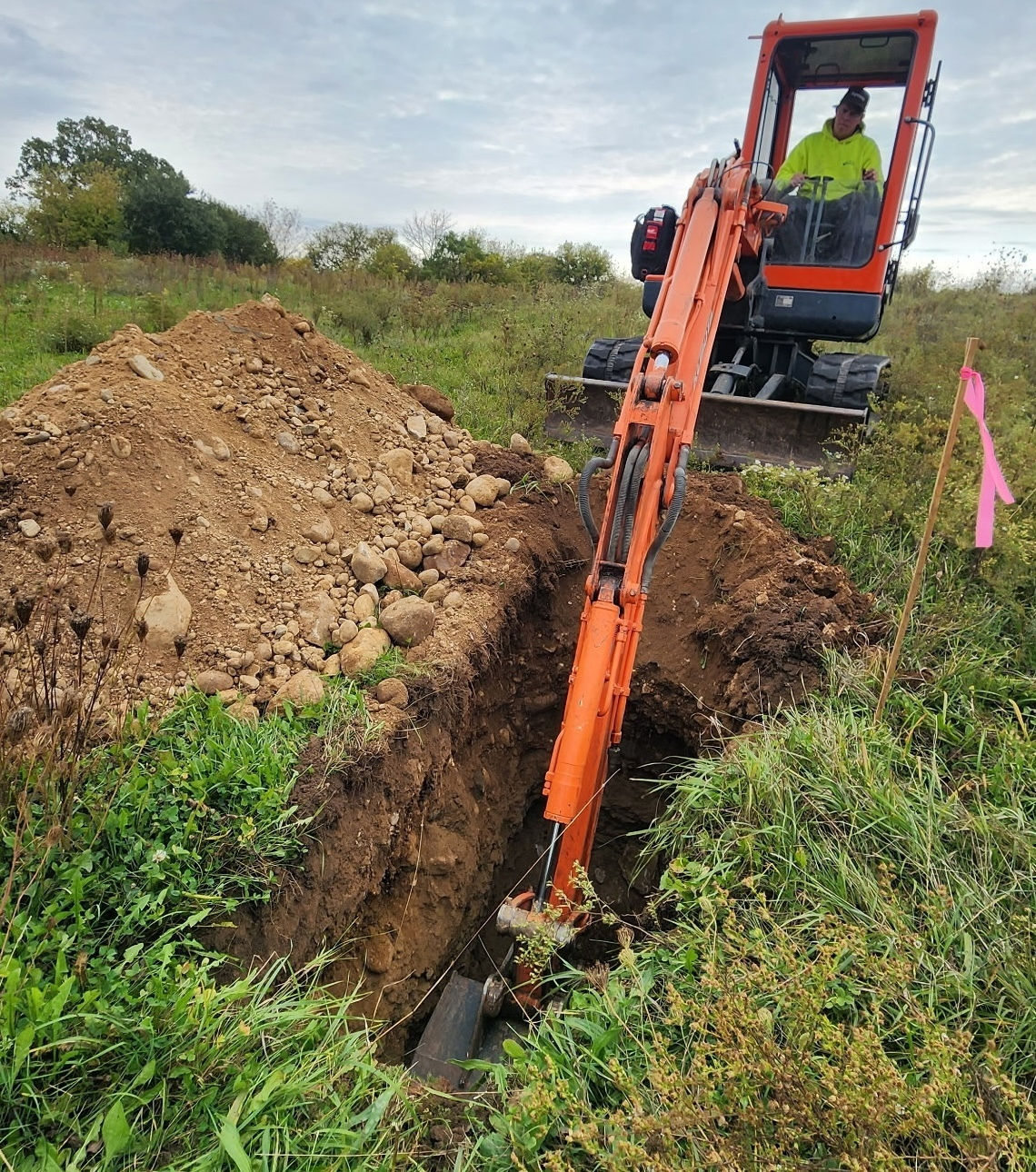
Here in Wisconsin we take soil testing very seriously. It is highly regulated and for a good reason. The goal is to make sure that the effluent will be properly treated, while at the same time protecting the groundwater from contamination.
So I was very surprised to learn from an acquaintance of mine (who had never seen a soil test performed and does not work in our industry) that he was able to perform his own soil test when building a house recently in another state. He was able to buy a kit and report the results, and then obtain all of the permits required for building.
I have read online posts where installers discuss ‘perc testing’ in their state. I certainly hope they are merely using wrong terminology. Wisconsin allowed perc testing until the end of the 1980s. Typically perc testing is merely measuring the speed at which water lowers (percolates) in a hole dug in the ground.
In Wisconsin, our soil tests and system installs are all based on a 3-foot vertical separation between the bottom of a system (the system elevation) and a limiting factor. Limiting factors include bedrock, groundwater, and indications of seasonally fluctuating high groundwater.
Wisconsin stopped using the perc test because, while it might reveal how fast water moves through the soil, it doesn’t indicate how close that water is to a limiting factor. Our 3-foot vertical separation rule is based on data indicating it takes 3 feet of suitable soil to adequately remove the contaminants from effluent. Some states use 2 feet as the vertical requirement in some cases. The ‘perc test’ gives you no information about the vertical depth to a limiting factor.

Conversations with installers in other states suggest that system sizing is determined by the number of bedrooms, with no variations. Wisconsin soil tests determine the square feet of the system per bedroom based on soil criteria. I think part of this difference is we have some significant variation in soil permeability and our designs reflect that. The soil test determines how many square feet are required. I realize some states and some areas have quite uniform soil and might not have as much variation in soil conditions.
One site variable that a lot of us see often is slope. In Wisconsin, the maximum slope for installing a system is 25%. Installers in other states claim limits of 45% and 65%. We are all working with different topography.
Slope makes a huge difference even here in Wisconsin where our limit is 25%. Mound systems here have an average width of about 30 feet. But if you are working on a slope that exceeds 20%, the mound width could be double that. There are many sites I’ve seen that do not have room for a 60-foot-wide mound.
I had one customer call for us to bid a replacement mound system. Somebody else had already performed the soil test. I met the customer at her house to see the proposed site, and the soil tester did the test on a hill with an 18% slope. Her lot was huge and had other, much less steep areas to test. I convinced her to allow us to do another soil test on an area of significantly less slope. We bid the mound on the 4% area we tested and our competitor bid his on the 18% area. We saved the customer $10,000 just by installing on an area that was not as steep as her first soil test. This is a huge savings and a very easy change to make. Work with your soil testers to test areas with less slope when available. It’s less expensive for your customer, and better for you as the installer as well.
The other critical issue is testing on natural ground, especially for mound systems. Filled sites are to be avoided no matter what, whether for in-ground or mound systems.
A home owner forwarded a soil test someone else had completed for me to bid on a mound system. There were ‘steps’ drawn in the middle of the proposed mound area. I went out to the site to look at it in person, and the soil tester delineated a hill that had steps cut into it as an area for a mound system.
Mounds in Wisconsin cannot be installed on sites that have been altered in any way, let alone with steps cut into the area. We retested in an area that was not cut, a little distance away from the original site, and found perfect, clean sand and gravel with no limiting factor and got the customer an in-ground system.
I mentioned soil tests in Wisconsin are highly regulated. Many counties require their inspectors to be on site and witness the soil test so they know the results firsthand. The original copies of the soil tests are then turned into the county. The paying customer also gets a copy.
I know some other states that have borrowed from Wisconsin's method of soil testing and I’m glad they did. Our soil test method was developed and updated during years of research in our university system. Our soil test method is designed to protect the groundwater while treating the effluent, and our licensed installers are trained to install systems in a manner that protects groundwater and public health.
What is your state’s method of soil testing? What are the parameters and criteria the soil test looks for? How does your soil test process aid in the design of systems, and protect groundwater and public health?
Soil testing is the foundation that Wisconsin uses to design and install our onsite systems. The soil testing criteria is robust, proven and regulated. It is my hope that we as an industry are doing the same to benefit and protect groundwater and public health.
About the author
Todd Stair is owner and president of Herr Septic and Sewer, Inc., with over 35 years’ experience designing, installing, repairing, replacing and evaluating septic and mound systems in southeast Wisconsin. He is the author of The Book on Septics and Mounds and a former president of the Wisconsin Onsite Water Recycling Association.
Continue reading for free