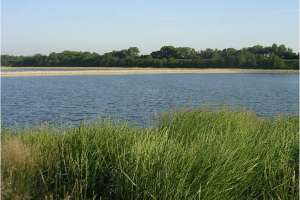

A lagoon is a passive method of providing secondary treatment of effluent. It is a constructed waterbody that is designed to receive liquid effluent and detain the effluent for 20 or more days as waste constituents are being removed. Some documents and regulations may refer to this treatment method as a pond.
Lagoons are used for residential (in some jurisdictions), small commercial and small community applications that have suitable, available land. If sufficient land is available, lagoon systems could service flows as large as 1 million gpd. Lagoon systems perform best when there are multiple (usually three or more) cells in series and some regulations even require three cells.
Single cell lagoons are allowed in some states for single-family residential purposes as shown in the figure. Multiple cells maximize treatment by ensuring slower effluent progression through the system. Lagoons can produce effluent that approaches secondary treatment standards for BOD. TSS is less reliably removed. Lagoons can be a lower-cost solution for treating wastewater generated by a small community.
Process in the pool
Lagoons provide treatment through physical and biological processes. The rate at which aerobic microorganisms oxidize organic matter is limited by the concentration of dissolved oxygen in the water, so lagoons are typically shallow with a large surface area (typically measured in acres). The surface area provides a large interface with the atmosphere, promoting oxygen transfer into the bulk solution (natural aeration). Because most lagoons are large, quiescent waterbodies, liquid-solid separation (primary treatment) also occurs. However, for small single-family systems, it is strongly recommended that a septic tank be used upstream of the lagoon to remove solids. A dispersal component is needed for the lagoon effluent.
There are several lagoon configurations. The differences among them primarily relate to their design depth, external inputs and influent and effluent characteristics. Reducing total nitrogen is desirable in environmentally sensitive areas, and the chosen design will reflect that requirement where required.
Facultative lagoons
These are the most common configuration for small community applications. They are typically 3 to 8 feet deep, with detention times greater than 30 days. ”Facultative” means that both aerobic and anaerobic conditions are present.
A facultative lagoon system forms three layers with respect to dissolved oxygen. The top layer is aerobic, the bottom layer is anaerobic and the middle layer is facultative. Much of the organic matter is oxidized in the top layer. Dead bacterial cells and other materials that are difficult to degrade will settle and form a sludge layer on the bottom of the lagoon. This anaerobic layer allows for continuous, slow degradation. Anaerobic degradation processes produce odors due to volatile fatty acids formed under low-oxygen conditions.

A particular advantage of facultative lagoons is that the aerobic layer can degrade many of these odorous compounds before they are released to the atmosphere, thus reducing the potential for odors. The three layers provide a very hostile environment for pathogens. Having both aerobic and anaerobic conditions encourages the die-off of microorganisms not adapted to this environment and enables nitrogen removal through nitrification/denitrification.
Aerated ponds
An aerated pond system is a lagoon with mechanical aeration. Aerated ponds are typically 15 to 25 feet deep and have a 20-40-day detention time. In a two-cell system, the first cell is aerated and completely mixed. The second cell is only aerated for the first two-thirds of the cell length. The last third is quiescent to promote settling of solids before discharge. It is common for these ponds to produce a high amount of total suspended solids or TSS (in excess of 30 mg/L). Because of the mechanical aeration used, these types of lagoons can have a much smaller footprint.
Maintenance
Facultative lagoons generally have low maintenance requirements because they have no moving parts. Inspect the system for strong odors, as they may indicate anaerobic conditions or improper inlet placement. Record whether odors are strong, mild, septic or rotten-egg-like, chemical or sour. The lagoon surface should be free of large floating materials and vegetation.
Vegetation growing within the lagoon should be removed manually using appropriate safety precautions. Some vegetation, such as cattails and duckweed, may be present along the lagoon edges without interfering with treatment, provided it is not blocking inlets or outlets or growing excessively. If the lagoon is preceded by a septic tank, routine operation and maintenance of the septic tank should help prevent large floating materials from reaching the lagoon.
Both lagoon types require periodic sludge removal. When lagoons are operated within recommended loading rates, solids removal is typically not necessary for eight years or longer. Anaerobic digestion helps slow the accumulation of organic solids. Aerated pond systems also require routine maintenance of the aerators.
Maintain the working water level at least 2 feet below the top of the berm, or as required by state regulations. This vertical distance, known as freeboard, provides emergency storage capacity for the lagoon during extreme weather events. Measure the lagoon depth regularly. If the working water level is too high, inspect the outflow pipes, if present, for clogging. Liquid levels may also rise temporarily during flow surges.
A primary maintenance issue with all lagoons is related to the physical structure and the surrounding vegetation. Woody vegetation must be prevented from growing in the berms that support the lagoon. Roots can create a pathway for water that may cause the berm to fail. Commonly the vegetation growing along the waterline is sprayed using a lagoon-safe chemical. Vegetation allowed to grow impedes wind over the surface of the water resulting in lower natural oxygenation. For the same reason, burrowing animals must be excluded.
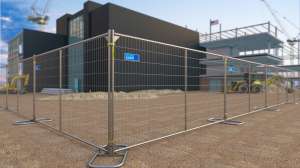
Fencing and signage around a lagoon must be maintained to prevent unauthorized access. The riprap (usually rock) must be maintained also. Over years, it can start sloughing down into the pond, exposing the berm. Maintenance should be performed to ensure riprap is in the proper place to ensure longevity of the berm.
Cold care
In cold climates, lagoons require extra care. Water depth is an important consideration in cold climates as having the water level too low may kill off the needed bacteria for treatment. Aeration methods cannot be used during winter months if the ponds are frozen at the surface.
Assess effluent quality to evaluate system performance and record the system’s operating condition. Observations should include clarity, dissolved oxygen, pH, temperature and the relative odor and color of effluent leaving the cell. Green effluent may indicate algae growth that consumes available oxygen while purple effluent may indicate anaerobic bacterial activity. Samples may need to be collected for laboratory analysis.
Continue reading for free