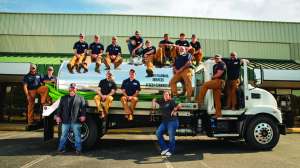
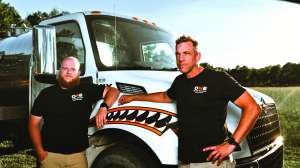
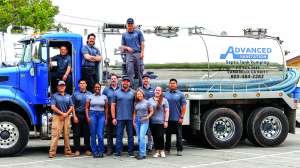
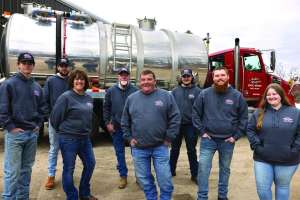
S.O.S. Septic of Englewood, Florida offers a range of services, from septic system pumping, replacement and repair to grease trap pumping along the Gulf Coast. But the family-owned company and its team of 45 employees have earned a reputation for providing 24-hour emergency septic services in southwest Florida after the worst weather the state can throw at the region. We spoke to S.O.S. owner Terry Jacobson, and supervisor Paul Ravagni about what it takes to prepare for severe weather and how they respond when a hurricane hits.
Pumper: Did you name the company S.O.S. Septic out of a plan to provide emergency septic services following local storms, or did that mission develop later?
Terry Jacobson: We called it S.O.S. Septic right from the start in September 1996, because I knew I would be focusing on emergency service storm work. True 24/7 septic service was missing in our region. A lot of other guys have tried it and then backed off because they didn’t want to put in the enormous commitment this sort of service requires. For the past 30 years, we’ve answered every call in-house around the clock to offer the quickest response.
Pumper: What range of services do you offer?
Terry Jacobson: We offer traditional service for septic system pumping, system replacement and repair and grease trap pumping for 600 restaurant clients. I haven’t done new septic system installs since the first year. We do repairs and replacements, but we will also install new tanks and new fields on existing residential systems.
Pumper: What kind of residential systems are typical in the area?
Terry Jacobson: They’re mostly a traditional tank and drainfield. On homes that were built too close to the water table before regulations were passed in 1983, we might need to add an elevated drainfield and lift station.
Pumper: Who are your clients for emergency storm work?
Terry Jacobson: We have regular contracts with municipal and county utility departments for infrastructure which needs to be stabilized as a priority. Then we deal with commercial and residential clients.
Pumper: How many pump trucks do you offer?
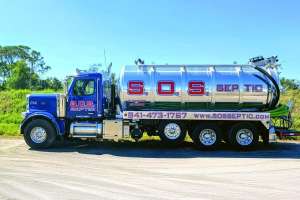
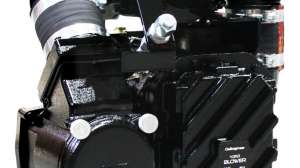
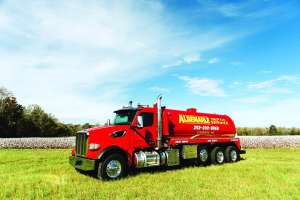
Terry Jacobson: We provide 14 pump trucks — 13 are Peterbilts — and one additional 400-gallon unit used only for grease trap pumping. We find the Peterbilts are easier to maintain and to get parts for. They’re built out by Engine & Accessory out of Miami, all with HyVac blowers and aluminum tanks because of the weight advantage. When the weather is good, we typically send 10 of these trucks for residential pumping and two for grease trap pumping. When county or city sewer departments call for trucks following a sewer main break or power outages because of storms, they typically need a lot of our trucks to keep the sewage flowing.
Pumper: What constitutes “storm season” for the area?
Terry Jacobson: Typically storm weather runs from May through October.
Pumper: How do you prepare for a storm?
Terry Jacobson: We keep our eye on the weather forecasts. Here at the shop, we’re a mile from the Intercoastal and only 12 to 15 feet above sea level. Hurricane Milton in October 2024 had a 10-foot storm surge on the barrier islands, which is pretty close. If we know something’s coming, we’ll stage our pump trucks where we think will be a safe place. Last summer we took a lot of the trucks to a location that was 22 feet above sea level at a local water treatment plant — probably an old sand dune. We want to make sure we have enough fuel, oil, engine fluids and spare tires on hand and we also stockpile food and water for our employees.
Pumper: What’s your service area for storm work?
Paul Ravagni: Our regular service area includes Charlotte, Sarasota and Lee counties. If a storm hits Marco Island or Naples 100 miles south of us, we’ll likely just get rain, so we work with a company there as well. We’ll also go south to Fort Myers Beach and north to Manatee County.
Pumper: How do you deploy your staff members?
Terry Jacobson: We schedule two drivers per truck, so they can each complete a 12-hour shift, get home for 12 hours and allow each truck to run 24 hours. Once we’re on a storm footing, those shift schedules can last from four or five days to three weeks.
Paul Ravagni: During a recent storm they declared a state of emergency with a mandatory evacuation. Our employees who have families naturally evacuated along with them. We have people who sign up just for the rainy season on an on-call basis to bring up our numbers as needed. For employees who have to work hours away from home, we also own several motor homes and campers we can drive to the work site.
Pumper: After a storm hits, how soon do you get to work?
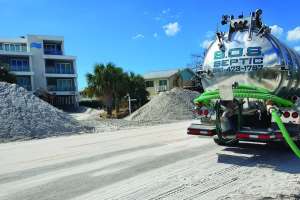
Paul Ravagni: Sometimes we get on high ground and wait a day or two after the storm until it’s safe to travel. For the first few days, we work only during daylight hours until we know the roads are safe. Some of the roads are buried in sand, roads are washed away and power lines are down, so there are a lot of variables. During the last storm, I think it took a month before we could service some of the residential customers because of the debris. On Manasota Key we had a house that the storm moved square on top of the road.
Pumper: What sort of work is your priority?
Paul Ravagni: We have emergency service contracts with municipal sewer utilities in Charlotte County and the Englewood Water District where we have to be there with up to seven trucks within two hours of a call, provided it’s safe to do so.
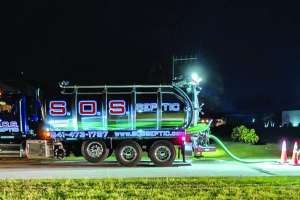
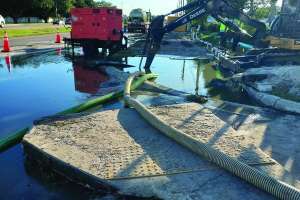
Terry Jacobson: If the power grid goes down there are emergency generators installed at maybe 25% of the lift stations. We’ve got to get out there and keep the wastewater moving, or pump it out and deliver it to the wastewater treatment plant. If there’s a sewer main break, there could be five or six lift stations that they have to shut down to dry up the break. We might have two trucks vacuuming the break area while other trucks are taking care of the lift stations that the department has sidelined.
Pumper: Is storm service hard on your pump trucks?
Paul Ravagni: We recently bought an automatic tire machine, because driving over hurricane debris can be hard on a truck.
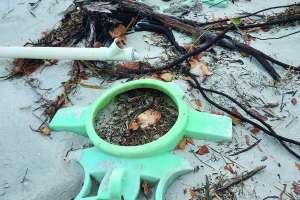
We also pump a lot of sand. When the covers come off the residential septic systems they also fill up with sand — we might pump 1,000 gallons worth of sand out of these tanks to get them functioning. Palm Island can be particularly bad. Our tanks range from 4,000 to 5,800 gallons, but when we empty the truck tanks, the sand doesn’t always come out with it. You could get as much as 2 feet or more of sand in the bottom of the tank. These tanks have a full-opening rear door on them, so when we take on too much sand, we can dump it out like a dump truck.
Pumper: What do you do with excess sand that might be contaminated by wastewater?
Terry Jacobson: We have a washout pit with an inground tank. The sand is limed for 30 days and periodically cleaned out.
Pumper: In addition to sand infiltrating septic tanks, what other damage can a storm inflict on residential systems?
Paul Ravagni: We see entire drainfields completely washed away by storms. There’s a lot of work required to get these systems functional as soon as possible. We have a fleet of construction equipment to perform repairs and remediation — a couple of Caterpillar backhoes and a 317 excavator, a Bobcat mini-excavator, a Ditch Witch loader backhoe, a pair of Kioti skid-steer loaders and three tri-axle dump trucks.
Pumper: If you had one piece of advice for pumping companies who are contemplating post-hurricane cleanup, what would it be?
Terry Jacobson: It involves more than just preparing your equipment, supplies and work schedules. You have to prepare yourself mentally for unpredictable conditions, for long hours, and for time away from your family. Working the aftermath of a hurricane involves a different mindset.